Subject vocabulary: Terms for academic disciplines in English.
- Learn common subject names in English
- Recognize differences between languages
- Practice pronunciation and usage
- Apply in context sentences
Math is the shortened form, Mathematics is the full term
The subject name matches the language name
Physics is the study of physical phenomena
Often taught as separate subjects in English-speaking schools
Includes Spanish, German, etc.
Common English school subjects: Math, English, Science, History, Geography, French, Spanish, Art, Music, PE, Computer Science.
• Short forms: Math instead of Mathematics
• Capitalization: Capitalize subject names when referring to them
• Pluralization: Use "subjects" for multiple academic areas
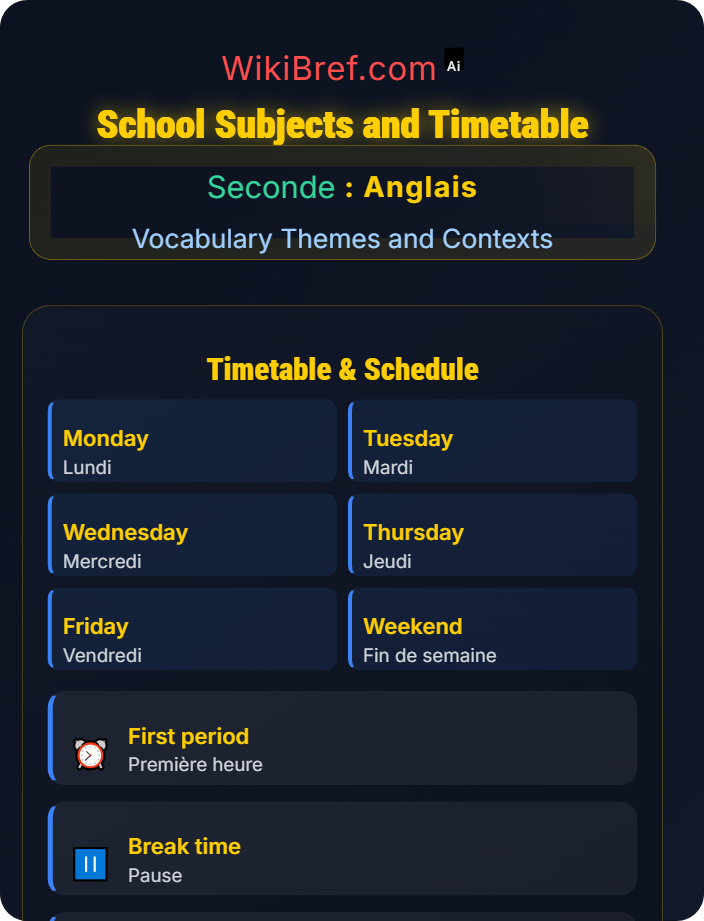
Timetable: Organized schedule showing classes and periods.
Monday, Tuesday, Wednesday, Thursday, Friday
Use standard time formats like "8:00 AM" or "Period 1"
Distribute subjects across different days and times
Ensure core subjects are distributed evenly
An effective timetable balances core subjects, includes breaks, and varies the order of subjects across days.
• Organization: Use consistent time formats
• Balancing: Distribute challenging subjects throughout the week
• Readability: Format clearly with rows and columns
Preference expression: Describing likes and dislikes about subjects.
"My favorite subject is..." or "I love studying..."
Use reasons like "because it's interesting" or "the teacher is engaging"
Mention particular topics or activities within the subject
Explain how the subject helps you or what skills it develops
Example: "My favorite subject is English because it allows me to express myself creatively. We read fascinating stories and write essays. It helps me become a better communicator."
• Structure: Use "because" to explain reasons
• Examples: Include specific content or activities
• Benefits: Mention how the subject is useful
Information seeking: Asking questions about someone's schedule.
"Hi! What classes do you have today?"
"What's your schedule like on Monday?"
"Do you have Math every day?"
"What time does your English class start?"
Effective questions include: "What classes do you have?", "When does... start?", "Do you have... every day?"
• Politeness: Start with a friendly greeting
• Specificity: Ask about particular days or times
• Follow-up: Ask related questions based on answers
Comparison: Evaluating and comparing subject difficulties.
Choose two or more subjects for comparison
"Math is harder than English" or "Science is easier than History"
Provide specific reasons why one is more difficult
Recognize that difficulty varies by individual
Comparisons use structures like "more difficult than", "less challenging than", or "as hard as".
• Comparisons: Use "more/less + adjective + than"
• Superlatives: Use "the most/least + adjective"
• Personal perspective: Acknowledge subjective nature
Exchange conversation: Discussing trading class spots with friends.
"Would you like to switch places in our classes?"
"I mean switching our Math and History periods."
"I have a doctor's appointment during Math, but I could attend History for you."
Ensure both parties agree to the arrangement
Class swapping requires clear communication, mutual benefit, and teacher approval.
• Politeness: Use conditional "would you like..."
• Clarity: Be specific about which classes
• Approval: Remember teacher authorization may be needed
Ranking: Ordering subjects from preference or performance.
Create a comprehensive list of your current subjects
Decide whether to rank by enjoyment, difficulty, or importance
Place them in order from best/worst or easiest/hardest
Explain why you ranked them in this particular order
Rating systems use ordinal numbers: "first, second, third" or "most favorite, least favorite".
• Ordinal numbers: Use "first, second, third" for rankings
• Consistency: Apply same criteria throughout
• Explanation: Provide reasons for each position
Activity description: Explaining what happens in specific classes.
"In Computer Science, we learn about programming and technology."
Programming exercises, debugging, software development
Software used, hardware, online platforms
Skills developed and applications learned
Computer Science classes involve programming, problem-solving, and understanding technology concepts.
• Present tense: Use "we learn", "we practice" for ongoing activities
• Specificity: Include actual activities and tools
• Results: Mention skills gained from the class
Benefit explanation: Describing advantages of specific subjects.
State clearly that you're discussing Drama class
Confidence building, creativity, teamwork, public speaking
Scenes performed, projects completed, skills practiced
How these skills apply outside the classroom
Drama class builds confidence, creativity, and communication skills applicable in many situations.
• Benefits: Use phrases like "helps with" or "develops"
• Examples: Provide concrete instances of skill development
• Applications: Connect skills to broader life uses
Recommendation: Advising others on which subjects to take.
Understand what subjects they might enjoy
Match subjects to their strengths and skills
Recommend 2-3 subjects with clear reasoning
Why these subjects would be advantageous for them
Effective recommendations consider interests, abilities, and future goals.
• Personalization: Tailor recommendations to individual needs
• Reasoning: Explain why each subject is recommended
• Balancing: Suggest mix of core and elective subjects