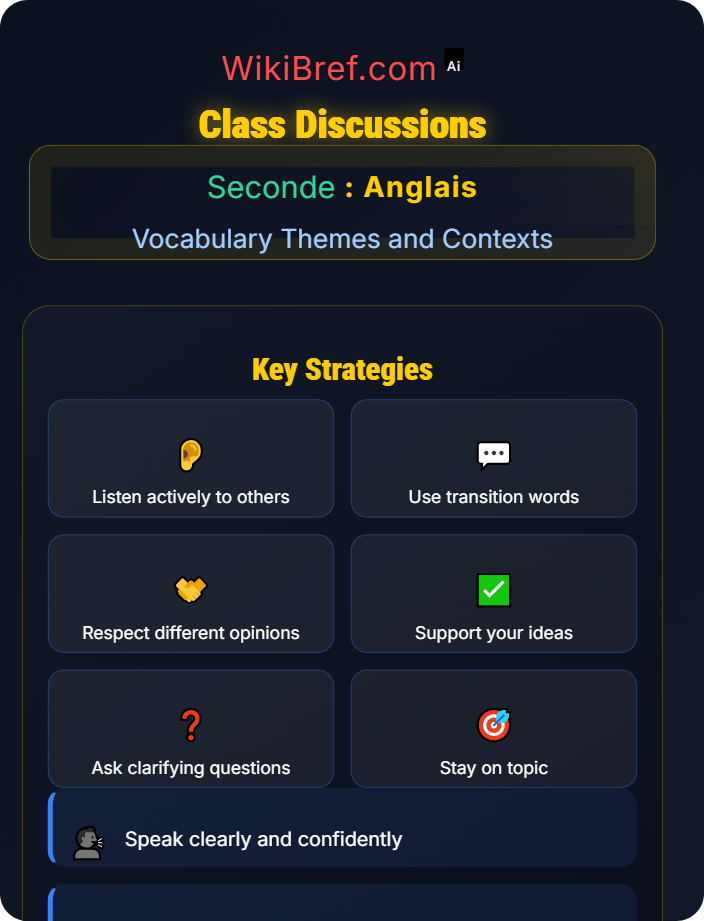
Class discussion : Échange oral structuré entre plusieurs personnes sur un sujet donné.
- Écouter attentivement les autres intervenants
- Attendre son tour pour parler
- Utiliser des expressions appropriées pour introduire son point de vue
- Donner des exemples concrets pour illustrer ses arguments
- Respecter les opinions divergentes
"In my opinion, social networks play a crucial role in modern society."
"They allow people to stay connected with friends and family, especially during difficult times like the pandemic."
"However, they can also lead to addiction and spread misinformation."
"Overall, I believe they are beneficial when used responsibly."
"In my opinion, social networks play a crucial role in modern society. They allow people to stay connected with friends and family, especially during difficult times like the pandemic. However, they can also lead to addiction and spread misinformation. Overall, I believe they are beneficial when used responsibly."
• Expressions utiles : "In my opinion", "I believe", "However", "Overall"
• Structure : Introduction → Avantages → Inconvénients → Conclusion
• Respect : Reconnaître les aspects positifs et négatifs
Community : Groupe de personnes partageant un lieu de vie ou des intérêts communs.
"Living in a community has many advantages. People can share resources, help each other, and build strong relationships."
"For example, neighbors can share tools, organize community gardens, or support each other during difficult times."
"However, some people might feel their privacy is invaded or conflicts may arise between different personalities."
"Despite these challenges, I think the benefits of community life outweigh the drawbacks."
"Living in a community has many advantages. People can share resources, help each other, and build strong relationships. For example, neighbors can share tools, organize community gardens, or support each other during difficult times. However, some people might feel their privacy is invaded or conflicts may arise between different personalities. Despite these challenges, I think the benefits of community life outweigh the drawbacks."
• Balance : Présenter les deux côtés de l'argument
• Exemples : Utiliser des exemples concrets pour illustrer
• Transition : Utiliser "However" pour introduire les inconvénients
Media comparison : Analyse comparative des différents types de médias et leurs caractéristiques.
"Traditional media includes newspapers, television, and radio, while digital media encompasses websites, social networks, and online videos."
"Digital media provides instant news updates, whereas traditional media often has delays due to production schedules."
"Traditional media reaches older generations who prefer physical newspapers, while digital media appeals to younger audiences."
"Both forms of media serve important roles in our information ecosystem."
"Traditional media includes newspapers, television, and radio, while digital media encompasses websites, social networks, and online videos. Digital media provides instant news updates, whereas traditional media often has delays due to production schedules. Traditional media reaches older generations who prefer physical newspapers, while digital media appeals to younger audiences. Both forms of media serve important roles in our information ecosystem."
• Contraste : Utiliser "while" pour comparer
• Clarté : Définir clairement chaque type de média
• Équilibre : Reconnaître les forces de chaque type
Polite interruption : Manière respectueuse d'attirer l'attention pour participer à une discussion.
"Wait for a natural pause in the conversation before speaking."
"You can say 'Excuse me' or 'Sorry to interrupt' to politely gain attention."
"Then add 'but I'd like to add something' or 'I have a different perspective'."
"Keep your intervention concise and relevant to the discussion."
"You can politely ask for the floor by saying: 'Excuse me, but could I add something?' or 'Sorry to interrupt, but I'd like to share my view on this.' Then proceed to make your point briefly and respectfully."
• Respect : Attendre un moment approprié
• Politesse : Utiliser "Excuse me", "Sorry to interrupt"
• Clarté : Indiquer clairement votre intention de participer
Agreement expressions : Phrases permettant de montrer qu'on soutient un point de vue.
"I completely agree with you" or "That's exactly what I was thinking."
"You're absolutely right about this because..." or "I couldn't agree more, especially when you mentioned..."
"Furthermore, I think this is also important because..." or "Another reason why I agree is..."
"Your point really resonates with me" or "I find that very convincing."
"There are several ways to express agreement: 'I completely agree with you', 'That's exactly what I was thinking', 'You're absolutely right about this because...', 'I couldn't agree more, especially when you mentioned...', 'Furthermore, I think this is also important because...', and 'Your point really resonates with me'."
• Clarté : Utiliser des expressions d'accord directes
• Renforcement : Ajouter des précisions pour appuyer l'accord
• Respect : Maintenir un ton respectueux et constructif
Disagreement expressions : Phrases permettant de contester un point de vue de manière respectueuse.
"I see your point, but I have a slightly different opinion" or "That's an interesting perspective, however..."
"I tend to think that..." or "From my perspective..."
"This is because..." or "Based on my experience..."
"What do you think about...?" or "How about considering...?"
"To express disagreement politely, you can say: 'I see your point, but I have a slightly different opinion'. Then present your view: 'I tend to think that...'. Provide reasons: 'This is because...'. Finally, invite further discussion: 'What do you think about this approach?'"
• Respect : Reconnaître d'abord le point de vue de l'autre
• Modération : Utiliser des expressions non confrontantes
• Justification : Expliquer vos raisons de désaccord
Clarification questions : Questions permettant de mieux comprendre un point présenté.
"Could you explain what you mean by...?" or "Can you give us an example of...?"
"So if I understand correctly, you're saying that...?"
"Could you elaborate on that point?" or "What specific aspects did you have in mind?"
"I'm curious about..." or "Could you tell us more about...?"
"Pour clarifier un point, vous pouvez dire: 'Could you explain what you mean by...?', 'So if I understand correctly, you're saying that...?', 'Could you elaborate on that point?', ou 'I'm curious about...'."
• Curiosité : Montrer un intérêt authentique
• Respect : Poser les questions de manière polie
• Compréhension : Reformuler pour confirmer votre compréhension
Media influence : Effet des médias sur les comportements, attitudes et opinions des jeunes.
"Media can educate young people about global issues and provide access to diverse perspectives."
"However, excessive exposure to idealized images can affect self-esteem and promote unrealistic standards."
"It's crucial for young people to develop critical thinking skills to evaluate media messages."
"Overall, media can be beneficial when consumed consciously and critically."
"In my opinion, media has both positive and negative impacts on youth. It can educate young people about global issues and provide access to diverse perspectives. However, excessive exposure to idealized images can affect self-esteem and promote unrealistic standards. It's crucial for young people to develop critical thinking skills to evaluate media messages. Overall, media can be beneficial when consumed consciously and critically."
• Équilibre : Présenter les deux côtés de l'impact
• Responsabilité : Souligner l'importance de la pensée critique
• Conclusion : Proposer une vue équilibrée et constructive
Civic responsibility : Obligations et actions des citoyens pour améliorer leur communauté.
"Citizens have several important roles: participating in local elections, volunteering, and following community rules."
"For instance, citizens can join neighborhood associations, participate in environmental initiatives, or help elderly residents."
"These activities strengthen community bonds and create a supportive environment for everyone."
"Active citizenship makes communities more resilient and prosperous for all members."
"Citizens have several important roles in a community: participating in local elections, volunteering, and following community rules. For instance, citizens can join neighborhood associations, participate in environmental initiatives, or help elderly residents. These activities strengthen community bonds and create a supportive environment for everyone. Active citizenship makes communities more resilient and prosperous for all members."
• Structuration : Organiser les rôles par catégories
• Exemples : Fournir des illustrations concrètes
• Bénéfices : Expliquer pourquoi ces rôles sont importants
Inclusive participation : Techniques pour favoriser l'implication de tous les membres d'un groupe.
"What's your take on this?" or "How do you see this situation?"
"That's a great point, thank you for sharing" or "I appreciate your perspective on this."
"There are no wrong answers here" or "Every opinion matters in this discussion."
"Sarah, what do you think about this?" or "We haven't heard from Michael yet, would you like to add anything?"
"To encourage others to participate, you can: Ask open-ended questions like 'What's your take on this?', recognize contributions with phrases like 'That's a great point, thank you for sharing', create a safe environment by saying 'There are no wrong answers here', and specifically invite quieter participants by saying 'We haven't heard from you yet, would you like to add anything?'"
• Inclusion : S'assurer que tout le monde se sent invité à participer
• Reconnaissance : Valider les contributions des autres
• Sécurité : Créer un climat propice à l'expression