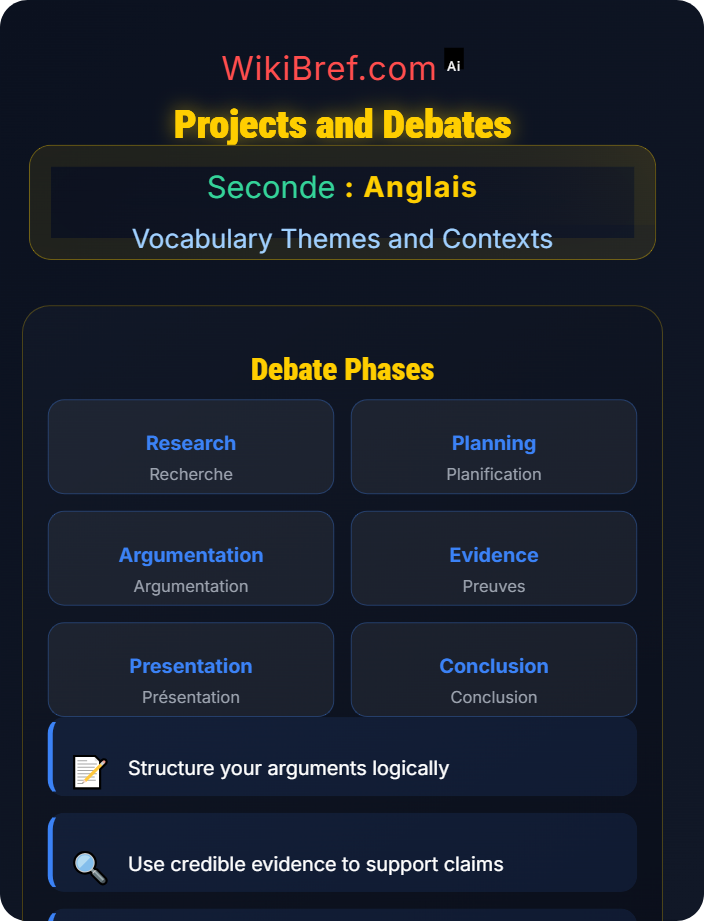
Project presentation : Présentation orale structurée d'un projet avec objectifs, méthodologie, résultats et conclusions.
- Introduction claire des objectifs
- Explication de la méthodologie
- Présentation des résultats
- Analyse des résultats
- Conclusion et perspectives
"Today, I'm presenting our environmental project focused on reducing plastic waste in our school. Our goal is to decrease single-use plastic consumption by 50% within six months."
"We conducted a baseline survey, implemented reusable bottle stations, and launched an awareness campaign using student ambassadors."
"Our results show a 30% reduction in plastic bottle purchases after two months, with 75% of students now using reusable bottles."
"This success demonstrates the effectiveness of peer education combined with infrastructure changes. Next steps include expanding to cafeteria items and measuring long-term behavior change."
"Today, I'm presenting our environmental project focused on reducing plastic waste in our school. Our goal is to decrease single-use plastic consumption by 50% within six months. We conducted a baseline survey, implemented reusable bottle stations, and launched an awareness campaign using student ambassadors. Our results show a 30% reduction in plastic bottle purchases after two months, with 75% of students now using reusable bottles. This success demonstrates the effectiveness of peer education combined with infrastructure changes. Next steps include expanding to cafeteria items and measuring long-term behavior change."
• Structure : Introduction → Méthodologie → Résultats → Perspectives
• Clarté : Données chiffrées pour étayer les arguments
• Continuité : Planification des actions futures
Argumentation en faveur : Présentation des avantages et preuves pour soutenir un point de vue.
"Solar energy represents the most promising solution for our energy future due to its abundance and environmental benefits."
"Solar panels produce electricity without emitting greenhouse gases, directly addressing climate change concerns. A typical residential system prevents approximately 3-4 tons of CO₂ emissions annually."
"While initial costs are high, solar systems pay for themselves within 6-10 years through reduced electricity bills, and panels last 25-30 years."
"Germany generated 10% of its electricity from solar in 2022, proving large-scale viability. Morocco's Noor Ouarzazate complex is the world's largest concentrated solar power plant."
"Solar energy represents the most promising solution for our energy future due to its abundance and environmental benefits. Solar panels produce electricity without emitting greenhouse gases, directly addressing climate change concerns. A typical residential system prevents approximately 3-4 tons of CO₂ emissions annually. While initial costs are high, solar systems pay for themselves within 6-10 years through reduced electricity bills, and panels last 25-30 years. Germany generated 10% of its electricity from solar in 2022, proving large-scale viability. Morocco's Noor Ouarzazate complex is the world's largest concentrated solar power plant."
• Preuves : Données chiffrées et exemples internationaux
• Équilibre : Avantages environnementaux et économiques
• Crédibilité : Citations de cas réels réussis
Argumentation contre : Identification des problèmes et propositions de solutions alternatives.
"Single-use plastics pose severe environmental and health threats. They take up to 1,000 years to decompose and contaminate our oceans with microplastics."
"Over 8 million tons of plastic enter our oceans annually, threatening marine life. Microplastics have been found in 93% of bottled water samples and even in human bloodstreams."
"Reusable alternatives exist for every single-use item: metal straws, cloth bags, glass containers, and bamboo utensils that are equally convenient and more durable."
"Governments should ban single-use plastics and incentivize sustainable alternatives. Consumers must shift their behavior and support eco-friendly businesses."
"Single-use plastics pose severe environmental and health threats. They take up to 1,000 years to decompose and contaminate our oceans with microplastics. Over 8 million tons of plastic enter our oceans annually, threatening marine life. Microplastics have been found in 93% of bottled water samples and even in human bloodstreams. Reusable alternatives exist for every single-use item: metal straws, cloth bags, glass containers, and bamboo utensils that are equally convenient and more durable. Governments should ban single-use plastics and incentivize sustainable alternatives. Consumers must shift their behavior and support eco-friendly businesses."
• Urgence : Statistiques choquantes pour capter l'attention
• Alternatives : Montrer que des solutions existent
• Appel : Proposer des actions concrètes
Persuasive presentation : Technique de communication visant à convaincre un auditoire de l'exactitude d'un point de vue.
"Begin with compelling statistics or personal stories that resonate with your audience's values and concerns."
"Present your main arguments in order of importance, supporting each with evidence, examples, and expert testimony."
"Use credible sources, scientific studies, case studies, and data visualization to support your claims."
"End with clear, specific recommendations that your audience can realistically implement immediately."
"Begin with compelling statistics or personal stories that resonate with your audience's values and concerns. Present your main arguments in order of importance, supporting each with evidence, examples, and expert testimony. Use credible sources, scientific studies, case studies, and data visualization to support your claims. End with clear, specific recommendations that your audience can realistically implement immediately."
• Émotion : Connecter avec l'auditoire
• Logique : Structure argumentative claire
• Crédibilité : Sources fiables et données probantes
Handling objections : Technique pour répondre aux contre-arguments de manière constructive et persuasive.
"Listen carefully to the objection without interrupting, showing respect for the opposing viewpoint."
"Acknowledge the concern with phrases like 'That's an important point' or 'I understand your concern about...'"
"Address the objection with specific facts, data, or examples that counter the concern while maintaining a respectful tone."
"Connect your response back to your main argument, showing how the objection doesn't invalidate your overall position."
"Listen carefully to the objection without interrupting, showing respect for the opposing viewpoint. Acknowledge the concern with phrases like 'That's an important point' or 'I understand your concern about...'. Address the objection with specific facts, data, or examples that counter the concern while maintaining a respectful tone. Connect your response back to your main argument, showing how the objection doesn't invalidate your overall position."
• Respect : Reconnaître la validité des objections
• Preuve : Répondre avec des faits concrets
• Redirection : Maintenir le focus sur votre thèse
Data presentation : Communication visuelle et verbale des informations statistiques pour illustrer une tendance ou un phénomène.
"This line graph shows global average temperature anomalies from 1880 to 2023, compared to the 20th-century average baseline."
"The chart reveals three distinct periods: gradual warming until 1940, a cooling phase until 1970, and accelerated warming from 1970 to present day."
"Notably, the 10 warmest years have occurred since 2005, with 2016, 2020, and 2023 tied as the warmest on record. The rate of warming has accelerated significantly since 1970."
"This trend correlates with increased greenhouse gas emissions from human activities, particularly fossil fuel combustion and deforestation. Without mitigation efforts, this trajectory suggests continued temperature increases with severe environmental consequences."
"This line graph shows global average temperature anomalies from 1880 to 2023, compared to the 20th-century average baseline. The chart reveals three distinct periods: gradual warming until 1940, a cooling phase until 1970, and accelerated warming from 1970 to present day. Notably, the 10 warmest years have occurred since 2005, with 2016, 2020, and 2023 tied as the warmest on record. The rate of warming has accelerated significantly since 1970. This trend correlates with increased greenhouse gas emissions from human activities, particularly fossil fuel combustion and deforestation. Without mitigation efforts, this trajectory suggests continued temperature increases with severe environmental consequences."
• Descriptif : Décrire les éléments visuels
• Analyses : Interpréter les tendances significatives
• Implications : Lier les données à des conséquences
Debate structure : Discussion organisée avec arguments pour et contre un sujet spécifique, suivant des règles de procédure.
"Organic farming offers significant environmental benefits by eliminating synthetic pesticides and fertilizers, protecting soil health and biodiversity."
"While organic produce costs more, it reduces healthcare costs associated with pesticide exposure and supports sustainable farming communities."
"Yes, organic yields may be lower, but improved soil health leads to greater long-term productivity. The European Union's Farm to Fork strategy demonstrates policy support for organic expansion."
"Organic agriculture represents a necessary transition toward sustainable food systems that protect both human health and environmental integrity, despite short-term yield challenges."
"Organic farming offers significant environmental benefits by eliminating synthetic pesticides and fertilizers, protecting soil health and biodiversity. While organic produce costs more, it reduces healthcare costs associated with pesticide exposure and supports sustainable farming communities. Yes, organic yields may be lower, but improved soil health leads to greater long-term productivity. The European Union's Farm to Fork strategy demonstrates policy support for organic expansion. Organic agriculture represents a necessary transition toward sustainable food systems that protect both human health and environmental integrity, despite short-term yield challenges."
• Équilibre : Reconnaître les limites
• Réfutation : Répondre aux contre-arguments
• Politique : Citer des initiatives institutionnelles
School project : Initiative collaborative visant à résoudre un problème local avec des objectifs mesurables et un plan d'action.
"Our school generates approximately 400kg of recyclable waste monthly, with only 15% currently being diverted from landfills through inadequate sorting practices."
"We aim to increase recycling rates to 70% within one semester through improved infrastructure, education, and incentive programs."
"Our approach includes installing color-coded bins, training student volunteers as recycling ambassadors, conducting weekly audits, and creating awareness campaigns."
"Expected outcomes include 280kg monthly waste diversion, reduced disposal costs, enhanced environmental awareness, and potential revenue from recyclable material sales."
"Our school generates approximately 400kg of recyclable waste monthly, with only 15% currently being diverted from landfills through inadequate sorting practices. We aim to increase recycling rates to 70% within one semester through improved infrastructure, education, and incentive programs. Our approach includes installing color-coded bins, training student volunteers as recycling ambassadors, conducting weekly audits, and creating awareness campaigns. Expected outcomes include 280kg monthly waste diversion, reduced disposal costs, enhanced environmental awareness, and potential revenue from recyclable material sales."
• Quantitatif : Données chiffrées pour le diagnostic
• Mesurable : Objectifs clairs et atteignables
• Pratique : Actions concrètes et réalisables
Group debate : Discussion structurée entre plusieurs participants divisés en équipes défendant des positions opposées.
"Establish clear rules including speaking time limits, respectful communication guidelines, and a neutral moderator to maintain order and fairness."
"Assign team roles: lead speakers, researchers, rebuttal specialists, and timekeepers to ensure balanced participation and organized argumentation."
"Follow a structured format: opening statements, argument rounds, cross-examination opportunities, closing arguments, and audience questions."
"Address interruptions promptly, redirect off-topic discussions, and encourage evidence-based responses rather than emotional reactions."
"Establish clear rules including speaking time limits, respectful communication guidelines, and a neutral moderator to maintain order and fairness. Assign team roles: lead speakers, researchers, rebuttal specialists, and timekeepers to ensure balanced participation and organized argumentation. Follow a structured format: opening statements, argument rounds, cross-examination opportunities, closing arguments, and audience questions. Address interruptions promptly, redirect off-topic discussions, and encourage evidence-based responses rather than emotional reactions."
• Structure : Format organisé et équitable
• Collaboration : Rôles définis pour chaque participant
• Modération : Gestion proactive des désaccords
Audience engagement : Techniques de communication visant à maintenir l'attention et l'intérêt de l'auditoire.
"Start with a surprising statistic, thought-provoking question, or compelling story that connects directly to your topic and audience interests."
"Maintain eye contact with different audience sections, use purposeful gestures, and move strategically to emphasize key points."
"Pose rhetorical questions, conduct quick polls, or invite brief reflections to make listeners active participants rather than passive observers."
"Modulate your voice volume, pace, and tone to match content significance, pause strategically for emphasis, and vary sentence structures."
"Start with a surprising statistic, thought-provoking question, or compelling story that connects directly to your topic and audience interests. Maintain eye contact with different audience sections, use purposeful gestures, and move strategically to emphasize key points. Pose rhetorical questions, conduct quick polls, or invite brief reflections to make listeners active participants rather than passive observers. Modulate your voice volume, pace, and tone to match content significance, pause strategically for emphasis, and vary sentence structures."
• Attention : Techniques pour capter l'intérêt initial
• Présence : Communication non-verbale efficace
• Participation : Impliquer activement l'auditoire