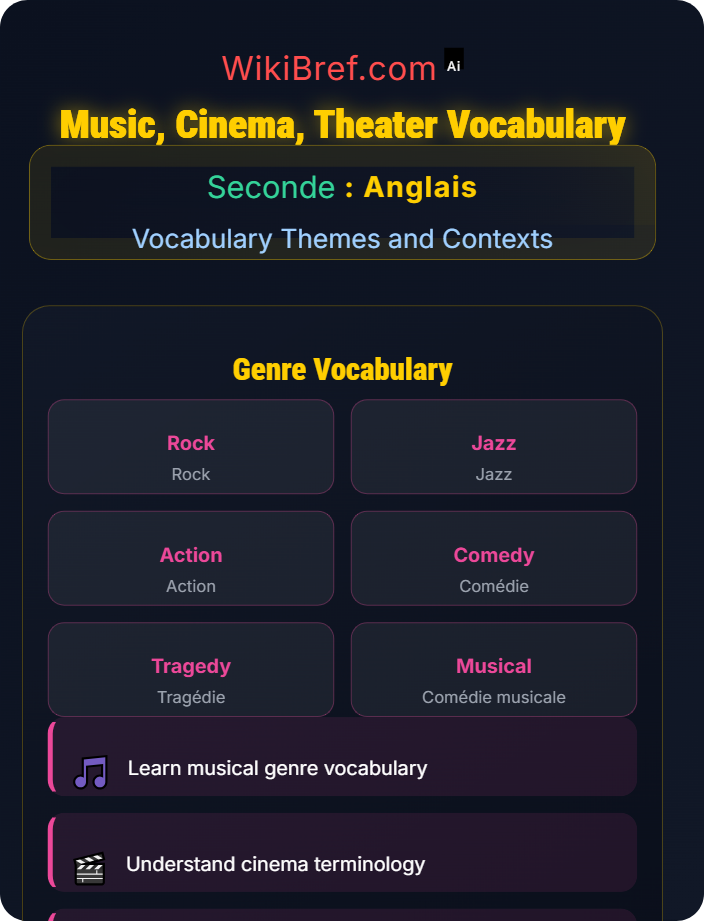
Musical terminology : Ensemble de termes techniques utilisés pour décrire les éléments fondamentaux de la musique.
- Identifier les concepts fondamentaux
- Associer chaque terme à un exemple sonore
- Pratiquer l'écoute active
- Appliquer les termes dans des contextes variés
- Reproduire les définitions en anglais
"Melody refers to the sequence of musical notes that form a recognizable tune. Rhythm is the pattern of beats and pauses that gives music its temporal structure."
"Harmony occurs when multiple notes are played simultaneously, creating chords. Tempo indicates the speed of the music, measured in beats per minute (BPM)."
"Genre categorizes music by style (rock, jazz, classical). Instrumentation refers to the specific instruments used in a piece of music."
"Dynamics indicate volume levels (pianissimo, forte). Texture describes the layers of sound (monophonic, homophonic, polyphonic)."
"Melody refers to the sequence of musical notes that form a recognizable tune. Rhythm is the pattern of beats and pauses that gives music its temporal structure. Harmony occurs when multiple notes are played simultaneously, creating chords. Tempo indicates the speed of the music, measured in beats per minute (BPM). Genre categorizes music by style (rock, jazz, classical). Instrumentation refers to the specific instruments used in a piece of music. Dynamics indicate volume levels (pianissimo, forte). Texture describes the layers of sound (monophonic, homophonic, polyphonic)."
• Structure : Classification par éléments musicaux
• Précision : Définitions techniques exactes
• Contexte : Application pratique des termes
Film crew roles : Ensemble des professionnels impliqués dans la création d'un film, chacun ayant des responsabilités spécifiques.
"The director guides the creative vision and manages the cast and crew. The producer oversees financing, logistics, and overall project management."
"The cinematographer (director of photography) handles camera work and lighting. The sound designer manages audio recording and mixing."
"Screenwriters create the script. Editors assemble footage, create pacing, and refine the narrative flow of the film."
"Additional key roles include costume designers, makeup artists, special effects technicians, and casting directors."
"The director guides the creative vision and manages the cast and crew. The producer oversees financing, logistics, and overall project management. The cinematographer (director of photography) handles camera work and lighting. The sound designer manages audio recording and mixing. Screenwriters create the script. Editors assemble footage, create pacing, and refine the narrative flow of the film. Additional key roles include costume designers, makeup artists, special effects technicians, and casting directors."
• Hiérarchie : Distinction entre direction et production
• Technique : Rôles techniques spécifiques
• Collaboration : Coordination entre les départements
Film genres : Catégories de films classés selon des conventions narratives, stylistiques ou thématiques.
"Drama focuses on realistic characters and situations. Comedy aims to entertain through humor. Action features exciting sequences and stunts."
"Horror intends to frighten and create suspense. Science fiction explores futuristic or technological concepts. Fantasy involves magical or supernatural elements."
"Documentary presents factual information about real subjects. Biography tells the life story of real people. Historical films depict past events or periods."
"Many films combine elements from multiple genres. Thriller blends mystery with suspense. Romantic comedy merges love stories with humor."
"Drama focuses on realistic characters and situations. Comedy aims to entertain through humor. Action features exciting sequences and stunts. Horror intends to frighten and create suspense. Science fiction explores futuristic or technological concepts. Fantasy involves magical or supernatural elements. Documentary presents factual information about real subjects. Biography tells the life story of real people. Historical films depict past events or periods. Many films combine elements from multiple genres. Thriller blends mystery with suspense. Romantic comedy merges love stories with humor."
• Classification : Regroupement par thèmes
• Caractéristiques : Traits distinctifs de chaque genre
• Fusion : Combinaisons possibles
Musical styles : Catégories de musique définies par des caractéristiques sonores, rythmiques, harmoniques et culturelles.
"Classical music features orchestral arrangements, formal structures, and compositions spanning centuries. It includes symphonies, concertos, and chamber music."
"Jazz emphasizes improvisation, syncopated rhythms, and blue notes. Blues originated in African-American communities with distinctive chord progressions and lyrical themes."
"Rock music utilizes electric guitars, drums, and bass with strong backbeats. Pop focuses on catchy melodies and broad appeal, often incorporating electronic elements."
"Hip-hop includes rapping, sampling, and DJ techniques. Electronic music relies on synthesizers, drum machines, and digital production methods."
"Classical music features orchestral arrangements, formal structures, and compositions spanning centuries. It includes symphonies, concertos, and chamber music. Jazz emphasizes improvisation, syncopated rhythms, and blue notes. Blues originated in African-American communities with distinctive chord progressions and lyrical themes. Rock music utilizes electric guitars, drums, and bass with strong backbeats. Pop focuses on catchy melodies and broad appeal, often incorporating electronic elements. Hip-hop includes rapping, sampling, and DJ techniques. Electronic music relies on synthesizers, drum machines, and digital production methods."
• Origine : Contexte historique de chaque style
• Caractéristiques : Éléments sonores distinctifs
• Évolution : Développement des genres
Theater production roles : Ensemble des participants à une représentation théâtrale, avec des responsabilités spécifiques sur scène et en coulisses.
"Actors portray characters and deliver dialogue. The protagonist drives the story forward. The antagonist opposes the protagonist's goals."
"The director interprets the script and guides performers. The stage manager coordinates rehearsals and live performances. The choreographer designs movement sequences."
"Lighting designers create mood and visibility. Sound technicians manage audio. Costume designers create character appearance. Set designers build the scenic environment."
"Makeup artists enhance character appearance. Props masters manage scene objects. Prompters assist actors during performances if needed."
"Actors portray characters and deliver dialogue. The protagonist drives the story forward. The antagonist opposes the protagonist's goals. The director interprets the script and guides performers. The stage manager coordinates rehearsals and live performances. The choreographer designs movement sequences. Lighting designers create mood and visibility. Sound technicians manage audio. Costume designers create character appearance. Set designers build the scenic environment. Makeup artists enhance character appearance. Props masters manage scene objects. Prompters assist actors during performances if needed."
• Scène : Rôles visibles du public
• Direction : Supervision artistique
• Technique : Support invisible
Film production process : Ensemble des étapes nécessaires pour créer un film, de l'idée initiale à la distribution.
"The development phase involves creating the initial concept, writing the screenplay, securing funding, and assembling key personnel including the director and producer."
"Pre-production includes casting actors, scouting locations, creating storyboards, scheduling shoots, and preparing equipment and budgets."
"During production, the actual filming takes place with the cast and crew working according to the shooting schedule and director's vision."
"Post-production involves editing footage, adding special effects, recording sound, and creating the final cut of the film."
"The development phase involves creating the initial concept, writing the screenplay, securing funding, and assembling key personnel including the director and producer. Pre-production includes casting actors, scouting locations, creating storyboards, scheduling shoots, and preparing equipment and budgets. During production, the actual filming takes place with the cast and crew working according to the shooting schedule and director's vision. Post-production involves editing footage, adding special effects, recording sound, and creating the final cut of the film."
• Séquence : Ordre chronologique des étapes
• Coordination : Collaboration entre départements
• Financement : Gestion budgétaire
Musical instruments : Objets utilisés pour produire des sons musicaux, classés selon leur méthode de production sonore.
"String instruments produce sound through vibrating strings. Examples include guitar, violin, cello, double bass, and harp. Players use bows, picks, or fingers to create vibrations."
"Wind instruments generate sound by air vibration. Woodwinds (flute, clarinet, saxophone) use reeds or air streams. Brass (trumpet, trombone, French horn) rely on lip vibration."
"Percussion instruments create sound by striking surfaces. Drums, cymbals, xylophone, maracas, and tambourine fall into this category."
"Keyboard instruments include piano, organ, and synthesizer. They produce sound through hammers striking strings (piano) or electronic generation (synthesizer)."
"String instruments produce sound through vibrating strings. Examples include guitar, violin, cello, double bass, and harp. Players use bows, picks, or fingers to create vibrations. Wind instruments generate sound by air vibration. Woodwinds (flute, clarinet, saxophone) use reeds or air streams. Brass (trumpet, trombone, French horn) rely on lip vibration. Percussion instruments create sound by striking surfaces. Drums, cymbals, xylophone, maracas, and tambourine fall into this category. Keyboard instruments include piano, organ, and synthesizer. They produce sound through hammers striking strings (piano) or electronic generation (synthesizer)."
• Classification : Par méthode de production sonore
• Technique : Mécanisme de son
• Exemples : Instruments spécifiques
Film technical vocabulary : Termes spécialisés utilisés par les professionnels pour décrire les techniques de tournage et de montage.
"Shot types include close-up (CU), medium shot (MS), wide shot (WS), and extreme close-up (ECU). Camera angles are high angle, low angle, and eye level."
"Camera movements encompass pan (horizontal rotation), tilt (vertical rotation), zoom (focal length change), and tracking shots (camera moves with subject)."
"Lighting techniques include three-point lighting, high-key and low-key lighting. Composition follows the rule of thirds and leading lines."
"Editing terms include cut, fade, dissolve, and cross-cutting. Sound elements encompass diegetic and non-diegetic sound, foley, and ADR (Automated Dialogue Replacement)."
"Shot types include close-up (CU), medium shot (MS), wide shot (WS), and extreme close-up (ECU). Camera angles are high angle, low angle, and eye level. Camera movements encompass pan (horizontal rotation), tilt (vertical rotation), zoom (focal length change), and tracking shots (camera moves with subject). Lighting techniques include three-point lighting, high-key and low-key lighting. Composition follows the rule of thirds and leading lines. Editing terms include cut, fade, dissolve, and cross-cutting. Sound elements encompass diegetic and non-diegetic sound, foley, and ADR (Automated Dialogue Replacement)."
• Technique : Aspects visuels et auditifs
• Précision : Terminologie professionnelle
• Création : Processus de fabrication
Musical technical roles : Professionnels spécialisés dans les aspects techniques de la création musicale et de la production sonore.
"Sound engineers operate recording equipment and adjust audio levels. Audio technicians maintain and troubleshoot technical equipment during sessions."
"Mixing engineers blend individual tracks, adjust volumes, and apply effects. Mastering engineers finalize the audio for distribution, ensuring consistent sound across playback systems."
"Music producers guide the creative process, make technical decisions, and oversee the project timeline. Arrangers adapt musical compositions for specific performances."
"Session musicians perform on recordings. Foley artists create sound effects. Sound designers craft audio atmospheres for various media."
"Sound engineers operate recording equipment and adjust audio levels. Audio technicians maintain and troubleshoot technical equipment during sessions. Mixing engineers blend individual tracks, adjust volumes, and apply effects. Mastering engineers finalize the audio for distribution, ensuring consistent sound across playback systems. Music producers guide the creative process, make technical decisions, and oversee the project timeline. Arrangers adapt musical compositions for specific performances. Session musicians perform on recordings. Foley artists create sound effects. Sound designers craft audio atmospheres for various media."
• Technique : Aspects sonores
• Production : Processus de création
• Spécialisation : Rôles spécifiques
Critical vocabulary : Termes utilisés pour analyser, évaluer et commenter des œuvres artistiques de manière professionnelle.
"Positive descriptors include: captivating, compelling, innovative, masterful, brilliant, moving, and sophisticated. These highlight exceptional qualities."
"Negative terms encompass: lackluster, predictable, amateurish, confusing, pretentious, and disjointed. These indicate weaknesses or disappointments."
"Technical evaluation uses: seamless, polished, raw, experimental, conventional, and groundbreaking. These assess the craftsmanship and innovation."
"Emotional impact vocabulary includes: thought-provoking, heartwarming, disturbing, inspiring, and cathartic. These describe audience responses."
"Positive descriptors include: captivating, compelling, innovative, masterful, brilliant, moving, and sophisticated. These highlight exceptional qualities. Negative terms encompass: lackluster, predictable, amateurish, confusing, pretentious, and disjointed. These indicate weaknesses or disappointments. Technical evaluation uses: seamless, polished, raw, experimental, conventional, and groundbreaking. These assess the craftsmanship and innovation. Emotional impact vocabulary includes: thought-provoking, heartwarming, disturbing, inspiring, and cathartic. These describe audience responses."
• Objectivité : Langage professionnel
• Précision : Termes spécifiques
• Équilibre : Aspects positifs et négatifs