Group Presentation: Collaborative project where team members share responsibilities to present a topic to an audience.
- Choose a favorite sport (e.g., football)
- Assign roles: researcher, designer, presenter, organizer
- Create timeline with deadlines
- Outline presentation structure
- Prepare visual aids and materials
Select football as the favorite sport with reasons like popularity, excitement, and health benefits
Researcher finds statistics and history; Designer creates slides; Presenter practices delivery; Organizer manages timeline
Introduction: Why football is popular → Main points: History, Rules, Benefits → Conclusion: Personal opinion
Research includes World Cup history, famous players, physical benefits, and cultural impact
Team rehearses together, timing each section and preparing for questions
Well-organized presentation with clear division of labor, covering history, rules, benefits, and personal connection to football
• Collaboration: Each member contributes their expertise
• Structure: Clear introduction, body, and conclusion format
• Engagement: Interactive elements to keep audience interested
Team Roles: Specific responsibilities assigned to maximize efficiency and utilize individual strengths.
Assess each member's skills: research ability, design talent, speaking confidence, organizational skills
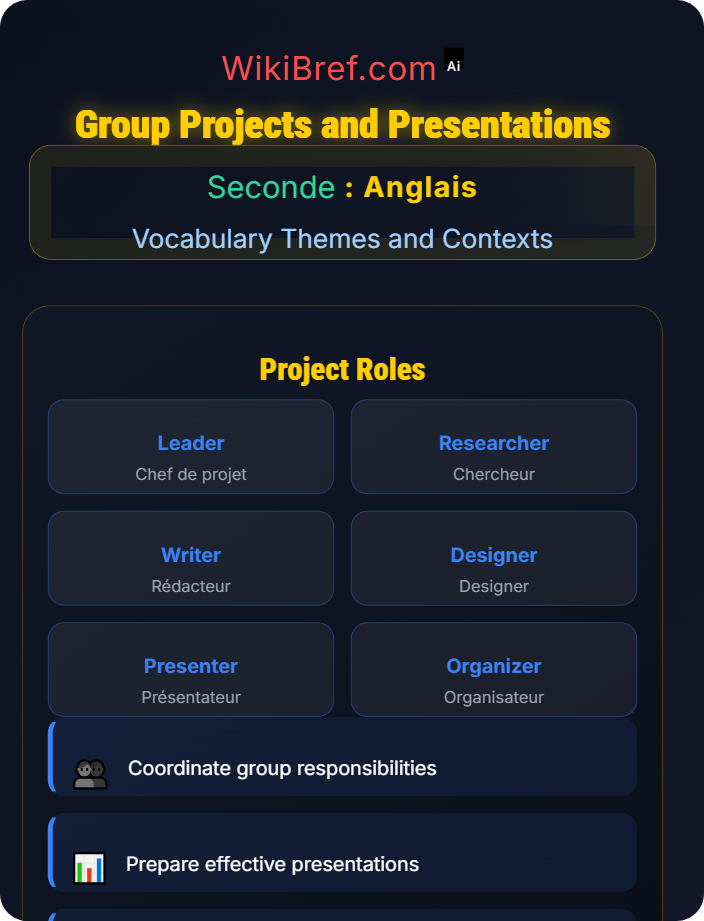
Project Leader coordinates efforts; Researcher gathers information; Designer creates visuals; Presenter delivers content
Researcher focuses on music genres; Designer creates visual timeline; Presenter practices musical terms; Leader manages schedule
Set up regular meetings, shared documents, and feedback channels
Track completion of tasks and provide mutual support
Efficiently organized team with clear roles: Leader (coordinates), Researcher (finds info), Designer (creates visuals), Presenter (delivers)
• Role Clarity: Each person knows their specific responsibility
• Strength Matching: Tasks align with individual capabilities
• Accountability: Clear ownership of deliverables
Leisure Activities: Recreational pursuits engaged in during free time for enjoyment and relaxation.
Identify video games as modern leisure activity, especially popular among young people
History of gaming → Types of games → Benefits → Challenges → Future trends
Include screenshots, console evolution timeline, statistics on gaming popularity
Use vocabulary: entertainment, technology, virtual reality, multiplayer, achievement
Include interactive polls, quiz about game facts, or demonstration of gameplay
Comprehensive presentation covering video games as leisure activity with historical context, types, benefits, and future perspectives
• Relevance: Connect topic to students' experiences
• Balanced View: Address both positive and negative aspects
• Current Information: Include recent developments and trends
Theater Performance: Live dramatic presentation combining acting, dialogue, music, and visual elements.
Start with interesting fact about theater history or famous play to capture attention
Historical background → Types of performances → Notable examples → Cultural significance
Include photos of famous theaters, costume designs, set models, and cast photos
Introduce terms: protagonist, antagonist, act, scene, stage directions, applause
Short role-play or reading of famous monologue to demonstrate theater's appeal
Engaging presentation about theater that combines historical knowledge, visual elements, and live demonstration
• Immersive Experience: Include live elements when possible
• Cultural Context: Explain significance within broader culture
• Multi-sensory Approach: Combine visual, auditory, and kinesthetic elements
Debate Format: Structured discussion where teams present arguments for and against a proposition.
Divide group into two teams: one supporting outdoor activities, one supporting indoor activities
Outdoor team: health benefits, nature connection, social interaction; Indoor team: weather protection, safety, comfort
Gather statistics, expert opinions, and real-life examples to support positions
Anticipate opposing arguments and prepare counterpoints
Opening statements → Arguments → Rebuttals → Closing statements
Structured debate with balanced arguments, evidence-based claims, and respectful discussion of both perspectives
• Respectful Dialogue: Maintain civility while disagreeing
• Evidence-Based: Support claims with credible sources
• Balanced Perspective: Acknowledge valid points from both sides
Cultural Comparison: Systematic analysis of similarities and differences between two cultures' approaches to similar activities.
Team members research popular sports in France and England separately, noting participation rates and cultural significance
Create comparison charts showing sports like football, rugby, tennis, and cycling in both countries
Explore how geography, climate, and history influence sports preferences in each country
Design infographics showing statistics, maps highlighting regional preferences, and timelines of sports development
Combine findings into coherent narrative highlighting both differences and surprising similarities
Comprehensive comparative analysis showing how cultural factors influence sports preferences in France and England
• Systematic Approach: Use consistent criteria for comparison
• Objectivity: Present facts without bias toward either culture
• Depth: Go beyond surface-level differences to explore underlying causes
Artistic Presentation: Educational presentation focusing on an artist's life, works, and cultural impact.
Choose an artist relevant to "Arts" category, considering both classical and contemporary options
Gather information about early life, influences, major achievements, and legacy
Examine signature styles, techniques, themes, and evolution of artistic expression
Explore how the artist influenced society, other artists, and cultural movements
Include high-quality reproductions of significant artworks with proper attribution
Informative presentation covering biographical details, artistic style, major works, and cultural influence of chosen artist
• Accuracy: Verify all biographical and artistic information
• Appropriateness: Select artwork suitable for educational context
• Contextualization: Place artist within broader cultural and historical framework
Leisure Activity: Recreational pursuit engaged in for pleasure, relaxation, or personal fulfillment during free time.
Define cycling as both recreational and transportation activity with multiple benefits
Detail cardiovascular fitness, muscle strengthening, mental health improvements, and weight management
Discuss eco-friendly transportation, reduced carbon footprint, and sustainable mobility
Explore community cycling groups, family activities, and cultural events centered around cycling
Address equipment needs, traffic awareness, and safe cycling practices
Comprehensive presentation covering health, environmental, social, and safety aspects of cycling as leisure activity
• Comprehensive Coverage: Address multiple dimensions of the activity
• Practical Relevance: Include actionable information for audience
• Balanced Perspective: Acknowledge both benefits and potential challenges
Art Form: Creative expression using movement, rhythm, and choreography to communicate emotions and ideas.
Trace evolution of dance from ancient rituals to contemporary forms across different cultures
Present various dance types: ballet, contemporary, hip-hop, traditional folk dances
Explain how dance communicates emotion and story through movement and gesture
Explore how dance reflects and shapes cultural identity and traditions
Discuss dance in education, therapy, entertainment, and competitive contexts
Complete presentation covering dance's historical development, various forms, expressive power, and cultural importance
• Historical Perspective: Show evolution over time
• Cultural Sensitivity: Respect diverse traditions and practices
• Multi-dimensional Approach: Cover artistic, physical, and cultural aspects
Festival: Community celebration featuring multiple activities, performances, and exhibitions over a defined period.
Define festival as event bringing together sports and arts activities for community engagement
Outline logistics: venue selection, scheduling, participant recruitment, equipment needs
Plan how sports competitions can complement artistic performances and exhibitions
Develop strategies for attracting diverse participants and spectators from local area
Establish measures for success: attendance, participant satisfaction, media coverage
Thoroughly planned festival project integrating sports and arts with detailed logistics and community engagement strategies
• Integration: Successfully combine sports and arts elements
• Feasibility: Consider practical constraints and resources
• Community Focus: Prioritize local engagement and participation