Anglais • 1ère

Differences Between Infinitive and Gerund
The Verbal Group - Infinitives and Gerunds

Infinitive vs Gerund Differences
🔄 Differences Between Infinitive and Gerund
Key distinctions and usage patterns
INFINITIVE
✅ to + base verb
✅ to study
✅ to go
📝 "I want to go"
GERUND
✅ -ing form
✅ studying
✅ going
📝 "I enjoy studying"
🎯
Definition: Infinitive (to + verb) vs Gerund (-ing form) serve different grammatical functions.
📚
Infinitive: "to + base verb" (to study, to work, to play).
🔄
Gerund: Base verb + -ing (studying, working, playing).
💡
Function: Some verbs take only infinitive, others only gerund, some both.
💡
Tip: Memorize verbs that take infinitive vs gerund
🔍
Attention: Some verbs change meaning with infinitive vs gerund
Rule: After prepositions use gerund, not infinitive
📋
Method: Practice with verb pattern classification
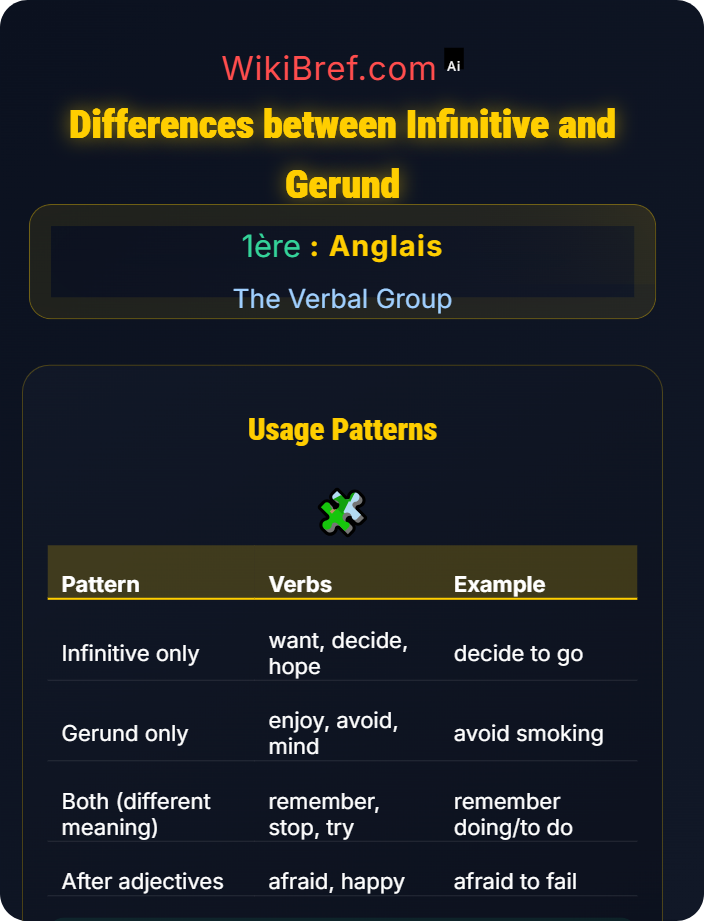
INFINITIVE VERBS
want to
need to
hope to
decide to
GERUND VERBS
enjoy +ing
finish +ing
avoid +ing
suggest +ing
BOTH POSSIBLE
start to/ing
continue to/ing
love to/ing
like to/ing
MEANING CHANGE
stop to: purpose
stop +ing: cease
remember to: future
remember +ing: past
Infinitive vs Gerund Exercises
1 Infinitive Verbs
Instructions :

Complete sentences with infinitive after verbs that take only infinitive.

Step 1: "I want ___ (to go) to the beach"

"want" takes infinitive → "to go"

Step 2: "She hopes ___ (to pass) the exam"

"hope" takes infinitive → "to pass"

Step 3: "They decided ___ (to travel) abroad"

"decide" takes infinitive → "to travel"

Step 4: "He needs ___ (to study) harder"

"need" takes infinitive → "to study"

Step 5: "We plan ___ (to visit) Paris"

"plan" takes infinitive → "to visit"

Completed Sentences :

1. to go, 2. to pass, 3. to travel, 4. to study, 5. to visit

Infinitive Rules :

Verbs: Want, hope, decide, need, plan, expect

Pattern: Subject + verb + to + base verb

Function: Express intention, desire, decision

2 Gerund Verbs
Instructions :

Complete sentences with gerund after verbs that take only gerund.

Step 1: "I enjoy ___ (reading) mystery novels"

"enjoy" takes gerund → "reading"

Step 2: "She avoids ___ (driving) at night"

"avoid" takes gerund → "driving"

Step 3: "He finished ___ (writing) the report"

"finish" takes gerund → "writing"

Step 4: "They suggested ___ (going) to the cinema"

"suggest" takes gerund → "going"

Step 5: "We practice ___ (speaking) English"

"practice" takes gerund → "speaking"

Completed Sentences :

1. reading, 2. driving, 3. writing, 4. going, 5. speaking

Gerund Rules :

Verbs: Enjoy, avoid, finish, suggest, practice, mind

Pattern: Subject + verb + -ing form

Function: Express ongoing activity, habit

3 Verbs with Both Forms
Instructions :

Complete sentences with either infinitive or gerund after verbs that accept both.

Step 1: "She started ___ (to study/studying) early"

"start" accepts both → "to study" or "studying"

Step 2: "He loves ___ (to cook/cooking) Italian food"

"love" accepts both → "to cook" or "cooking"

Step 3: "They continued ___ (to work/working) late"

"continue" accepts both → "to work" or "working"

Step 4: "I like ___ (to swim/swimming) in the morning"

"like" accepts both → "to swim" or "swimming"

Step 5: "We began ___ (to sing/singing) together"

"begin" accepts both → "to sing" or "singing"

Both Forms Acceptable :

1. to study/studying, 2. to cook/cooking, 3. to work/working, 4. to swim/swimming, 5. to sing/singing

Both Forms Rules :

Verbs: Start, begin, love, like, continue, hate

Pattern: Either infinitive or gerund acceptable

Meaning: Generally same, sometimes slight nuance

Meaning Change Exercises
4 Verbs with Meaning Change
Instructions :

Complete sentences with appropriate form when meaning changes.

Step 1: "He stopped ___ (smoking) years ago" (ceased)

Meaning: ceased the activity → Gerund "smoking"

Step 2: "He stopped ___ (to rest) during the hike" (purpose)

Meaning: purpose of stopping → Infinitive "to rest"

Step 3: "I remember ___ (meeting) you last year" (past memory)

Meaning: past event → Gerund "meeting"

Step 4: "Remember ___ (to call) your parents" (future reminder)

Meaning: future action → Infinitive "to call"

Step 5: "I forgot ___ (locking) the door" (past action)

Meaning: past memory → Gerund "locking"

Completed Sentences :

1. smoking, 2. to rest, 3. meeting, 4. to call, 5. locking

Meaning Change Rules :

Stop: Gerund = cease, Infinitive = purpose

Remember: Gerund = past, Infinitive = future

Forget: Gerund = past, Infinitive = future

5 Context-Based Choice
Instructions :

Choose between infinitive and gerund based on context and meaning.

Step 1: "I tried ___ (to open/opening) the door" (attempt)

Meaning: attempted → Infinitive "to open"

Step 2: "I tried ___ (to quit/quitting) smoking" (experiment)

Meaning: experimented → Gerund "quitting"

Step 3: "She prefers ___ (to work/working) from home"

General preference → Either acceptable

Step 4: "He means ___ (to help/helping) his friends"

Intention → Infinitive "to help"

Step 5: "This means ___ (to save/saving) money"

Implication → Gerund "saving"

Context Choices :

1. to open, 2. quitting, 3. working/to work, 4. to help, 5. saving

Context Rules :

Try: Infinitive = attempt, Gerund = experiment

Mean: Infinitive = intention, Gerund = implication

Context: Meaning determines form choice
Key Points Summary
🎯
Memorization: Learn verb patterns: infinitive only, gerund only, both
🔍
Meaning Change: Some verbs change meaning with infinitive vs gerund
Prepositions: Always use gerund after prepositions
📋
Practice: Group verbs by pattern for easier learning
Infinitive Only
want to, hope to
desire/intention
Gerund Only
enjoy +ing, avoid +ing
habit/activity
Both Forms
start to/+ing
similar meaning
Differences between infinitive and gerund Infinitives and Gerunds