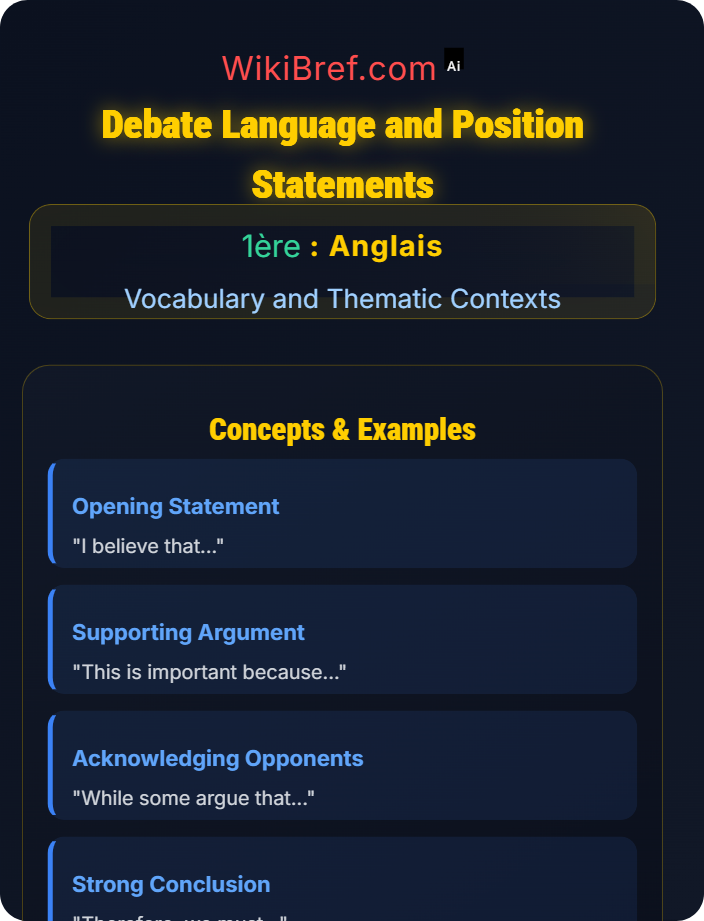
Position statement : Affirmation claire et directe de votre point de vue sur un sujet spécifique, généralement au début d'un débat.
- Choisir une position claire : Pour ou contre un sujet
- Identifier les arguments principaux : 2-3 points clés
- Préparer les preuves : Données, exemples, études
- Anticiper les contre-arguments : Préparer des réfutations
"I firmly believe that social media platforms pose a significant threat to personal privacy and should be more strictly regulated to protect users' data."
"Firstly, companies like Facebook and Google collect vast amounts of personal data without users' full understanding. According to a 2021 study, the average smartphone app shares data with 37 third-party tracking companies."
"Secondly, these platforms have been involved in numerous data breaches and scandals, such as the Cambridge Analytica incident, which affected over 87 million users and potentially influenced election outcomes."
"Thirdly, the business model of these platforms relies on targeted advertising, which requires extensive data collection. This creates an inherent conflict between profit motives and user privacy protection."
"While opponents argue that personalized content improves user experience, this benefit does not outweigh the fundamental right to privacy and the potential for misuse of personal information."
"In conclusion, we must demand stronger privacy regulations and transparency from social media companies to protect our digital rights. Citizens should support legislation that limits data collection and increases accountability."
Un bon énoncé de position commence par une déclaration claire, est suivi d'arguments structurés avec des preuves concrètes, et inclut des réfutations d'arguments opposés pour renforcer la position.
• Clarté : Position exprimée dès le début
• Preuves : Arguments soutenus par des données
• Structure : Logique et cohérence
• Réfutation : Anticipation des contre-arguments
Langage du débat : Vocabulaire et expressions spécifiques utilisés pour exprimer des arguments, poser des questions, et réfuter des points de vue.
"I strongly believe that comprehensive gender equality education should be integrated into school curricula from an early age to create a more equitable society."
"Firstly, research indicates that children develop gender stereotypes as early as age 6. Therefore, early intervention is crucial to prevent these biases from becoming deeply ingrained."
"Moreover, countries like Sweden and Norway, which have implemented comprehensive gender equality programs, show reduced gender wage gaps and increased female participation in STEM fields."
"Furthermore, I acknowledge that some may argue this could confuse children about gender roles. However, evidence suggests that understanding equality actually promotes healthier relationships and self-esteem."
"To counter the argument that this is unnecessary, studies from the University of California show that children who receive gender equality education demonstrate higher levels of empathy and cooperation."
"In summary, investing in gender equality education is not just morally imperative but economically beneficial, creating future generations that value fairness and respect."
"I respectfully disagree because..." / "While that point has merit, consider..." / "The evidence suggests otherwise..." / "My opponent fails to consider..."
Le langage du débat efficace utilise des connecteurs logiques, des transitions claires, un ton respectueux mais convaincant, et des phrases structurées pour présenter, réfuter et conclure des arguments.
• Connecteurs : Pour relier les idées logiquement
• Respect : Langage courtois même en désaccord
• Conviction : Confiance dans l'expression
• Structure : Organisation claire des arguments
Équilibre dans le débat : Capacité à reconnaître les points forts des deux côtés tout en maintenant sa propre position.
"I firmly believe that transitioning to renewable energy sources is not only environmentally necessary but also economically viable in the long term."
"According to the International Renewable Energy Agency, renewable energy costs have decreased by 70% for solar and 40% for wind since 2010, making them increasingly competitive with fossil fuels."
"Furthermore, the IPCC reports that renewable energy could provide 85% of global electricity by 2050, significantly reducing greenhouse gas emissions and mitigating climate change impacts."
"I understand that critics argue renewable energy has intermittency issues and requires substantial initial investment. These are legitimate concerns that require technological solutions."
"However, battery storage technology is rapidly advancing, and countries like Denmark generate 50% of their electricity from wind power, demonstrating that these challenges can be overcome."
"While fossil fuel industries currently provide more stable employment, the renewable sector is creating jobs faster than any other industry, with solar and wind employment growing by 6% annually."
"In conclusion, the transition to renewable energy is inevitable and beneficial, though it requires careful planning to address legitimate economic concerns and ensure a just transition for workers."
Un débat équilibré reconnaît les points de vue opposés tout en maintenant une position ferme, utilise des données objectives, et propose des solutions aux objections soulevées.
• Objectivité : Utilisation de données fiables
• Équilibre : Reconnaissance des deux côtés
• Solutions : Proposition de réponses aux objections
• Transition : Plan progressif et réaliste
Langage de l'ouverture d'esprit : Expression de compréhension des complexités d'un sujet sensible tout en défendant une position.
"I believe that successful integration of immigrants requires a balanced approach that respects cultural diversity while promoting shared civic values and responsibilities."
"Research from Harvard University demonstrates that culturally diverse societies are more innovative and economically productive, with diverse teams showing 35% better performance on complex tasks."
"Studies by the OECD show that immigrant entrepreneurs create jobs at higher rates than native-born entrepreneurs, contributing significantly to economic growth and innovation."
"I acknowledge that integration poses challenges, including language barriers, cultural differences, and competition for resources. These issues require thoughtful policy responses rather than exclusion."
"Effective integration policies include language training programs, job placement services, and community building initiatives. Canada's points-based immigration system serves as a successful model."
"Contrary to common misconceptions, immigrants contribute more in taxes than they consume in services, with studies showing a positive fiscal impact after the first decade of residence."
"Rather than viewing immigration as a threat, we should recognize it as an opportunity to strengthen our societies through the contributions of diverse talents and perspectives."
Le débat sur l'immigration nécessite une approche nuancée qui reconnaît les défis tout en soulignant les bénéfices, en utilisant des données objectives et en proposant des solutions concrètes.
• Humilité : Reconnaissance de la complexité du sujet
• Empathie : Compréhension des préoccupations légitimes
• Preuves : Données fiables pour soutenir les arguments
• Constructif : Proposition de solutions concrètes
Préparation anticipative : Capacité à anticiper les arguments opposés et à préparer des réponses équilibrées et informées.
"I believe that artificial intelligence, while disruptive, presents more opportunities than threats for the workforce when properly managed through education and policy."
"The World Economic Forum predicts that AI will create 97 million new jobs by 2025, particularly in data science, AI ethics, and human-AI collaboration roles that require uniquely human skills."
"AI tools increase productivity by 40% in many industries, allowing workers to focus on creative and strategic tasks rather than repetitive ones, ultimately enhancing human capabilities."
"I understand concerns about job displacement, particularly in routine-based occupations. However, history shows that technological revolutions create more jobs than they eliminate in the long term."
"During the Industrial Revolution, fears about machines replacing workers proved unfounded. Instead, it led to entirely new industries and job categories that were previously unimaginable."
"To address legitimate concerns, we need robust retraining programs, universal basic income pilots, and education reforms focusing on creativity, critical thinking, and emotional intelligence."
"Rather than resisting AI advancement, we should embrace it strategically, ensuring that the benefits are distributed equitably and that workers are prepared for the evolving job market."
Un débat équilibré sur l'IA et l'emploi reconnaît les craintes légitimes tout en mettant en évidence les opportunités, en s'appuyant sur des exemples historiques et en proposant des solutions concrètes.
• Prospective : Vision à long terme
• Historique : Apprentissage des révolutions technologiques passées
• Préparatif : Anticipation des défis et solutions
• Équilibre : Reconnaissance des deux côtés de la question