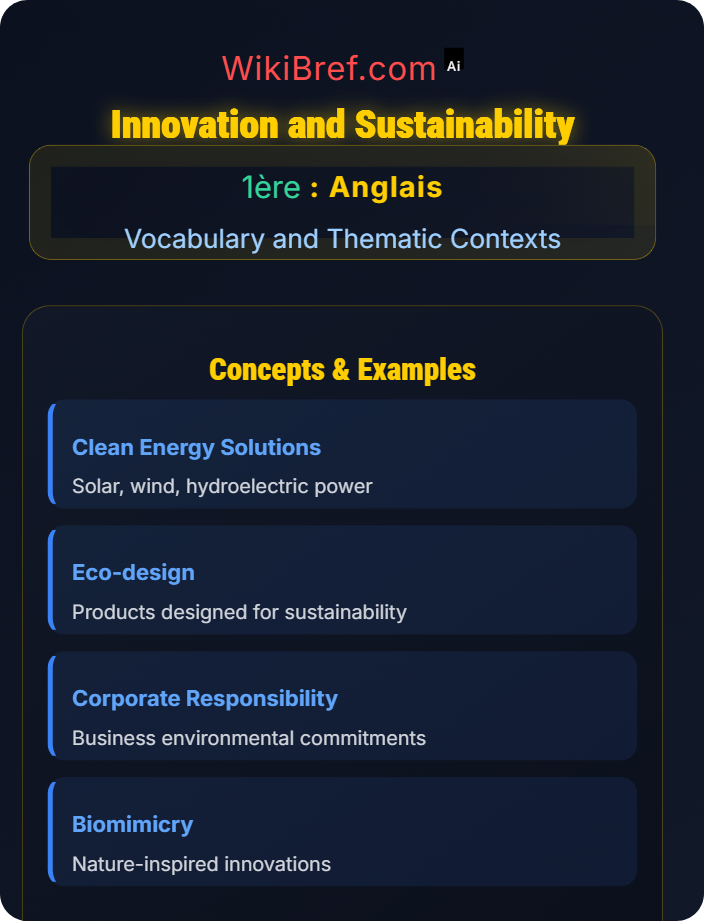
Énergies renouvelables : Sources d'énergie naturelles qui se régénèrent plus rapidement qu'elles ne sont consommées.
- Identification des sources : Solaires, éoliennes, hydrauliques, géothermiques
- Évaluation des innovations : Technologies avancées, rendement
- Analyse environnementale : Impact positif et négatif
- Considération économique : Coût, rentabilité, accessibilité
"Renewable energy sources like solar and wind power offer sustainable alternatives to fossil fuels. They produce zero emissions during operation, reducing carbon footprints and combating climate change."
"Recent innovations include perovskite solar cells with higher efficiency rates, floating solar farms, and advanced wind turbine designs. Smart grid technologies optimize energy distribution and storage."
"Renewable energy reduces greenhouse gas emissions, air pollution, and dependence on finite resources. It helps preserve ecosystems and biodiversity by minimizing habitat destruction from mining and drilling."
"Despite benefits, renewable energy faces challenges: solar panel manufacturing involves toxic materials, wind turbines can affect bird migration patterns, and large-scale installations may disrupt local ecosystems."
"Initial investment costs for renewable energy infrastructure are high, but operational costs are low. Government incentives and decreasing technology prices make renewables increasingly competitive with traditional energy sources."
"Emerging technologies like fusion power, advanced battery storage, and green hydrogen promise to make renewable energy more efficient and reliable, accelerating the transition to sustainable energy systems."
Les innovations dans les énergies renouvelables offrent des solutions durables pour réduire les émissions de carbone, mais nécessitent une évaluation attentive de leur impact environnemental complet et des investissements stratégiques pour une adoption à grande échelle.
• Équilibre : Avantages et inconvénients des technologies
• Évaluation : Impact sur tout le cycle de vie
• Viabilité : Équilibre économique et environnemental
• Progression : Amélioration continue des performances
Économie circulaire : Système économique qui vise à éliminer les déchets et à maintenir les produits et matériaux en circulation le plus longtemps possible.
"The circular economy operates on the 'reduce, reuse, recycle' principle. It designs out waste and pollution, keeps products and materials in use, and regenerates natural systems through innovative business models."
"Advanced recycling technologies like chemical recycling break down plastics to molecular level. 3D printing enables on-demand manufacturing, reducing material waste and transportation needs."
"Product-as-a-service models shift ownership to access, extending product lifecycles. Companies like Philips offer lighting as a service, maintaining equipment for optimal performance and end-of-life recovery."
"Blockchain technology enables supply chain transparency, allowing consumers to verify sustainability claims. IoT sensors track product conditions and optimize maintenance, extending useful life."
"Biotechnology creates sustainable materials from organic sources. Mycelium packaging replaces polystyrene, lab-grown leather reduces animal agriculture impact, and algae-based plastics offer biodegradable alternatives."
"Transitioning to circular models requires significant investment in new technologies, changes in consumer behavior, and regulatory support. Standardization of recycling processes and quality control remain challenges."
"Circular economy models reduce resource consumption, decrease waste generation, lower carbon emissions, and create new employment opportunities in green sectors while maintaining economic growth."
L'économie circulaire repose sur des innovations technologiques qui transforment les modèles économiques traditionnels en intégrant la durabilité, la traçabilité et l'optimisation des ressources tout en maintenant la viabilité économique.
• Systémique : Approche holistique du cycle de vie
• Innovation : Technologies qui réimaginent la valeur
• Collaboration : Coordination entre acteurs économiques
• Transparence : Traçabilité et responsabilité
Transports durables : Systèmes de mobilité qui minimisent l'impact environnemental tout en répondant aux besoins de déplacement.
"Electric vehicles produce zero tailpipe emissions, reducing urban air pollution. They offer quieter operation, lower maintenance costs, and higher energy efficiency compared to internal combustion engines."
"Solid-state batteries promise higher energy density, faster charging, and improved safety. Silicon anodes and lithium metal technologies could triple battery capacity and extend driving ranges significantly."
"Smart charging networks optimize grid integration and enable vehicle-to-grid technology. Wireless charging systems and battery swapping stations offer convenient alternatives to traditional plug-in charging."
"Battery production requires rare earth minerals with environmental and social concerns. Mining lithium, cobalt, and nickel has ecological impacts. Proper recycling systems are essential for sustainability."
"Solar panels integrated into vehicle roofs extend range and reduce grid dependency. Charging stations powered by renewable energy sources maximize the environmental benefits of electric vehicles."
"Car-sharing and ride-hailing services using electric vehicles reduce individual car ownership. Autonomous electric shuttles and connected mobility platforms optimize transportation efficiency and reduce congestion."
"Hydrogen fuel cells offer alternative zero-emission technology for heavy-duty and long-distance transport. Hyperloop and other innovative transport systems could revolutionize sustainable mobility."
Les transports durables combinent l'innovation technologique des véhicules électriques avec des systèmes de recharge intelligents, des sources d'énergie renouvelables, et des modèles de mobilité partagée pour réduire l'empreinte carbone des déplacements.
• Complet : Chaîne de valeur intégrale
• Intégration : Réseau électrique et énergies renouvelables
• Accessibilité : Infrastructure pour tous les usagers
• Cycle : Gestion responsable des batteries
Bâtiments écologiques : Constructions conçues pour minimiser l'impact environnemental par l'efficacité énergétique et l'utilisation de matériaux durables.
"Sustainable building materials include recycled steel, bamboo, reclaimed wood, and hempcrete. These materials reduce environmental impact while offering comparable strength and durability to conventional materials."
"Solar panels, geothermal systems, and small wind turbines can be integrated into building designs. Green roofs and living walls provide insulation while improving air quality and biodiversity."
"Smart HVAC systems optimize heating and cooling based on occupancy and weather conditions. IoT sensors monitor air quality, humidity, and energy usage for maximum efficiency and comfort."
"Rainwater harvesting systems, greywater recycling, and permeable surfaces reduce water consumption and manage stormwater runoff. Water-efficient fixtures further minimize usage without sacrificing performance."
"LEED, BREEAM, and similar certifications evaluate buildings' environmental performance across energy, water, materials, and indoor environmental quality. These standards guide sustainable design practices."
"While initial costs may be higher, green buildings offer long-term savings through reduced energy bills, lower maintenance costs, and increased property values. Health benefits from improved indoor air quality also reduce healthcare costs."
"Self-healing concrete, 3D-printed sustainable materials, and biomimetic designs inspired by nature will advance green construction. Net-zero energy buildings that produce as much energy as they consume are becoming mainstream."
La construction écologique combine des matériaux durables, des technologies intelligentes, des systèmes énergétiques renouvelables, et des pratiques de certification environnementale pour créer des bâtiments qui minimisent leur impact écologique tout en optimisant le confort et l'efficacité.
• Performance : Équilibre entre durabilité et fonctionnalité
• Intégration : Systèmes intelligents pour l'efficacité
• Certification : Normes reconnues pour la durabilité
• Rendement : Bénéfices à long terme
Gestion de l'eau : Approche intégrée pour utiliser, traiter et conserver les ressources en eau de manière durable et équitable.
"Nanofiltration and reverse osmosis membranes remove contaminants at molecular level. UV sterilization and ozone treatment eliminate pathogens without chemicals. Advanced oxidation processes break down persistent pollutants."
"Atmospheric water generators extract moisture from air, providing fresh water in arid regions. Solar-powered atmospheric water systems offer sustainable solutions for remote areas with limited water infrastructure."
"Smart water meters detect leaks and monitor consumption in real-time. IoT sensors in distribution networks predict maintenance needs and prevent contamination. AI algorithms optimize treatment processes and predict water quality changes."
"Greywater recycling systems treat and reuse water from sinks and showers for irrigation. Blackwater treatment converts sewage into reusable water and energy. Rainwater harvesting captures and stores precipitation for later use."
"Solar desalination and forward osmosis reduce energy requirements for seawater treatment. Graphene-based filters offer more efficient salt removal. Wave-powered desalination plants harness ocean energy for freshwater production."
"Smart irrigation systems use weather data and soil sensors to optimize water usage. Low-flow fixtures and dual-flush toilets reduce consumption. Water-efficient landscaping and xeriscaping minimize outdoor water needs."
"Decentralized water treatment systems bring clean water to underserved communities. Mobile water purification units provide emergency relief. Community-managed water systems ensure sustainable local ownership and maintenance."
Les technologies de gestion de l'eau combinent des systèmes de purification avancés, des approches intelligentes de conservation, des méthodes de dessalement innovantes, et des solutions décentralisées pour garantir un accès équitable à l'eau potable tout en préservant cette ressource précieuse.
• Accessibilité : Solutions pour tous les contextes
• Énergie : Intégration des sources renouvelables
• Économie : Approches abordables et durables
• Communauté : Participation locale dans la gestion