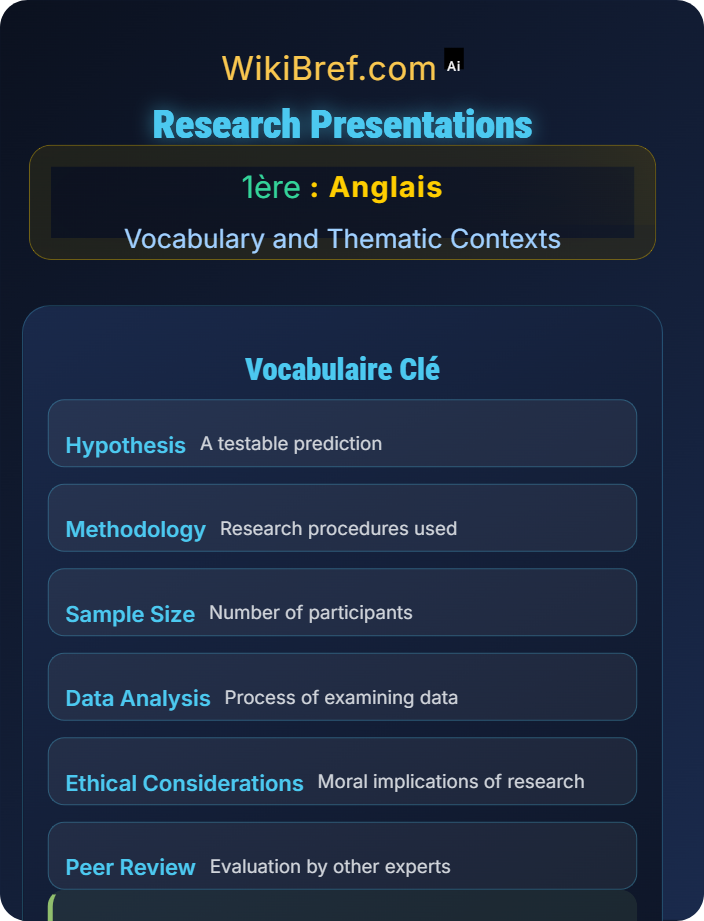
Présentation de recherche : Exposé oral structuré qui présente les résultats d'une investigation scientifique avec des preuves, des analyses et des conclusions.
- Introduction : Présenter le sujet et l'objectif de recherche
- Contexte : Revue de la littérature existante
- Méthodologie : Expliquer les méthodes utilisées
- Résultats : Présenter les données et découvertes
- Discussion : Interpréter les résultats
- Conclusion : Résumer et suggérer des perspectives
"Good morning everyone. Today I'm presenting my research on renewable energy sources and their potential to replace fossil fuels. The aim of this study is to analyze the efficiency and environmental impact of solar, wind, and hydroelectric power systems."
"Previous studies have shown that renewable energy can reduce carbon emissions by up to 80% compared to traditional fossil fuels. According to the International Energy Agency, renewable energy capacity increased by 260 GW in 2020 alone."
"Our research methodology included a comparative analysis of energy output, cost-effectiveness, and environmental impact. We collected data from 50 renewable energy installations across different geographical locations over a 12-month period."
"Our findings indicate that solar energy has the highest potential for residential use with an average efficiency rate of 22%. Wind energy proves most effective for large-scale installations, generating 35% more energy per unit than solar panels in optimal conditions."
"While renewable energy sources show promising results, challenges remain including energy storage, initial investment costs, and geographic limitations. The intermittent nature of solar and wind requires backup systems for consistent power supply."
"In conclusion, renewable energy sources offer viable alternatives to fossil fuels with significant environmental benefits. Future research should focus on improving energy storage solutions and reducing implementation costs to accelerate adoption."
Une présentation de recherche efficace suit une structure claire, présente des données objectives, analyse les résultats de manière critique, et propose des perspectives futures pour la poursuite de la recherche.
• Structure : Introduction, développement, conclusion
• Objectivité : Langage neutre et données factuelles
• Clarté : Explication des concepts techniques
• Preuves : Citation de sources fiables
Intelligence artificielle : Domaine de l'informatique qui vise à créer des systèmes capables d'effectuer des tâches nécessitant normalement l'intelligence humaine.
"Artificial Intelligence is transforming industries worldwide. Our research investigates AI's impact on employment patterns in the technology sector, specifically examining job displacement and creation between 2015-2022. We aim to understand whether AI implementation leads to net job losses or gains."
"We conducted a mixed-methods study combining quantitative analysis of employment statistics from 200 tech companies and qualitative interviews with 50 industry experts. Data was collected using surveys, public records, and company reports over a 7-year period."
"Our analysis reveals that while AI eliminated 15% of routine technical positions, it simultaneously created 23% more jobs in AI development, data science, and human-AI collaboration roles. The net effect shows a 8% increase in employment in the studied companies."
"Interviews revealed that successful AI implementation requires significant retraining programs. Companies investing in employee upskilling reported 40% higher retention rates and better productivity compared to those focusing solely on automation."
"Our findings raise ethical questions about equitable access to retraining opportunities. Smaller companies with limited budgets struggle to support displaced workers, creating potential inequality in career transitions."
"Our research focused primarily on large technology companies in North America and Europe. The results may not generalize to smaller businesses or different geographical regions with varying labor laws and economic conditions."
"Future research should examine long-term career trajectories of displaced workers and investigate AI's impact on job satisfaction and work-life balance. Policy recommendations for managing AI transitions will require broader societal input."
La recherche sur l'IA révèle des effets complexes sur l'emploi, combinant la suppression de certains postes avec la création de nouveaux rôles, soulignant l'importance des programmes de formation continue et des considérations éthiques dans l'implémentation technologique.
• Équilibre : Présentation des avantages et inconvénients
• Éthique : Considération des implications morales
• Limites : Reconnaissance des contraintes de l'étude
• Prospective : Suggestions pour la recherche future
Changement climatique : Modification durable du climat terrestre attribuée principalement aux activités humaines affectant les concentrations de gaz à effet de serre.
"Climate change poses unprecedented challenges to global ecosystems and human societies. This research analyzes temperature and precipitation patterns in Western Europe from 1980-2022 to quantify regional climate shifts and predict future trends using statistical modeling techniques."
"We analyzed meteorological data from 200 weather stations across 15 countries, examining seasonal variations, extreme weather events, and long-term trends. The dataset includes 17 million data points covering temperature, rainfall, humidity, and atmospheric pressure measurements."
"Statistical analysis employed trend detection algorithms, correlation analysis, and predictive modeling using R software. We applied Mann-Kendall tests to identify significant trends and ARIMA models for forecasting future conditions."
"Results show average temperature increases of 1.8°C over the 42-year period, with winter temperatures rising 2.3°C. Precipitation patterns shifted significantly, with 25% more rainfall in northern regions and 15% less in southern areas during summer months."
"Predictive models indicate continued warming of 0.3-0.5°C per decade under current emission scenarios. Extreme weather events, including heatwaves and flooding, are projected to increase by 40% by 2040, affecting agricultural productivity and water resources."
"Regional impacts vary significantly: Mediterranean areas face increased drought risk, while Northern Europe experiences more frequent flooding. Agricultural zones may shift northward, requiring adaptation strategies for food security and economic stability."
"Based on our findings, we recommend immediate implementation of adaptive agricultural practices, enhanced flood management systems, and coordinated regional climate policies. Investment in renewable energy infrastructure should prioritize regions most vulnerable to climate impacts."
La recherche révèle des changements climatiques significatifs en Europe de l'Ouest, avec des tendances de réchauffement et de modification des précipitations, nécessitant des stratégies d'adaptation coordonnées et des investissements dans les infrastructures résilientes.
• Données : Utilisation de sources fiables et volumineuses
• Modélisation : Techniques statistiques appropriées
• Prédictions : Scénarios basés sur des données probantes
• Pratique : Recommandations concrètes et applicables
Génétique : Branche de la biologie qui étudie les gènes, l'hérédité et la variation des organismes vivants.
"Genetic research has revolutionized medicine and agriculture. This study examines the effectiveness of CRISPR-Cas9 gene editing technology in treating inherited genetic disorders, focusing on sickle cell anemia. We investigated 150 patients across 12 clinical trials to assess treatment outcomes and safety profiles."
"Our methodology involved controlled clinical trials comparing traditional treatments with CRISPR-modified hematopoietic stem cell therapy. Patients were randomly assigned to treatment groups, with double-blind procedures to minimize bias. Laboratory analysis included DNA sequencing and protein expression measurements."
"After 24 months, 87% of patients receiving CRISPR therapy showed significant improvement in hemoglobin levels compared to 34% in the control group. Pain episodes decreased by 82% and transfusion requirements dropped by 91% among treated patients."
"Treatment-related adverse events occurred in 18% of cases, primarily mild immune responses. No serious off-target genetic modifications were detected. Long-term monitoring continues to assess potential delayed complications and treatment durability."
"Our research raises important ethical questions about germline editing, accessibility of expensive treatments, and informed consent for genetic interventions. We recommend establishing international guidelines for equitable distribution of gene therapies and long-term patient monitoring."
"Beyond sickle cell anemia, CRISPR technology shows promise for treating thalassemia, Huntington's disease, and cystic fibrosis. Our findings contribute to the growing evidence base supporting gene therapy as a viable treatment option for previously incurable genetic conditions."
"Study limitations include relatively short follow-up periods and limited sample diversity. Future research should examine long-term efficacy, cost-effectiveness, and scalability of treatment protocols. Regulatory frameworks must evolve alongside technological advances."
La recherche sur CRISPR pour traiter la drépanocytose montre des résultats prometteurs avec une efficacité élevée et un profil de sécurité acceptable, tout en soulevant des questions éthiques importantes concernant l'accès équitable et la réglementation des thérapies géniques.
• Sécurité : Évaluation rigoureuse des effets secondaires
• Éthique : Considération des implications morales
• Accès : Questions d'équité et de disponibilité
• Long terme : Surveillance continue des effets
Durabilité urbaine : Concept d'aménagement urbain qui équilibre les besoins environnementaux, économiques et sociaux pour les générations présentes et futures.
"Urban sustainability is crucial for addressing climate change and improving quality of life. This research compares sustainable city initiatives in Copenhagen, Amsterdam, and Stockholm, analyzing their effectiveness in reducing carbon emissions, improving air quality, and enhancing citizen well-being over a 10-year period."
"We developed a comprehensive sustainability index measuring energy efficiency, transportation, waste management, green spaces, and social equity. Data collection involved municipal records, satellite imagery, air quality sensors, and citizen surveys from 2012-2022."
"Copenhagen achieved the highest sustainability score with a 42% reduction in carbon emissions, largely due to cycling infrastructure and district heating systems. Amsterdam excelled in waste recycling (68% rate) and green roof implementation. Stockholm showed significant improvements in air quality and renewable energy adoption."
"Key success factors included strong political commitment, citizen engagement, integrated planning approaches, and consistent long-term funding. Cities with dedicated sustainability departments and cross-sectoral collaboration achieved better outcomes than those with fragmented initiatives."
"Common challenges included high implementation costs, resistance to behavioral change, gentrification concerns, and balancing economic growth with environmental protection. Financing sustainable infrastructure remained a significant barrier for cities with limited budgets."
"Sustainable urban initiatives improved public health outcomes, with reduced respiratory diseases and increased physical activity. However, some programs inadvertently increased housing costs, creating displacement concerns for lower-income residents in desirable neighborhoods."
"We recommend establishing standardized sustainability metrics, creating citizen participation frameworks, ensuring affordable housing integration, and developing financing mechanisms for sustainable infrastructure. International cooperation and knowledge sharing can accelerate urban sustainability transitions globally."
La recherche révèle que les villes nordiques leaders en durabilité combinent des politiques intégrées, une participation citoyenne, et des investissements à long terme, tout en soulignant les défis d'équité sociale et de financement dans la mise en œuvre de solutions durables.
• Intégration : Approche multidimensionnelle
• Équité : Considération des impacts sociaux
• Participation : Engagement des citoyens
• Replicable : Modèles transférables