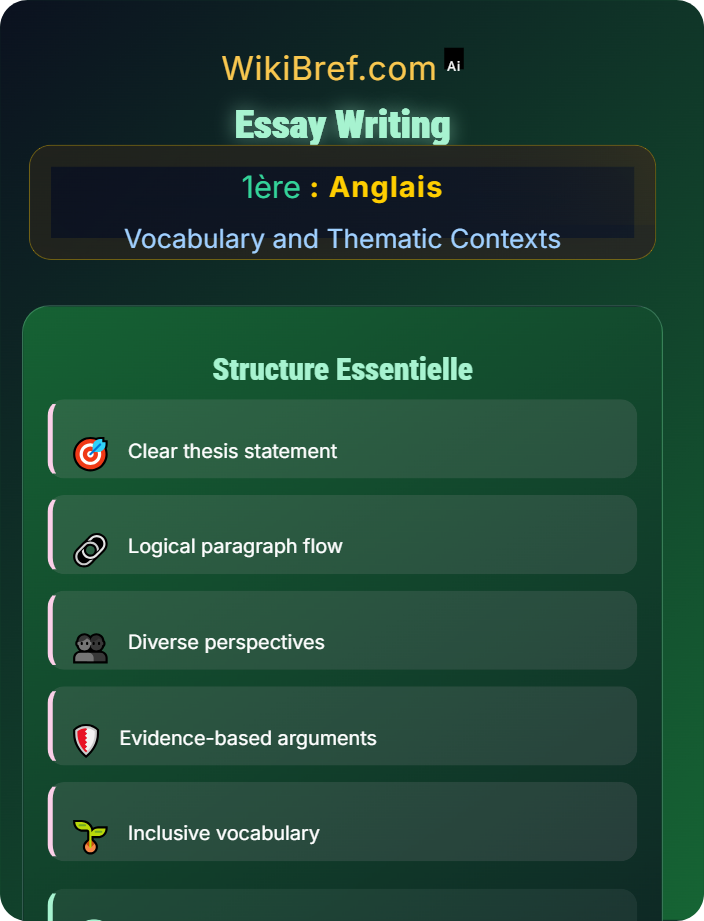
Introduction : Première partie d'un essai qui présente le sujet et l'idée principale.
- Commencer avec une accroche (hook) pour capter l'attention
- Donner un contexte général sur le sujet
- Présenter la thèse (thesis statement)
"In today's globalized world, diversity has become a cornerstone of successful societies."
"Schools, workplaces, and communities are increasingly diverse, bringing together people from different backgrounds, cultures, and abilities."
"This essay argues that inclusion is essential for creating environments where everyone can thrive and contribute meaningfully."
Introduction complète: "In today's globalized world, diversity has become a cornerstone of successful societies. Schools, workplaces, and communities are increasingly diverse, bringing together people from different backgrounds, cultures, and abilities. This essay argues that inclusion is essential for creating environments where everyone can thrive and contribute meaningfully."
• Structure : Hook + Background + Thesis Statement
• Clarté : L'idée principale est clairement exprimée
• Accroche : Utilisation d'une phrase générale pour attirer l'attention
Paragraphe de développement : Section qui développe une idée principale avec des détails et exemples.
Thèse du paragraphe: "Diversity brings numerous benefits to educational institutions."
Expliquer comment la diversité améliore l'apprentissage et la créativité.
Fournir des exemples concrets de la valeur de la diversité.
Relier le paragraphe au suivant avec un connecteur.
Diversity brings numerous benefits to educational institutions. Students exposed to different cultures, perspectives, and backgrounds develop enhanced critical thinking skills and creativity. For instance, when students collaborate on projects with peers from various ethnicities and nationalities, they learn to approach problems from multiple angles. Furthermore, diverse classrooms prepare students for a globalized workforce where cross-cultural communication is essential. This exposure to diversity ultimately creates more empathetic and open-minded individuals.
• Thèse : Idée principale clairement exprimée
• Développement : Explication détaillée avec exemples
• Connecteurs : Utilisation de mots de liaison appropriés
Conclusion : Dernière partie d'un essai qui résume les idées principales et propose une perspective finale.
Résumer brièvement les points principaux de l'essai.
Réaffirmer la thèse principale de manière différente.
Donner une perspective sur l'avenir ou une réflexion finale.
To conclude, equality in education and society is not just a moral imperative but also a practical necessity for progress. The evidence presented demonstrates that inclusive environments foster innovation, empathy, and understanding among diverse populations. As we move forward, it becomes increasingly important for institutions to prioritize equality and inclusion. Only through such efforts can we build a society where every individual has the opportunity to reach their full potential, regardless of their background, identity, or circumstances.
• Résumé : Synthèse des idées principales
• Réaffirmation : Reformulation de la thèse
• Perspective : Réflexion sur l'avenir ou l'importance
Essai complet : Composition structurée comprenant introduction, développement et conclusion.
Créer un plan avec thèse, idées principales et exemples.
"Tolerance is the foundation of peaceful coexistence in our diverse world. As globalization connects people from different backgrounds, the ability to accept and respect differences becomes crucial. This essay argues that tolerance is essential for building harmonious societies."
"Tolerance promotes understanding between different cultures and religions. When individuals practice tolerance, they engage in meaningful dialogue and learn from one another's experiences. For example, multicultural festivals celebrate diversity while fostering mutual respect."
"Some argue that tolerance may lead to accepting harmful practices. However, tolerance does not mean accepting everything without question. Instead, it involves respectful dialogue and setting boundaries for acceptable behavior while maintaining respect for human dignity."
"Educational institutions play a crucial role in promoting tolerance. Schools that emphasize diversity and inclusion create environments where students learn to appreciate differences. Research shows that students in diverse settings develop better problem-solving skills and empathy."
"In conclusion, tolerance remains fundamental to peaceful coexistence in our interconnected world. By fostering understanding and respect, we can build societies that celebrate diversity while maintaining unity. The future depends on our collective commitment to tolerance."
Un essai complet sur la tolérance comprend une introduction claire avec thèse, trois paragraphes de développement avec exemples et transitions, et une conclusion qui résume et affine l'argumentation.
• Structure : Introduction → 3 paragraphes → Conclusion
• Logique : Idées bien organisées et connectées
• Exemples : Preuves concrètes pour soutenir les arguments
Comparaison : Technique d'analyse qui examine les similitudes et différences entre deux sujets.
Choisir deux cultures à comparer (par exemple, française et japonaise).
Identifier des aspects similaires et différents (coutumes, valeurs, éducation).
"Cultural diversity enriches our world by offering different perspectives and approaches to life. French and Japanese cultures, though distinct in many ways, share common values of respect and tradition. This essay compares and contrasts these two fascinating cultures."
"Both French and Japanese cultures place high importance on respect and etiquette. In France, formal greetings and polite conversation are valued, while in Japan, bowing and careful attention to social hierarchy demonstrate respect. Both cultures also emphasize the importance of education and cultural heritage."
"Despite similarities, significant differences exist. French culture tends toward direct communication and open debate, while Japanese culture values indirect communication and consensus. Additionally, French cuisine emphasizes individual portions, whereas Japanese dining often involves shared dishes."
"In conclusion, both French and Japanese cultures offer unique perspectives that contribute to global understanding. While they differ in communication styles and social customs, their shared emphasis on respect and tradition demonstrates universal human values that transcend cultural boundaries."
Un essai de comparaison présente des similitudes et différences entre deux cultures tout en soulignant leur valeur respective et leur contribution à la diversité humaine.
• Comparaison : Similitudes ET différences
• Respect : Valorisation des deux cultures
• Structure : Organisation claire des points de comparaison