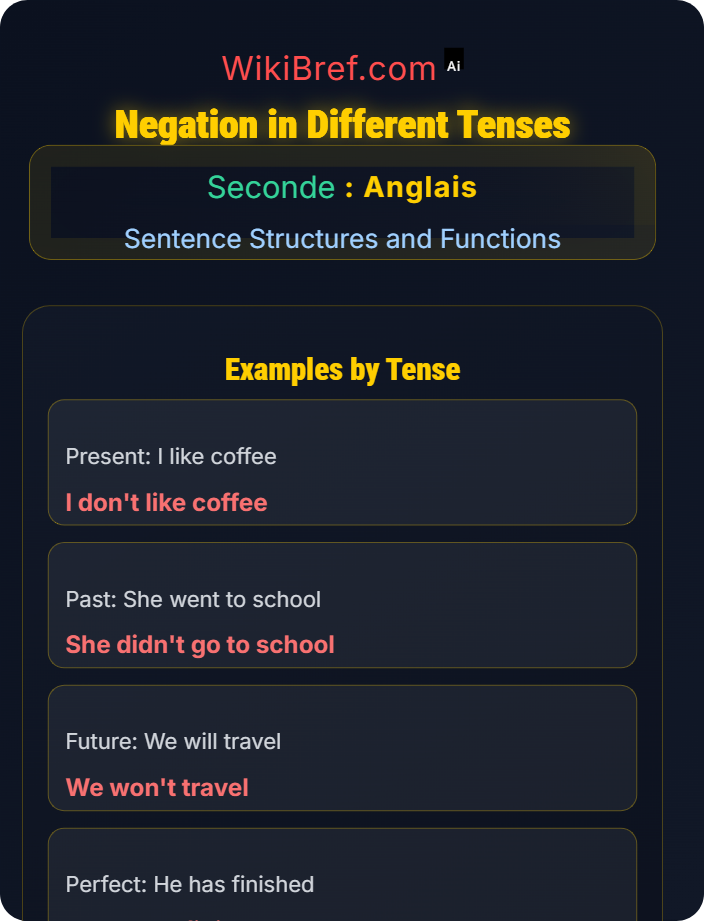
| Temps | Structure | Exemple |
|---|---|---|
| Present Simple | do/does + not | I don't eat / He doesn't eat |
| Past Simple | did + not | I didn't eat |
| Future Simple | will + not | I will not eat |
| Present Continuous | am/is/are + not | I am not eating |
| Past Continuous | was/were + not | I was not eating |
Présent simple : Utilise "do" ou "does" pour former la négation.
"She plays tennis" → Sujet: She, Verbe: plays (3e personne singulier)
3e personne singulier → "does"
"does not" ou "doesn't"
"play" (sans "s")
"She does not play tennis" ou "She doesn't play tennis"
She does not play tennis / She doesn't play tennis
• Structure : Subject + does/do + not + base verb
• Contraction : does not → doesn't
• Verbe : Toujours à l'infinitif dans la négation
Passé simple : Utilise "did" pour former la négation.
"They visited Paris" → Sujet: They, Verbe: visited (passé)
Toujours "did" pour le passé simple
"did not" ou "didn't"
"visit" (forme base)
"They did not visit Paris" ou "They didn't visit Paris"
They did not visit Paris / They didn't visit Paris
• Structure : Subject + did + not + base verb
• Contraction : did not → didn't
• Verbe : Toujours à l'infinitif dans la négation
Futur simple : Utilise "will" pour former la négation.
"He will come" → Sujet: He, Verbe: will come (futur)
"will" est déjà l'auxiliaire du futur
"will not" ou "won't"
"come" (déjà à l'infinitif)
"He will not come" ou "He won't come"
He will not come / He won't come
• Structure : Subject + will + not + base verb
• Contraction : will not → won't
• Verbe : Toujours à l'infinitif dans la négation
Présent continu : Utilise "am/is/are" pour former la négation.
"We are studying" → Sujet: We, Verbe: are studying (présent continu)
1ère personne pluriel → "are"
"are not" ou "aren't"
"studying" (participe présent)
"We are not studying" ou "We aren't studying"
We are not studying / We aren't studying
• Structure : Subject + am/is/are + not + -ing verb
• Contraction : are not → aren't
• Verbe : Toujours en "-ing" dans le continu
Passé continu : Utilise "was/were" pour former la négation.
"She was reading" → Sujet: She, Verbe: was reading (passé continu)
3e personne singulier → "was"
"was not" ou "wasn't"
"reading" (participe présent)
"She was not reading" ou "She wasn't reading"
She was not reading / She wasn't reading
• Structure : Subject + was/were + not + -ing verb
• Contraction : was not → wasn't
• Verbe : Toujours en "-ing" dans le continu
Présent parfait : Utilise "have/has" pour former la négation.
"I have finished" → Sujet: I, Verbe: have finished (présent parfait)
1ère personne singulier → "have"
"have not" ou "haven't"
"finished" (participe passé)
"I have not finished" ou "I haven't finished"
I have not finished / I haven't finished
• Structure : Subject + have/has + not + past participle
• Contraction : have not → haven't
• Verbe : Toujours au participe passé dans le parfait
Passé parfait : Utilise "had" pour former la négation.
"They had left" → Sujet: They, Verbe: had left (passé parfait)
Toujours "had" pour le passé parfait
"had not" ou "hadn't"
"left" (participe passé)
"They had not left" ou "They hadn't left"
They had not left / They hadn't left
• Structure : Subject + had + not + past participle
• Contraction : had not → hadn't
• Verbe : Toujours au participe passé dans le parfait
Conditionnel : Utilise "would" pour former la négation.
"He would help" → Sujet: He, Verbe: would help (conditionnel)
"would" est l'auxiliaire du conditionnel
"would not" ou "wouldn't"
"help" (déjà à l'infinitif)
"He would not help" ou "He wouldn't help"
He would not help / He wouldn't help
• Structure : Subject + would + not + base verb
• Contraction : would not → wouldn't
• Verbe : Toujours à l'infinitif dans le conditionnel
Subjonctif : Forme spéciale pour exprimer des souhaits, hypothèses.
"If I were rich" → Subjonctif de "be" au conditionnel
"were" devient "were not" ou "weren't"
"If I were not rich" ou "If I weren't rich"
Subjonctif de "be" = were (toutes personnes)
"were not" → "weren't" (contraction)
If I were not rich / If I weren't rich
• Subjonctif "be" : Toujours "were" (I, he, she, it)
• Négation : Ajouter "not" après le verbe
• Contraction : were not → weren't
Verbe "to be" : Négation directe sans auxiliaire supplémentaire.
"The books are interesting" → "are" est le verbe "to be"
Pluriel → "are"
"are not" ou "aren't"
"interesting" (adjectif)
"The books are not interesting" ou "The books aren't interesting"
The books are not interesting / The books aren't interesting
• Structure : Subject + am/is/are + not + complement
• Directe : Pas besoin d'auxiliaire supplémentaire
• Contraction : are not → aren't