Présent Simple & Continu
Présent Simple: I work / He works
Présent Continu: I am working
Présent Continu: I am working
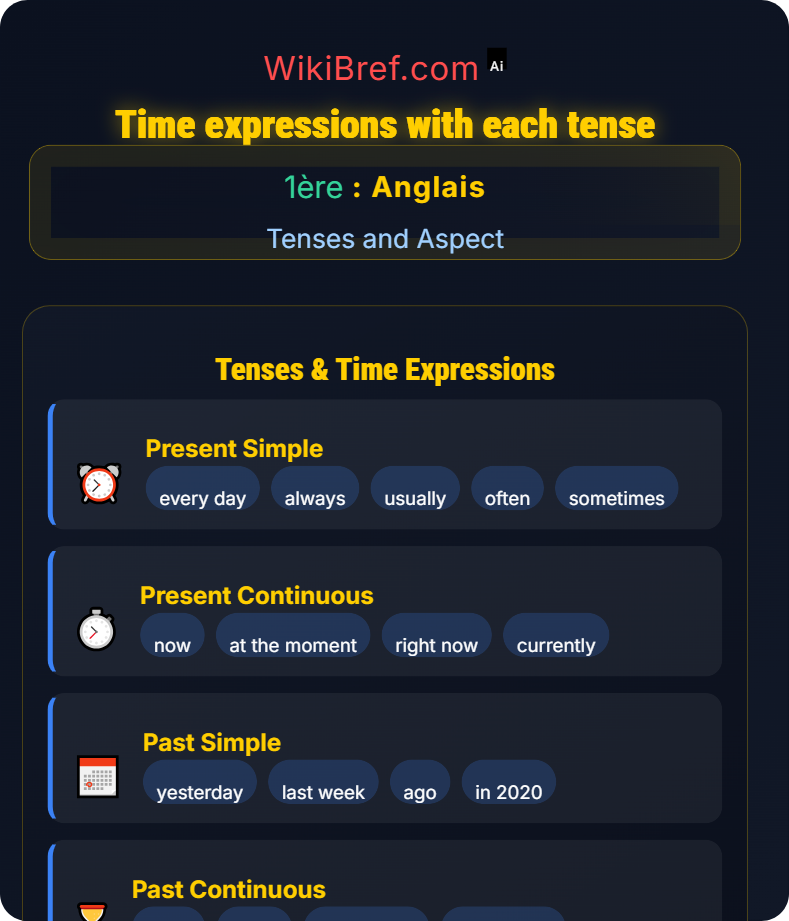
| Temps | Expressions |
|---|---|
| Présent Simple | every day, usually, often, always, never, sometimes |
| Présent Continu | now, at the moment, currently, right now |
Exemples Présent Simple:
I work every day.
She usually goes to school early.
They never eat meat.
She usually goes to school early.
They never eat meat.
Exemples Présent Continu:
I am reading now.
She is studying at the moment.
They are playing football currently.
She is studying at the moment.
They are playing football currently.
Passé Composé & Imparfait
Passé composé: yesterday, last week/month/year, ago
Imparfait: when I was young, used to, while, during
Passé composé = action achevée
Imparfait = action habituelle ou contexte
Exemples détaillés
Passé composé:
I went to Paris yesterday.
She bought a car last week.
We visited London three years ago.
She bought a car last week.
We visited London three years ago.
Imparfait:
I was playing when he arrived.
She used to read every evening.
They were studying while listening to music.
She used to read every evening.
They were studying while listening to music.
Futur Simple & Futur Continu
Futur Simple: tomorrow, next week/month/year, in + période
Futur Continu: at this time next week, this time tomorrow
Will + base verb pour le futur simple
Will be + -ing pour le futur continu
Futur continu = action en cours dans le futur
Règles et Formules
Futur Simple:
I will go tomorrow.
She will arrive next week.
They will finish in two hours.
She will arrive next week.
They will finish in two hours.
Futur Continu:
I will be studying at 8 PM.
She will be traveling this time next month.
They will be sleeping at midnight.
She will be traveling this time next month.
They will be sleeping at midnight.
Règles importantes:
1. Présent simple pour les vérités générales
2. Présent continu pour les actions en cours
3. Passé composé pour actions terminées
4. Imparfait pour habitudes passées
5. Futur pour événements futurs
2. Présent continu pour les actions en cours
3. Passé composé pour actions terminées
4. Imparfait pour habitudes passées
5. Futur pour événements futurs