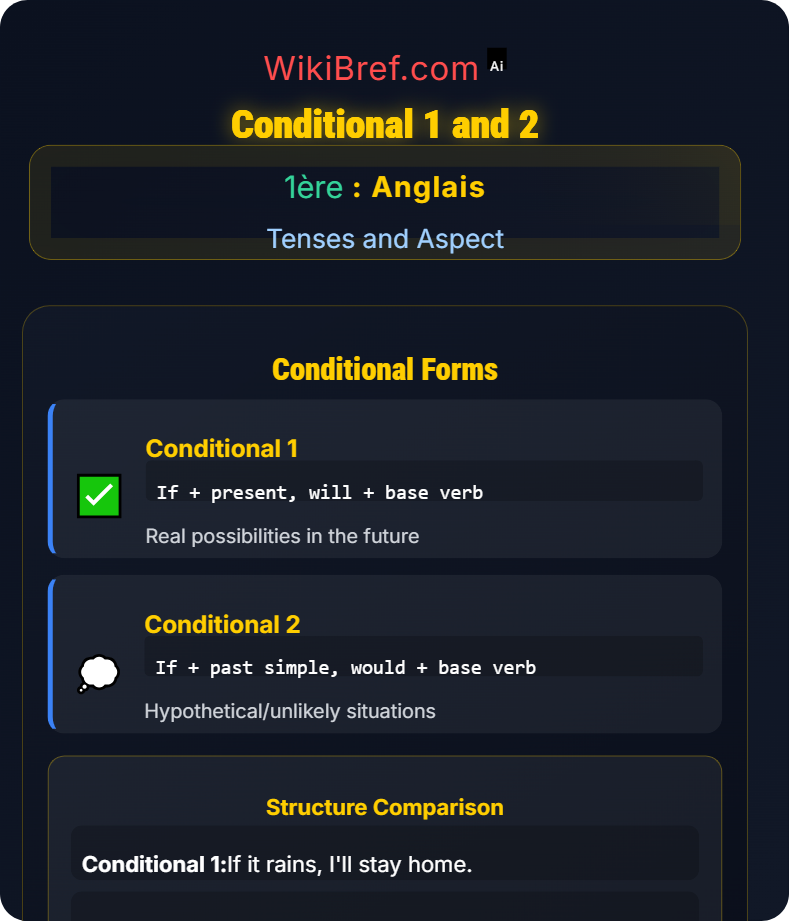
Conditional 1 (Réel)
If + present simple, will + base verb
If I study,
I will pass.
If I studied,
I would pass.
Situation possible
Réaliste
Futur probable
Cause et effet réels
Exemples C1:
If it rains, I will stay home.
If you study hard, you will succeed.
I'll call you if I finish early.
If you study hard, you will succeed.
I'll call you if I finish early.
Conditional 2 (Irréel)
Situation hypothétique
Improbable ou impossible
Souhaits, fantasmes
Formule: If + past simple, would + base verb
Contre-factuel
Formule
If + past simple, would + base verb
Exemples C2:
If I had money, I would travel.
If I were rich, I would buy a house.
I would help if I knew how.
If I were rich, I would buy a house.
I would help if I knew how.
Différences clés
Conditional 1:
Usage: Conditions réalistes
Temps: Présent/Futur
Probabilité: Élevée
Exemple: If I win the lottery, I will buy a car.
Temps: Présent/Futur
Probabilité: Élevée
Exemple: If I win the lottery, I will buy a car.
Conditional 2:
Usage: Conditions irréelles
Temps: Passé/Hypothétique
Probabilité: Faible/Impossible
Exemple: If I won the lottery, I would buy a mansion.
Temps: Passé/Hypothétique
Probabilité: Faible/Impossible
Exemple: If I won the lottery, I would buy a mansion.
Erreurs fréquentes
Erreur 1:
Mélanger les structures C1 et C2
Erreur 2:
Oublier "would" dans la principale de C2
Erreur 3:
Utiliser C2 pour des situations réalistes
Conseils de mémorisation
C1 = Réel/Probable, C2 = Irréel/Imaginaire
C1: If + pres, will + V; C2: If + past, would + V
Pratiquer avec des scénarios de vie