Définitions & Concepts Clés
Pluriel Régulier:
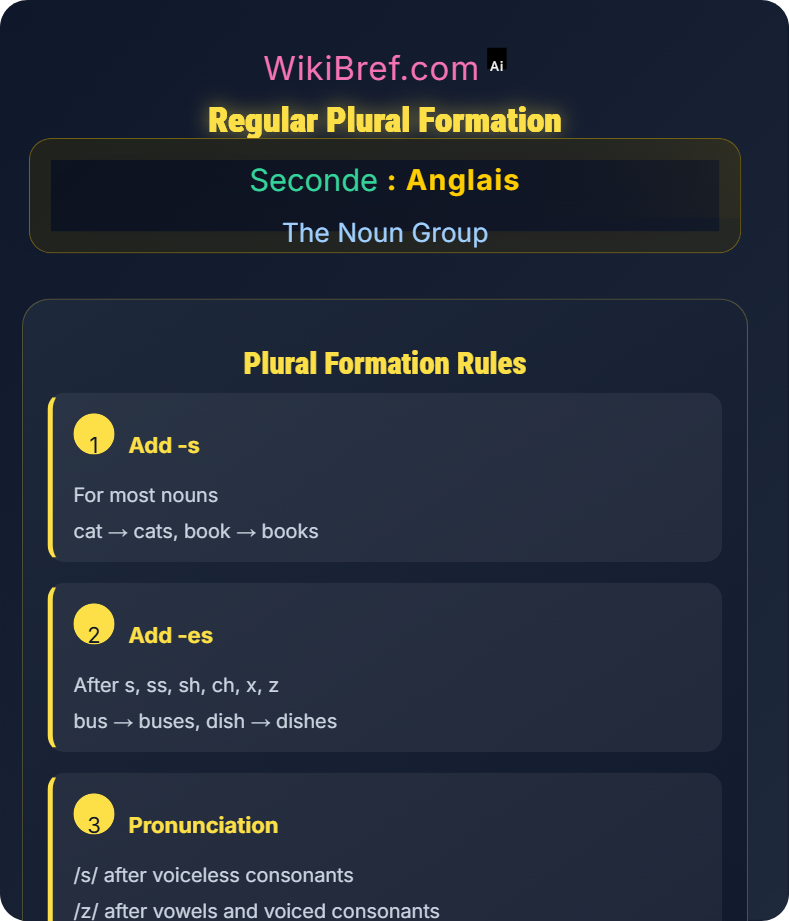
Forme plurielle obtenue en ajoutant -s ou -es au singulier.
Formation Standard:
Règles systématiques pour former le pluriel.
Formule de Base
Singulier + -s = Pluriel
Ex: book → books
Règles de Formation
book → books
cat → cats
dog → dogs
car → cars
Règles de Formation
+s: most nouns
+es: -s, -ss, -sh, -ch, -x, -o
-y → -ies: consonant+y
-f/fe → -ves: knife→knives
Cas Spéciaux
Terminaison -o:
piano → pianos
tomato → tomatoes
tomato → tomatoes
Terminaison -f/fe:
leaf → leaves
life → lives
life → lives
Exemples Pratiques
Standard +s:
book → books
chair → chairs
student → students
chair → chairs
student → students
+es terminaisons:
box → boxes
brush → brushes
watch → watches
brush → brushes
watch → watches
-y → -ies:
city → cities
baby → babies
story → stories
baby → babies
story → stories
-f/fe → -ves:
wolf → wolves
knife → knives
wife → wives
knife → knives
wife → wives
Prononciation
🔥 /s/: cats, books, hats
🎯 /z/: dogs, bags, girls
⚡ /ɪz/: boxes, churches, buses
Tableau de Formation
Type 1 (+s):
car → cars
tree → trees
door → doors
pen → pens
tree → trees
door → doors
pen → pens
Type 2 (+es):
bus → buses
dish → dishes
match → matches
potato → potatoes
dish → dishes
match → matches
potato → potatoes
Type 3 (-y → -ies):
city → cities
family → families
party → parties
baby → babies
family → families
party → parties
baby → babies
Type 4 (-f/fe → -ves):
leaf → leaves
thief → thieves
wife → wives
shelf → shelves
thief → thieves
wife → wives
shelf → shelves
Conseils & Astuces
Most +s
Check endings
Consonant + y → ies
Practice pronunciation
Memorize irregulars
Erreurs Fréquentes
Erreur 1:
Omitting -es for special endings
Erreur 2:
Changing -y to -ies for vowel+y
Erreur 3:
Not changing -f to -ves
Erreur 4:
Adding -es to all -o words