Définitions
Stative Verbs ≠ Action Verbs
Différence fondamentale en anglais
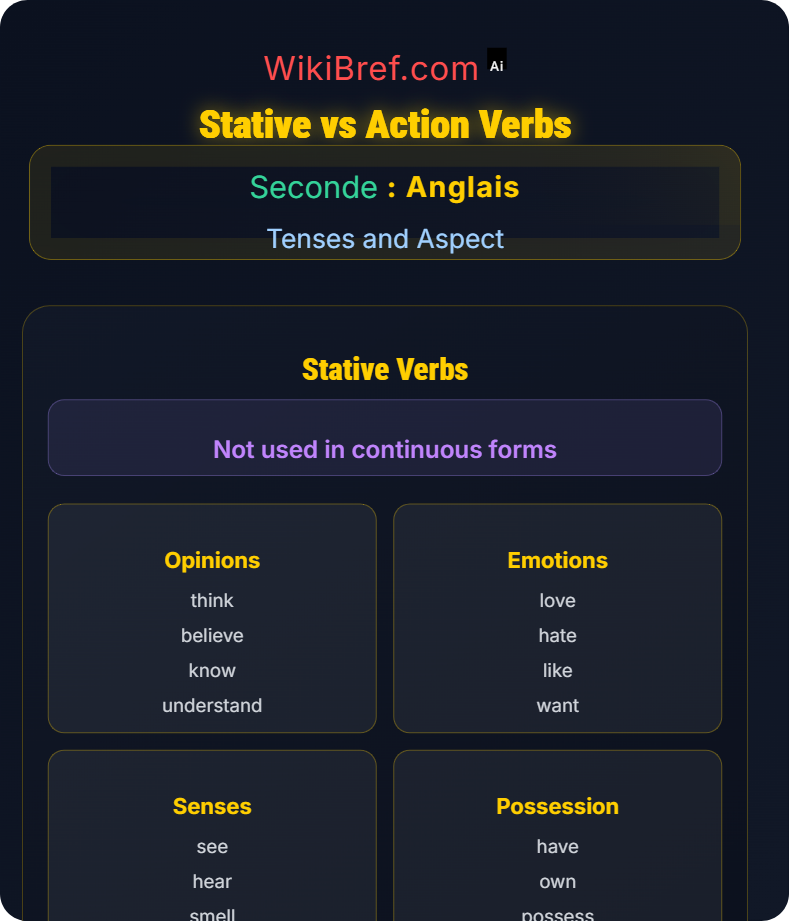
Verbes Statifs :
• Expriment un état, une condition
• Ne peuvent pas être utilisés au Present Continuous
• Ex: know, love, hate, have (possession)
• Expriment un état, une condition
• Ne peuvent pas être utilisés au Present Continuous
• Ex: know, love, hate, have (possession)
Verbes d'Action :
• Expriment une action physique ou mentale
• Peuvent être utilisés au Present Continuous
• Ex: run, eat, think (réfléchir), play
• Expriment une action physique ou mentale
• Peuvent être utilisés au Present Continuous
• Ex: run, eat, think (réfléchir), play
Statifs
I know him
She loves music
We have a car
I know him
She loves music
We have a car
Action
I am running
She is eating
We are playing
I am running
She is eating
We are playing
Catégories de Verbes Statifs
Pensée: know, believe, understand
Émotions: love, hate, like, want
Perception: see, hear, smell, taste
Possession: have, own, belong
Jugement: seem, appear, consider
Etat: be, exist, consist
Exemples de phrases incorrectes
❌ Erreur commune :
• I am knowing the answer
• She is having a car
• They are seeing a movie
• She is having a car
• They are seeing a movie
✅ Correction :
• I know the answer
• She has a car
• They are watching a movie
• She has a car
• They are watching a movie
Catégories de Verbes d'Action
Physique: run, walk, jump, swim
Communication: speak, write, read, listen
Action mentale: think (réfléchir), plan, decide
Loisirs: play, dance, sing, paint
Mouvement: move, drive, fly, climb
Travail: work, build, cook, teach
Cas Particuliers
Think (statif vs action) :
• I think he's right (opinion - statif)
• I am thinking about the problem (réfléchir - action)
• I am thinking about the problem (réfléchir - action)
Have (statif vs action) :
• I have a car (possession - statif)
• I am having lunch (expérience - action)
• I am having lunch (expérience - action)
See (statif vs action) :
• I see the mountain (perception - statif)
• I am seeing my doctor (rencontrer - action)
• I am seeing my doctor (rencontrer - action)
Conseils & Astuces
Verbes statifs ≠ Present Continuous
Attention aux cas ambigus
Verbes d'action = Present Continuous
Pratiquez avec des exemples concrets
Certains verbes changent de sens