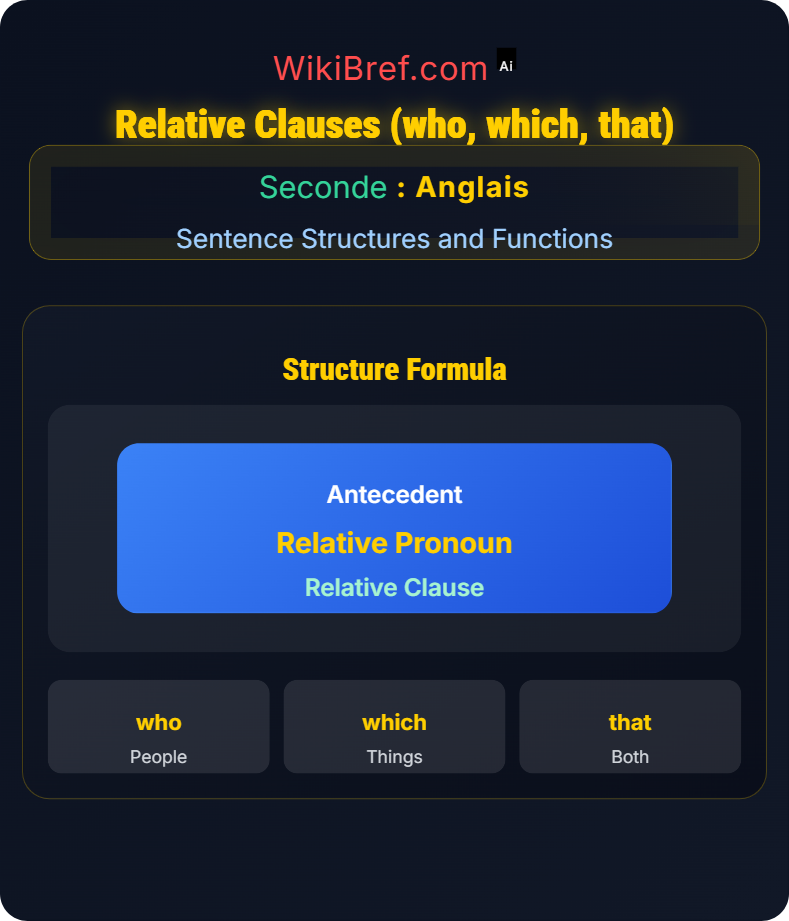
Définition & Structure
Relative Clause: Antecedent + Relative Pronoun + Clause
(Provides additional information about the noun)
(Provides additional information about the noun)
Structure de base:
The man who lives next door
The book which I bought yesterday
The car that is red
The book which I bought yesterday
The car that is red
Fonction:
Donner des détails sur un nom
Connecter deux phrases
Éviter la répétition
Connecter deux phrases
Éviter la répétition
Règles fondamentales
Who: personnes
Which: objets/choses
That: personnes/objets
Relie la subordonnée au nom
Types de relative clauses
Defining: essentielle à la compréhension
Non-defining: information supplémentaire
Restrictive: précise le nom
Non-restrictive: parenthèse
Différenciation des pronoms
Who (personnes):
The woman who teaches us
The student who is absent
The student who is absent
Which (choses):
The house which is old
The book which I read
The book which I read
That (tout):
The car that is expensive
The person that helped me
The person that helped me
Conseils & Astuces
Identifiez le nom à modifier
Choisissez le pronom selon le type de nom
That peut remplacer who/which
Non-defining: virgules de chaque côté
Pratiquez avec des phrases simples d'abord
Exemples de pratique
Exercice 1:
Combine: "The girl is tall" + "The girl is my friend" → "The girl who is tall is my friend"
Exercice 2:
Choisissez: "The book ___ I bought is interesting" → "which" ou "that"
Exercice 3:
Identifiez: "The man who called me" → "who" = relative pronoun