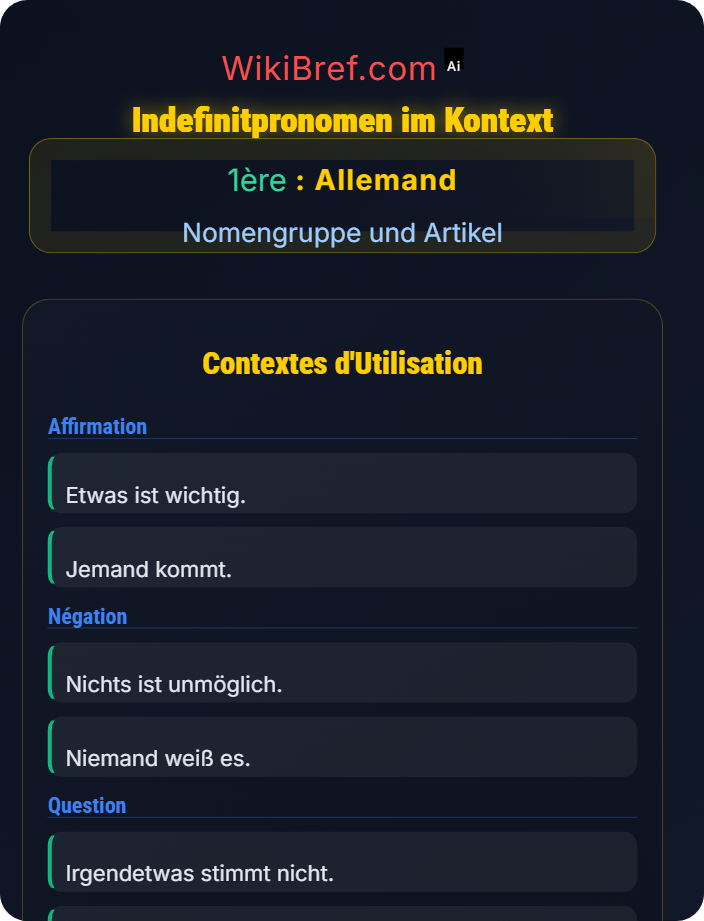
Indefinitpronomen : Les pronoms indéfinis expriment une personne ou une chose indéterminée. Dans cette phrase, le pronom est sujet du verbe.
| Cas | jemand | niemand | etwas | nichts |
|---|---|---|---|---|
| Nominativ | jemand | niemand | etwas | nichts |
| Akkusativ | jemanden | niemanden | etwas | nichts |
| Dativ | jemandem | niemandem | etwas | nichts |
- Identifiez le verbe et sa structure
- Déterminez la fonction du pronom dans la phrase
- Sélectionnez le pronom approprié selon le sens
- Appliquez la déclinaison correcte
"___ hat angerufen" - "hat" est le verbe au présent parfait
Le pronom est sujet de "hat angerufen" → Nominativ
"Quelqu'un a téléphoné" → "jemand" (personne indéterminée)
Nominativ pour sujet = "jemand"
"Jemand hat angerufen" - accord correct
"Jemand hat angerufen."
• Sujet : Toujours au Nominativ
• jemand : Pour une personne indéterminée
• Verbe : "hat angerufen" requiert un sujet
Objet direct : Lorsque le pronom indéfini est objet direct, il prend l'Akkusativ.
"Ich habe ___ gehört" - "habe gehört" est le verbe à l'accompli
"___ gehört" - le pronom est objet de "hören" → Akkusativ
"J'ai entendu quelque chose" → "etwas" (chose indéterminée)
Akkusativ pour objet direct = "etwas"
"Ich habe etwas gehört" - accord correct
"Ich habe etwas gehört."
• Verbe transitif : "hören" prend un objet direct
• Akkusativ : Pour l'objet direct
• etwas : Pour une chose indéterminée
Verbe Dativ : Le verbe "helfen" prend un objet indirect (Dativ).
"helfen" signifie "aider" et prend le Dativ
"Kannst du ___ helfen?" - "du" est le sujet, "helfen" le verbe
"helfen" prend le Dativ → l'objet est au Dativ
"aider quelqu'un" → "jemandem" (personne indéterminée)
Dativ pour objet indirect = "jemandem"
"Kannst du jemandem helfen?"
• Verbes Dativ : "helfen" prend le Dativ
• Dativ : Pour les objets indirects
• jemandem : Pour une personne indéterminée au Dativ
Sujet indéterminé : Lorsque le pronom est sujet d'un verbe, il est au Nominativ.
"___ ist wichtig" - "ist" est le verbe d'état
"___ ist" - le pronom est sujet de "sein" → Nominativ
"Quelque chose est important" → "etwas" (chose indéterminée)
Nominativ pour sujet = "etwas"
"Etwas ist wichtig" - accord correct
"Etwas ist wichtig."
• Sujet : Toujours au Nominativ
• etwas : Pour une chose indéterminée
• Verbe d'état : "sein" avec sujet
Infinitive Construction : L'objet de "brauchen" est au Akkusativ.
"Ich brauche ___ zu essen" - "brauche" est le verbe principal
"Ich brauche ___" - le pronom est objet de "brauchen" → Akkusativ
"J'ai besoin de quelque chose à manger" → "etwas" (chose indéterminée)
Akkusativ pour objet direct = "etwas"
"Ich brauche etwas zu essen" - accord correct
"Ich brauche etwas zu essen."
• Verbe transitif : "brauchen" prend un objet direct
• Akkusativ : Pour l'objet direct
• etwas : Pour une chose indéterminée
Tableau complet des déclinaisons des pronoms indéfinis.
| Cas | jemand- | niemand- | etwas- | nichts- |
|---|---|---|---|---|
| Nominativ | jemand | niemand | etwas | nichts |
| Akkusativ | jemanden | niemanden | etwas | nichts |
| Dativ | jemandem | niemandem | etwas | nichts |
Comment distinguer les différents pronoms indéfinis.
| Forme | Sens | Usage | Exemple |
|---|---|---|---|
| jemand- | quelqu'un | Personne indéterminée | Jemand kommt |
| niemand- | personne | Négation totale | Niemand weiß es |
| etwas- | quelque chose | Chose indéterminée | Etwas ist kaputt |
| nichts- | rien | Absence totale | Nichts ist wichtig |