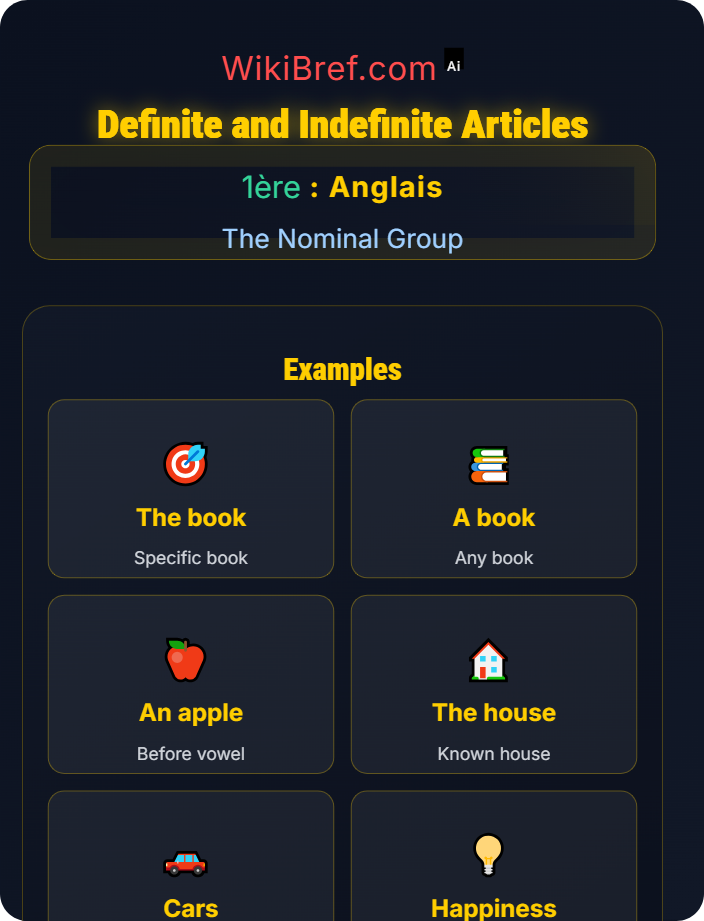
Articles: Words that define a noun as specific (the) or unspecific (a/an).
Determine if the noun refers to something specific or general in the context.
Use "the" for specific items, "a/an" for general items.
Use "an" before vowel sounds (a, e, i, o, u), "a" before consonant sounds.
"I saw _____ eagle yesterday" → "an eagle" because it's general and "eagle" starts with vowel sound.
If the noun was previously mentioned or is known to both speaker and listener, use "the".
Correct article selection depends on specificity, context, and pronunciation rules. Always consider whether the noun is specific (the) or general (a/an).
• Specificity: "The" indicates specific, known nouns
• Generality: "A/An" indicates general, unknown nouns
• Vowel Sound: Use "an" before vowel sounds regardless of spelling
Definite vs Indefinite: "The" is definite, "a/an" is indefinite.
Find "the", "a", or "an" in the sentence.
Determine if the noun refers to something previously mentioned or generally known.
Is the noun referring to a specific item or a general example?
"The" = definite; "A/An" = indefinite.
Definite articles ("the") refer to specific, known nouns. Indefinite articles ("a/an") refer to general, unknown nouns. Context determines classification.
• Definite: "The" indicates specific, identifiable nouns
• Indefinite: "A/An" indicates general, non-specific nouns
• Context: Previous mention makes nouns definite
Article Mistakes: Incorrect use of "the", "a", or "an" based on context.
Identify the noun and its surrounding context.
Is the noun specific (requires "the") or general (requires "a/an")?
For "a/an", ensure correct choice based on sound, not spelling.
Replace incorrect article with correct one.
Common mistakes include using "the" for general statements and "a/an" for specific references. Always verify definiteness and vowel sound rules.
• Sound Rule: "An" before vowel sounds, "a" before consonant sounds
• Specificity: Match article definiteness to noun specificity
• Context: Previous mention makes nouns definite
Definite Article "The": Used when referring to specific, known, or unique nouns.
When the speaker and listener know exactly which item is being discussed.
After a noun has been introduced with "a/an", subsequent mentions use "the".
With unique items like "the sun", "the moon", "the Eiffel Tower".
With superlative adjectives: "the tallest", "the fastest".
With ordinal numbers: "the first", "the second".
We use "the" for specific, known, unique, or previously mentioned nouns, with superlatives and ordinal numbers. It indicates definiteness and shared knowledge between speakers.
• Specificity: "The" indicates specific, identifiable nouns
• Previous Mention: First mention uses "a/an", later mentions use "the"
• Uniqueness: Unique items always take "the"
Original Sentences: Examples demonstrating proper article usage in context.
Use "a/an" to introduce new, general concepts: "I saw a bird in the garden."
Use "the" for known or specific items: "The bird flew away quickly."
Practice "an" with vowel sounds: "She is an honest person."
Use "the" with unique items: "The Earth orbits the Sun."
Effective original sentences demonstrate proper article usage in natural contexts, showing the difference between specific ("the") and general ("a/an") references.
• Context: Match article definiteness to noun specificity
• Natural Use: Create sentences that reflect real language use
• Variety: Include different contexts (general, specific, unique)