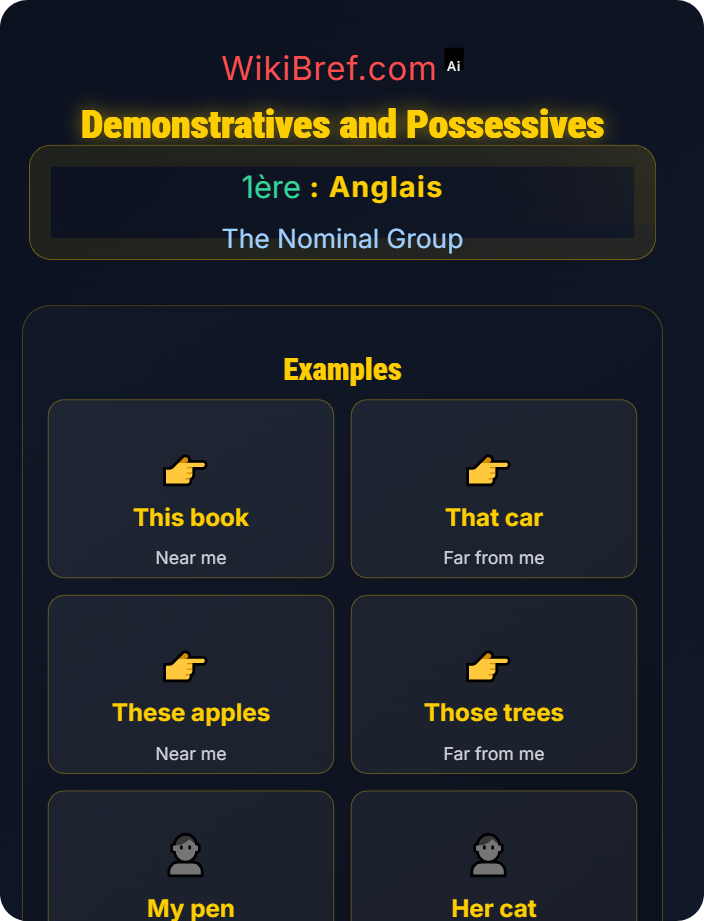
Demonstratives: Words that point to specific nouns based on proximity.
Determine if the noun is near ("this/these") or far ("that/those").
Use "this/that" for singular, "these/those" for plural.
"_____ book is interesting" → If the book is near: "This book is interesting".
Ensure the demonstrative matches the spatial relationship described.
Select the demonstrative that correctly points to the intended noun.
Correct demonstrative choice depends on physical proximity and number of the noun. "This/these" for near objects, "that/those" for distant ones.
• Proximity: "This/These" = near, "That/Those" = far
• Number: "This/That" = singular, "These/Those" = plural
• Context: Physical location determines demonstrative choice
Possessive Adjectives: Words showing ownership relationships (my, your, his, her, its, our, their).
Determine who possesses the noun in the sentence.
Match possessive to corresponding subject pronoun (I → my, you → your, he → his).
Some possessives vary by gender (his/her), others by number (our/their).
"______ car is red" → If speaker owns it: "My car is red".
Possessive adjectives must agree with the possessor, not the possessed noun. They show ownership without requiring articles.
• Agreement: Possessives agree with the possessor, not the possessed
• No Articles: Possessives don't require articles (not "the my book")
• Relationship: Show ownership relationship between subject and object
Classification: Distinguishing between pointing words and ownership words.
Look at the specific word in question: "this", "my", "those", "her", etc.
Is it pointing to something or showing ownership?
Demonstratives: this, that, these, those. Possessives: my, your, his, her, its, our, their.
Confirm the function matches the intended meaning in the sentence.
Demonstratives point to specific nouns based on proximity. Possessives show ownership relationships. Context determines classification.
• Function: Demonstratives = pointing, Possessives = ownership
• Words: Demonstratives: this/that/these/those; Possessives: my/your/his/etc.
• Context: Sentence context clarifies the function of the word
Key Difference: Demonstratives point to nouns, possessives indicate ownership.
Demonstratives point to specific nouns based on physical or conceptual proximity.
Possessives show ownership or relationship between the subject and the noun.
Demonstratives = identification/pointing; Possessives = ownership/relation.
"This book is mine" - "This" points to specific book, "mine" shows ownership.
Demonstratives identify location/proximity, possessives establish possession.
Demonstratives point to specific nouns based on proximity (this/that/these/those). Possessives show ownership relationships (my/your/his/her). Demonstratives focus on identification, possessives on possession.
• Function: Demonstratives identify, possessives possess
• Meaning: Demonstratives = location/proximity, Possessives = ownership
• Usage: Both can appear in same sentence with different functions
Original Sentences: Examples demonstrating proper demonstrative and possessive usage.
Use "this/that/these/those" to point to specific items: "This apple is red."
Include "my/your/his/her" to show ownership: "My car is blue."
Create sentence with both: "This is my book, and that is her pen."
Use different situations: spatial, temporal, abstract references.
Effective original sentences demonstrate both demonstrative and possessive usage in natural contexts, showing the distinct functions of each type of determiner.
• Context: Match demonstratives to actual proximity in examples
• Natural Use: Create sentences reflecting real language use
• Distinction: Clearly show the different functions of each type