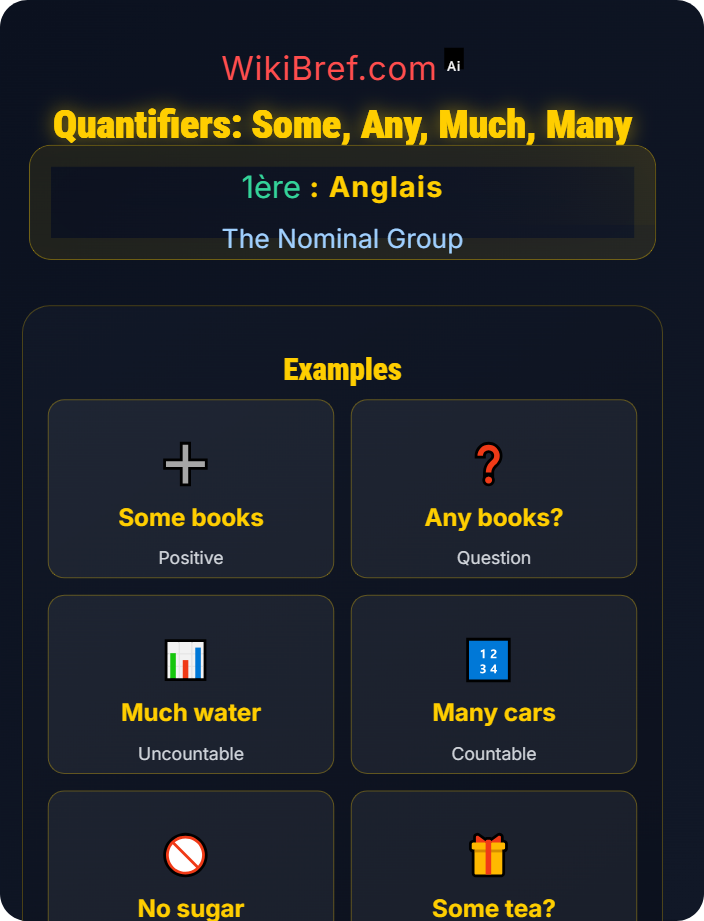
Quantifiers: Words expressing quantity of nouns (some, any, much, many).
Determine if the noun is countable (apples, books) or uncountable (water, time).
Positive sentence → use some; Negative/Question → use any.
Many for countable nouns, much for uncountable nouns.
Ensure the quantifier fits the intended meaning.
Select the quantifier that correctly expresses the quantity.
Quantifier choice depends on noun type (countable/uncountable) and sentence type (positive/negative/question). Remember: many + countable, much + uncountable.
• Noun Type: Countable nouns use many/some/any, uncountable use much/some/any
• Sentence Type: Positive sentences use some, negative/questions use any
• Context: Consider the intended meaning and quantity expression
Completion: Filling gaps with appropriate quantifiers based on context.
Identify the noun and its position in the sentence.
Check if the noun following the gap is countable or uncountable.
Identify if it's a positive, negative, or interrogative sentence.
Use the appropriate quantifier based on noun type and sentence type.
Successful completion requires understanding both the grammatical rules and contextual meaning of each sentence.
• Analysis: Examine sentence structure and noun type
• Context: Consider the meaning and intent of the sentence
• Rules: Apply quantifier rules systematically
Classification: Distinguishing between countable and uncountable nouns.
Look at the specific word in question: "water", "books", "time", etc.
Can you count the noun? Can it be made plural? Does it accept "a/an"?
Food items, liquids, abstract concepts are often uncountable.
Countable nouns work with "many", uncountable with "much".
Countable nouns can be counted and made plural (books, cars). Uncountable nouns cannot be counted directly (water, time, advice).
• Countability: Can the noun be counted? Can it be pluralized?
• Articles: Countable nouns accept "a/an", uncountable do not
• Quantifiers: Countable with many/few, uncountable with much/little
Usage Context: Different situations where some and any are appropriate.
"Some" is typically used in positive sentences: "I have some money."
"Any" is used in negative sentences: "I don't have any money."
"Any" is used in questions: "Do you have any money?"
"Some" can be used in questions when offering or requesting: "Would you like some tea?"
Consider the speaker's expectation and tone in the sentence.
"Some" is used in positive sentences and polite offers/requests. "Any" is used in negative sentences and most questions. Context and expectation determine usage.
• Sentence Type: Positive = some, Negative/Questions = any
• Offers/Requests: Use some in questions when offering or requesting
• Expectation: Consider speaker's expectation in context
Original Sentences: Examples demonstrating proper quantifier usage in context.
Use "some" with countable/uncountable in positive context: "I bought some apples."
Use "any" in negative context: "I didn't buy any apples."
Use "any" in questions: "Did you buy any apples?"
Use "some" in polite offers: "Would you like some coffee?"
Effective original sentences demonstrate proper quantifier usage across different sentence types and contexts, showing the distinction between countable and uncountable nouns.
• Context: Match quantifier to sentence type (positive/negative/question)
• Natural Use: Create sentences reflecting real language use
• Distinction: Clearly show countable vs uncountable noun usage