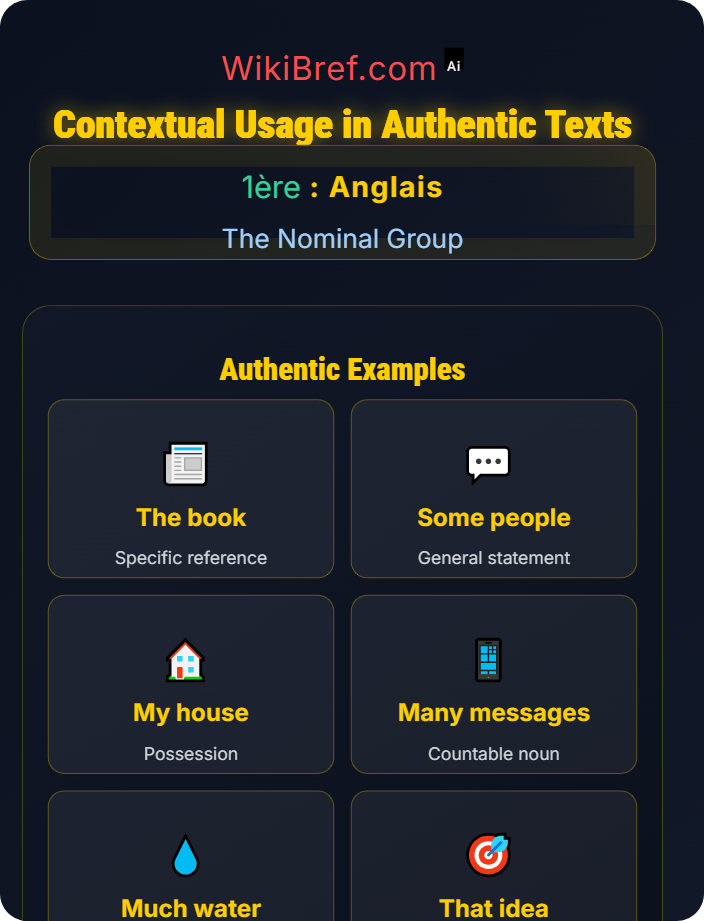
Determiners: Words that specify or quantify nouns based on context.
Understand the overall context and topic before analyzing individual determiners.
Look for initial introductions of people, places, or things.
Note how previously mentioned items are referred to later.
Determine why "the" or "a/an" was chosen based on context.
Assess what readers are expected to know about the subjects.
In newspaper articles, determiner usage reflects the writer's assumption about reader knowledge. First mentions typically use indefinite articles, while subsequent references use definite articles.
• First Mention: Generally uses indefinite articles (a/an)
• Subsequent References: Uses definite articles (the)
• Shared Knowledge: Assumes reader familiarity with certain topics
Quantifiers: Words expressing quantity of nouns (some, any, much, many).
Determine if nouns are countable or uncountable in the context.
Positive, negative, or question sentences influence quantifier choice.
Consider whether the author wants to emphasize quantity or make general statements.
Look at how quantifiers relate to the magazine's target audience and purpose.
Magazine texts often use quantifiers strategically to engage readers. "A lot of" and "plenty of" emphasize abundance, while "few" and "little" create scarcity effects.
• Noun Type: Countable nouns use many/few, uncountable use much/little
• Engagement: Magazines often use quantifiers for emphasis
• Target Audience: Consider reader expectations and interests
Definite vs Indefinite: Distinction based on whether the noun is specific or general.
First-person narratives may use different determiners than third-person.
Note how characters are first introduced versus later references.
Determine if locations are familiar to characters or newly discovered.
How determiner usage changes as the narrative develops.
In stories, definite articles often indicate familiar or important elements, while indefinite articles introduce new elements. Narrative development influences the shift from indefinite to definite usage.
• Introduction: New elements use indefinite articles
• Familiarity: Previously established elements use definite articles
• Narrative Progression: Shifts from indefinite to definite as story develops
Author Intent: Understanding why writers choose specific determiners in context.
Authors consider what readers already know about the topic.
Determiners can create formality, intimacy, or emphasis.
Different text types follow specific determiner usage patterns.
Authors control what information is presented as known vs. new.
Writers assume shared cultural knowledge affects determiner choice.
Authors choose determiners based on audience knowledge, stylistic goals, genre requirements, and cultural assumptions. These choices guide reader understanding and create intended effects.
• Audience Awareness: Authors consider reader knowledge levels
• Stylistic Choice: Determiners contribute to tone and style
• Information Control: Guide reader attention and understanding
Authentic Creation: Writing passages that demonstrate natural determiner and quantifier usage.
Create a clear scenario or situation for the passage.
Use indefinite articles for new elements, definite for established ones.
Match quantifiers to noun types and sentence purposes.
Make reasonable assumptions about what readers know.
Effective authentic passages demonstrate natural determiner and quantifier usage by following logical progression from new to established information while considering reader expectations.
• Logical Flow: Progress from indefinite to definite usage
• Reader Expectations: Make reasonable assumptions about knowledge
• Natural Language: Reflect real-world usage patterns