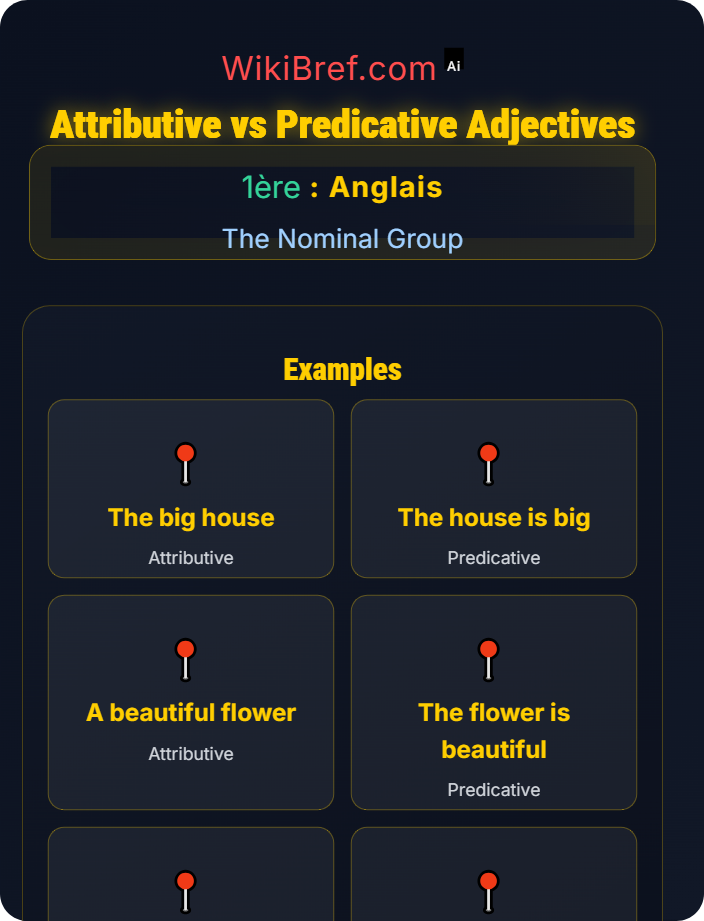
Attributive Adjective: Comes directly before the noun it modifies.
Find the adjective in the sentence.
Find the noun the adjective is describing.
Is the adjective before the noun (attributive) or after a linking verb (predicative)?
Look for verbs like "is", "are", "was", "were", "seems", "becomes".
Determine if it's attributive or predicative based on position.
Attributive adjectives appear before the noun they modify (the happy child), while predicative adjectives appear after linking verbs (the child is happy).
• Position: Attributive = before noun, Predicative = after linking verb
• Linking Verbs: Identify "is", "are", "seems", "becomes" as indicators of predicative use
• Function: Both types describe nouns but in different positions
Conversion: Changing adjective position while maintaining meaning.
Determine if the adjective is currently attributive or predicative.
Move the adjective to the opposite position while preserving meaning.
Include linking verbs when converting to predicative form.
Ensure the converted sentence remains grammatically correct.
Converting between forms involves changing the adjective position and adjusting linking verbs accordingly: "the tall man" becomes "the man is tall".
• Restructuring: Move adjective to appropriate position
• Linking Verbs: Add/remove as needed for predicative/attributive forms
• Meaning Preservation: Maintain the descriptive function of the adjective
Linking Verbs: Verbs that connect the subject to a predicative adjective.
Find the adjective that appears after the main verb.
Determine which verb comes before the adjective.
Verify if it's a linking verb (is, are, seems, becomes, etc.).
Ensure the verb connects the subject to the adjective.
Linking verbs connect the subject to predicative adjectives. Common linking verbs include "is", "are", "was", "were", "seems", "appears", "becomes", "feels", "looks".
• Identification: Linking verbs connect subject to adjective
• Common Types: "is", "are", "seems", "becomes", "appears"
• Function: Acts as bridge between subject and description
Predicative-only Adjectives: Adjectives that can only appear after linking verbs.
Examples: "afraid", "alive", "aware", "asleep", "alone".
These adjectives describe states that are temporary or subjective.
They cannot precede nouns due to their inherent meaning.
Correct: "He is afraid" - Incorrect: "the afraid man".
Learn which adjectives are restricted to predicative use.
Some adjectives like "afraid", "alive", "aware", "asleep" can only be used predicatively because they describe temporary states or subjective conditions that cannot precede nouns.
• Restriction: Some adjectives can only be used predicatively
• Reason: Temporary states or subjective conditions
• Examples: afraid, alive, aware, asleep, alone, awake
Combined Sentences: Examples using both attributive and predicative adjectives.
Create a sentence with an adjective before a noun: "The beautiful garden".
Include a linking verb with an adjective: "The garden is beautiful".
Use both forms in the same sentence: "The beautiful garden is beautiful".
Use different adjectives to demonstrate the concept clearly.
Effective sentences demonstrate both attributive and predicative usage, showing how the same adjective can function differently based on its position in the sentence.
• Integration: Combine both forms naturally in sentences
• Position: Maintain correct positions for each form
• Meaning: Ensure both forms contribute to overall sentence meaning