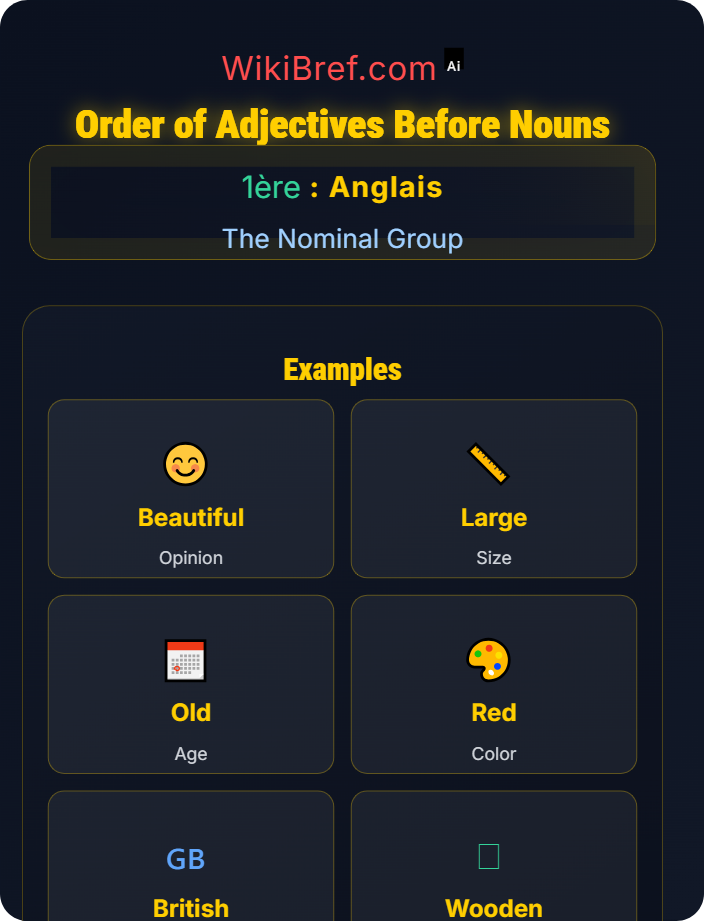
Adjective Order: The sequence OSASCOMP (Opinion-Size-Age-Shape-Color-Origin-Material-Purpose).
List all adjectives that describe the noun.
Determine which category each adjective belongs to (opinion, size, age, etc.).
Arrange adjectives according to the established order.
Ensure no two adjectives from the same category are adjacent.
Combine the ordered adjectives with the noun.
Correct order follows OSASCOMP sequence: "a beautiful small old round red French wooden cooking pot" demonstrates the proper sequence of adjective categories.
• Sequence: Follow OSASCOMP order consistently
• Categorization: Properly identify each adjective's category
• Spacing: Use commas between adjectives when necessary
Categories: Each adjective belongs to one of the eight categories in the order system.
Separate each adjective in the sequence.
Determine what aspect of the noun each adjective describes.
Assign each adjective to its appropriate category.
Check if the current order matches OSASCOMP.
Each adjective must be categorized correctly to determine proper placement: opinion (beautiful), size (small), age (old), shape (round), color (red), origin (French), material (wooden), purpose (cooking).
• Classification: Each adjective fits into one specific category
• Analysis: Consider the adjective's descriptive function
• Verification: Cross-check with established categories
Correction: Rearranging adjectives to follow the proper sequence.
Recognize when adjectives are out of sequence.
Determine the category for each adjective in the sequence.
Reorganize adjectives according to OSASCOMP.
Ensure the corrected sequence sounds natural and follows rules.
Correction involves identifying misplaced adjectives and reordering them according to the OSASCOMP sequence, ensuring the resulting phrase sounds natural.
• Error Recognition: Identify when adjectives are out of sequence
• Reorganization: Apply OSASCOMP sequence to reorder
• Naturalness: Ensure corrected sequence sounds natural
Natural Order: Adjective sequences that follow cognitive processing patterns.
We process subjective information before objective details.
Opinions come first, specific physical attributes come last.
The order creates natural speech patterns and flow.
English speakers expect this sequence from early exposure.
Some fixed expressions may break the pattern.
Natural orders follow cognitive patterns (subjective to objective) and create fluent speech, while unnatural orders disrupt these patterns and sound awkward to native speakers.
• Cognitive Pattern: Subjective information precedes objective
• Linguistic Flow: Creates natural speech rhythm
• Cultural Expectation: Native speakers expect this sequence
Original Creation: Forming sentences with properly ordered multiple adjectives.
Select a noun to be described by multiple adjectives.
Pick adjectives representing different aspects of the noun.
Arrange the adjectives according to the established sequence.
Combine adjectives and noun into a coherent phrase.
Effective original sentences demonstrate proper adjective ordering by following the OSASCOMP sequence while maintaining natural-sounding, meaningful phrases.
• Selection: Choose adjectives from different categories
• Order: Follow OSASCOMP sequence consistently
• Naturalness: Ensure resulting phrase sounds natural