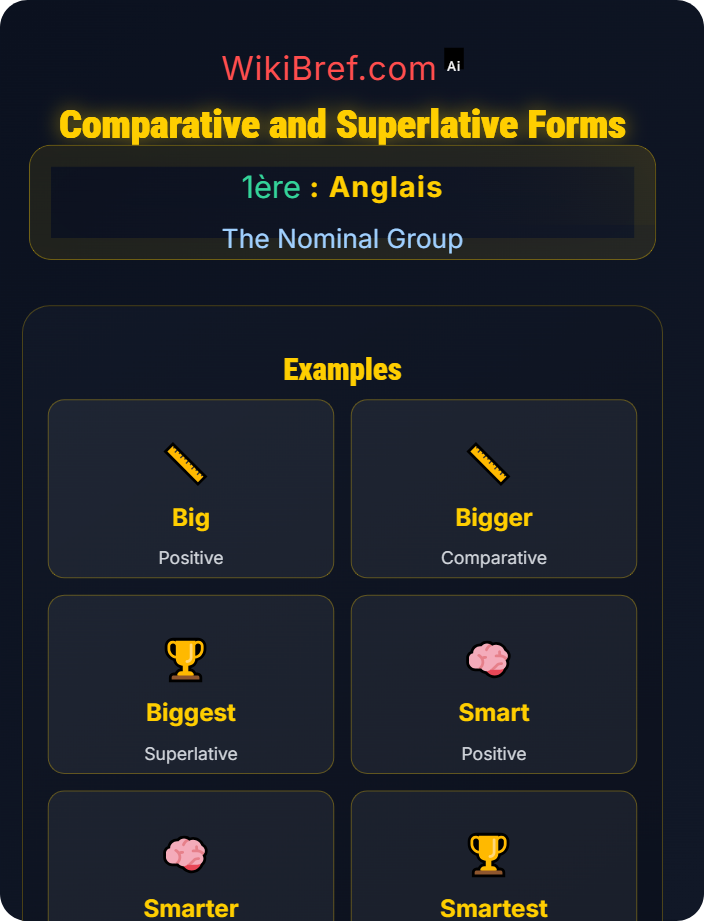
Comparison Forms: Ways to express degrees of comparison (more than, most of all).
Determine if the adjective has one, two, or three+ syllables.
One-two syllables: add -er/-est; Three+ syllables: use more/most.
Double consonants, change 'y' to 'i', etc.
Verify if the adjective has irregular comparative/superlative forms.
Create positive, comparative, and superlative forms together.
Regular conversion follows syllable-based rules: "tall" → "taller" → "tallest", "beautiful" → "more beautiful" → "most beautiful". Irregular forms must be memorized.
• Syllable Count: One-two syllables use -er/-est, three+ use more/most
• Special Endings: Apply doubling and 'y' to 'i' rules
• Irregular Forms: Memorize exceptions like good/better/best
Contextual Usage: Using comparative or superlative forms appropriately based on context.
Two items = comparative, three or more = superlative.
Look for "than" (comparative) or "the" before adjective (superlative).
Ensure the form matches the number of items being compared.
Superlatives typically include "the" before the adjective.
Correct usage depends on the number of items being compared: "John is taller than Mike" (two people), "Mary is the tallest in the class" (multiple people).
• Item Count: Two items = comparative, three+ = superlative
• Markers: "Than" indicates comparative, "the" often indicates superlative
• Context: Consider the comparison being made
Error Correction: Identifying and fixing incorrect comparative/superlative forms.
Spot incorrect form usage (e.g., "more tall" instead of "taller").
Determine syllable count and proper formation method.
Use appropriate comparative or superlative form.
Ensure the corrected form fits the comparison being made.
Common errors include using "more" with short adjectives ("more tall" → "taller") and miscounting items in comparison contexts.
• Form Matching: Match form to syllable count
• Context Verification: Ensure form matches comparison type
• Error Recognition: Identify common mistakes
Irregular Comparatives/Superlatives: Forms that don't follow standard patterns.
Good → better → best, bad → worse → worst, far → farther/further → farthest/furthest.
Many irregular forms come from Old English and Germanic roots.
Some have different meanings in comparative/superlative forms.
Group similar irregular forms for easier learning.
Repetition helps solidify irregular form memory.
Irregular forms like "good/better/best" and "bad/worse/worst" must be memorized. They originated from different root words in Old English and don't follow standard patterns.
• Memorization: Irregular forms must be learned individually
• Historical Origin: Many come from Old English/Germanic roots
• Pattern Groups: Similar forms can be grouped for easier learning
Integrated Sentences: Examples using both comparative and superlative forms.
Decide what to compare and how many items are involved.
Choose adjectives that work well in both forms.
Use comparative for two items, superlative for three or more.
Verify sentence structure and form usage.
Effective sentences demonstrate both forms naturally: "This car is faster than that one, but it's not the fastest in the showroom."
• Integration: Combine both forms naturally in sentences
• Context: Ensure comparisons match form usage
• Flow: Maintain natural-sounding sentence structure