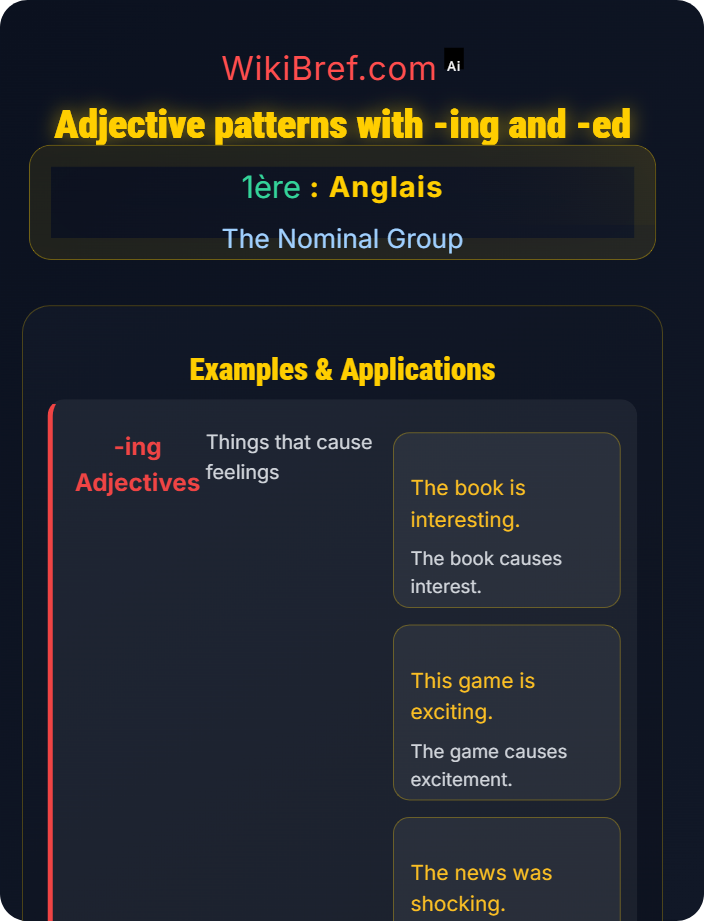
-ing vs -ed: -ing adjectives describe the source of feeling; -ed adjectives describe the person experiencing the feeling.
Determine if the adjective describes the cause of feeling or the person feeling.
Is the noun causing the feeling or receiving the feeling?
Use -ing for the cause of emotion, -ed for the experiencer.
Check if the selected form makes sense in context.
Ensure the sentence is grammatically and semantically correct.
Correct choice depends on whether the noun is causing (-ing) or experiencing (-ed) the emotion: "The exciting game made the fans excited."
• Cause vs Effect: -ing = causing emotion, -ed = experiencing emotion
• Agent Focus: Identify who/what is the source of the feeling
• Context Verification: Ensure the meaning is clear and logical
Relationship: Understanding the dynamic between cause and effect in -ing/-ed pairs.
Identify the -ing and -ed forms of the same adjective.
Determine which noun is acting and which is being acted upon.
Who or what is producing the feeling vs. who is receiving it?
Connect the -ing form to the cause, the -ed form to the effect.
The -ing form represents the stimulus causing the emotion, while the -ed form represents the person experiencing the emotion: "The boring lecture" (cause) vs "bored students" (effect).
• Dynamic Relationship: -ing = stimulus, -ed = response
• Emotional Direction: Identify the direction of emotional impact
• Role Identification: Distinguish between active and passive roles
Error Correction: Identifying and fixing incorrect -ing/-ed adjective usage.
Spot when -ing and -ed forms are used incorrectly.
Determine what the speaker likely meant to express.
Replace the incorrect form with the appropriate one.
Ensure the corrected sentence makes logical sense.
Common errors involve swapping -ing and -ed forms: "I'm boring" (incorrect) → "I'm bored" (correct) when expressing one's own feeling.
• Error Recognition: Identify incorrect usage patterns
• Meaning Restoration: Restore the intended emotional relationship
• Form Correction: Apply appropriate -ing/-ed form
Semantic Distinction: The fundamental difference in meaning between -ing and -ed adjectives.
-ing adjectives represent active, causing role; -ed adjectives represent passive, receiving role.
Determine the flow of emotion from stimulus to recipient.
How each form functions in the sentence structure.
How the choice affects the meaning conveyed to the listener.
Combine all elements to fully explain the semantic difference.
The semantic difference lies in the emotional relationship: -ing adjectives describe the source of emotion (active role), while -ed adjectives describe the experiencer of emotion (passive role).
• Active vs Passive: -ing = active/causal, -ed = passive/experiencing
• Emotional Direction: Source vs. recipient of feeling
• Functional Role: Different grammatical functions in sentences
Contrasting Examples: Sentences that clearly demonstrate the difference between -ing and -ed forms.
Select a verb that commonly forms both -ing and -ed adjectives.
Form a sentence using the -ing form to describe the stimulus.
Form a sentence using the -ed form to describe the recipient.
Make sure the sentences clearly show the difference in meaning.
Effective contrasting sentences demonstrate the difference: "The thrilling roller coaster created thrilling experiences" (stimulus) vs "Thrilled riders celebrated the ride" (experience).
• Parallel Structure: Use similar sentence patterns for clear contrast
• Clear Distinction: Ensure both forms show different roles
• Logical Connection: Maintain coherence between cause and effect