Sensory Details: Description that appeals to the five senses to create vivid mental images.
Take time to examine the object from all angles and perspectives.
Consider how the object looks, sounds, feels, smells, and tastes.
Choose precise words that accurately convey the sensory experience.
Structure the description in a coherent manner.
Follow OSASCOMP sequence when using multiple adjectives.
Effective object descriptions combine sensory details with precise vocabulary and proper adjective order: "The beautiful small antique wooden rocking chair sat quietly in the corner, its smooth varnished surface gleaming softly in the afternoon light."
• Sensory Engagement: Appeal to multiple senses for richer descriptions
• Specificity: Use precise vocabulary over generic terms
• Adjective Order: Follow OSASCOMP sequence for natural flow
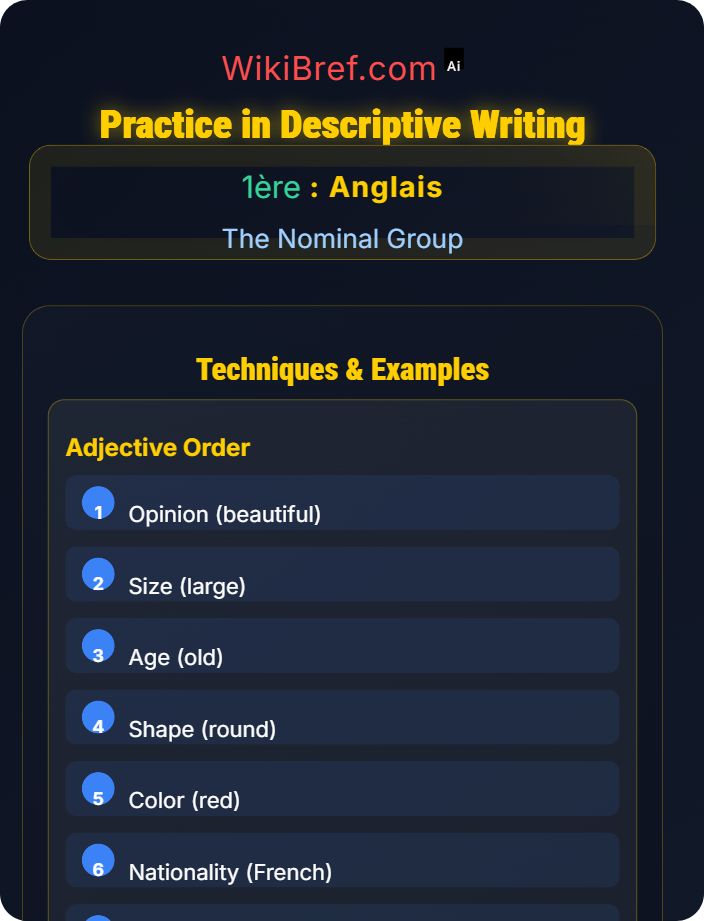
Adjective Order: The sequence OSASCOMP (Opinion-Size-Age-Shape-Color-Origin-Material-Purpose).
List all adjectives that describe the noun.
Assign each adjective to its appropriate category.
Place adjectives in the correct sequence.
Ensure the sequence sounds natural and fluent.
Correct adjective order follows the OSASCOMP sequence: "a beautiful small old round red French wooden cooking pot" places opinion first and purpose last.
• Category Identification: Properly classify each adjective
• Sequential Ordering: Follow OSASCOMP consistently
• Fluency Check: Ensure the sequence sounds natural
Description Enhancement: Transform generic, weak descriptions into vivid, engaging ones.
Recognize generic or vague language in the original description.
Replace general terms with precise, concrete words.
Add details that appeal to the senses.
Ensure multiple adjectives follow proper sequence.
Improvement involves replacing vague terms with specific, sensory-rich language: "a big red ball" becomes "a massive crimson rubber playground ball with a slightly worn surface."
• Specificity: Replace generic terms with precise alternatives
• Sensory Enhancement: Add details that engage the senses
• Structural Integrity: Maintain proper adjective order
Descriptive Techniques: Methods used to create vivid, engaging descriptions.
Explain how engaging multiple senses creates stronger imagery.
Describe how metaphors and similes enhance descriptions.
Explain the importance of precise adjective selection and order.
Consider how organization and flow contribute to effectiveness.
Combine all elements to explain overall effectiveness.
Effective descriptive techniques combine sensory details, precise vocabulary, proper adjective order, and figurative language to create vivid mental images that engage readers and bring scenes to life.
• Sensory Engagement: Multiple senses create stronger mental images
• Precision: Specific words create clearer pictures
• Structural Order: Proper adjective sequence ensures natural flow
Original Creation: Writing paragraphs that demonstrate effective descriptive techniques.
Select a person, place, or object to describe.
Generate ideas for details that appeal to multiple senses.
Organize multiple adjectives according to OSASCOMP sequence.
Add metaphors or similes to enhance the description.
Effective descriptive paragraphs combine vivid sensory details, proper adjective order, and engaging language: "The ancient weathered lighthouse stood majestically against the stormy sky, its white-painted surface scarred by decades of salt spray..."
• Subject Selection: Choose interesting, describable subjects
• Sensory Integration: Engage multiple senses for fuller descriptions
• Structural Consistency: Maintain proper adjective order throughout