Adjective to Abstract: Adding suffixes like -ness, -ity to adjectives to form abstract nouns.
Determine which adjective needs to be converted to an abstract noun.
Choose the correct suffix based on the adjective ending and meaning.
Follow the specific rule for adding the suffix (e.g., remove 'y' and add 'iness').
Verify if any spelling adjustments are needed during the transformation.
Ensure the resulting abstract noun accurately represents the quality of the adjective.
Common transformations include: happy → happiness, kind → kindness, free → freedom. The suffix added depends on the adjective's structure and meaning.
• Suffix Selection: Use -ness for most adjectives (happy → happiness)
• Spelling Changes: Remove 'y' and add 'iness' (happy → happiness)
• Meaning Preservation: The abstract noun should represent the quality of the adjective
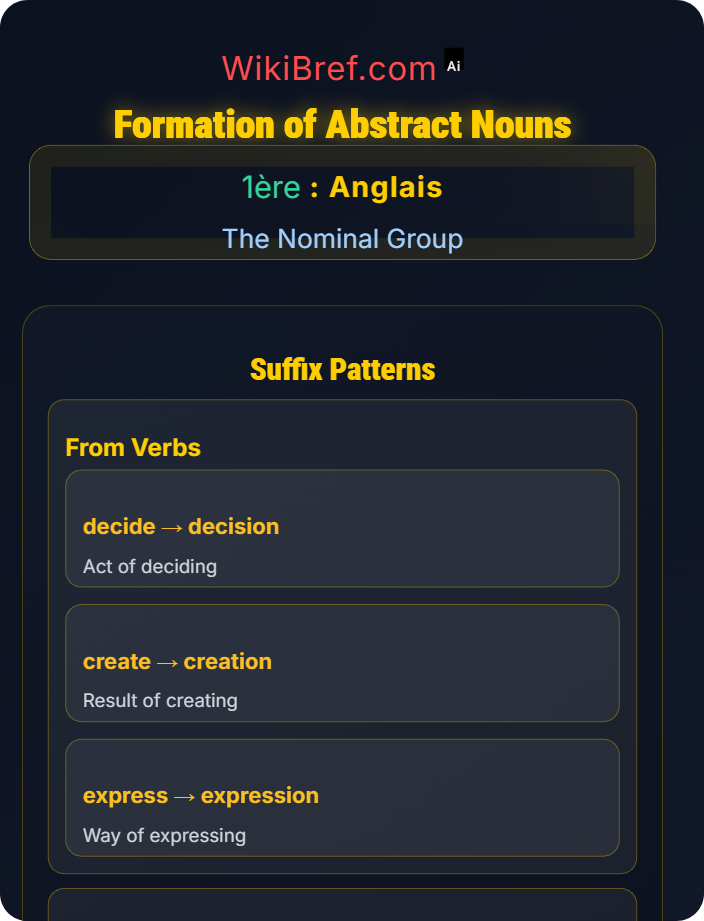
Verb to Abstract: Adding suffixes like -tion, -ment, -ance to verbs to form abstract nouns.
Determine which verb needs to be converted to an abstract noun.
Select the correct suffix based on the verb pattern and meaning.
Follow the specific transformation rule for the chosen suffix.
Make any required spelling changes during the transformation.
Common transformations include: create → creation, develop → development, assist → assistance. The suffix depends on the verb's pattern and meaning.
• Common Suffixes: -tion, -ment, -ance, -ence for verb-to-abstract conversion
• Pattern Recognition: Certain verb endings suggest specific suffixes
• Meaning Transformation: The abstract noun represents the action or result of the verb
Abstract vs Concrete: Abstract nouns represent intangible concepts; concrete nouns represent tangible objects.
Analyze the noun to determine if it represents something tangible or intangible.
Ask if you can see, touch, hear, smell, or taste the noun.
Determine if it's an idea, quality, or state rather than a physical object.
Label it as abstract if intangible, concrete if tangible.
Concrete nouns (tangible): book, dog, table. Abstract nouns (intangible): love, freedom, justice. The distinction depends on whether the concept can be physically experienced.
• Tangibility Test: Can you physically interact with the noun?
• Conceptual Nature: Does it represent an idea or quality?
• Physical Properties: Abstract nouns lack measurable physical properties
Meaning Shift: The transformation from source word to abstract noun represents a conceptual change.
Understand what the original word (adjective, verb, etc.) represents.
Determine what concept the resulting abstract noun represents.
Recognize how the meaning transforms from concrete to abstract.
Explain how the abstract noun relates to the source word's meaning.
Illustrate the transformation with clear examples.
The meaning transformation involves shifting from a specific characteristic (adjective) or action (verb) to the abstract concept of that characteristic or action: 'happy' (feeling joy) → 'happiness' (state of joy).
• Semantic Evolution: The abstract noun captures the essence of the source word
• Conceptual Abstraction: Moving from specific instance to general concept
• Meaning Relationship: The abstract noun represents the quality or result of the source
Contextual Application: Using formed abstract nouns in meaningful sentences.
Convert the given word to its abstract noun form.
Think about how to use the abstract noun in a meaningful context.
Create a sentence that properly incorporates the abstract noun.
Ensure the abstract noun is used correctly in the sentence.
Effective sentences demonstrate proper abstract noun usage: "The pursuit of happiness drives many people to achieve great things." The abstract noun 'happiness' represents the concept of being happy.
• Proper Formation: Ensure the abstract noun is correctly derived
• Contextual Fit: The sentence should make logical sense with the abstract noun
• Grammatical Integration: The abstract noun should function properly as a noun