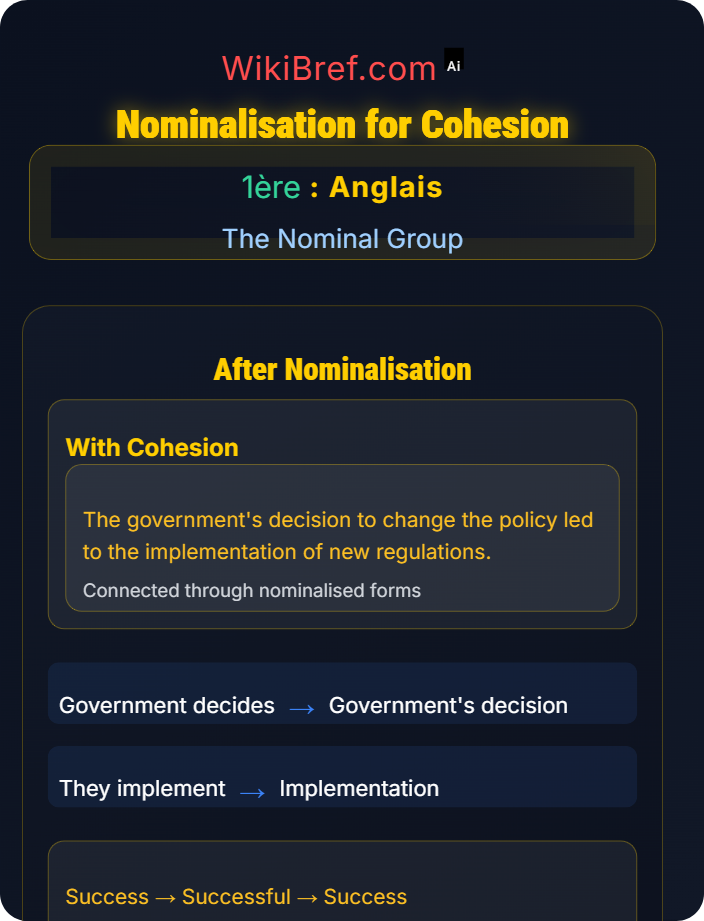
Verbal Nominalisation: Converting verbs into abstract nouns to create cohesive links between sentences.
Determine which verb represents a key concept that should be referenced later.
Choose the correct suffix based on the verb pattern (-tion, -ment, -ance, etc.).
Convert the verb to its abstract noun form.
Use the nominalised form to create a cohesive link to the original concept.
Ensure the nominalised form effectively connects ideas across sentences.
Effective verbal nominalisation transforms verbs like "achieve" into "achievement" to create cohesive links: "Students work hard. Their achievement reflects their effort."
• Suffix Selection: Use appropriate suffixes (-tion, -ment, -ance) for different verb patterns
• Cohesive Purpose: Nominalisation connects ideas across sentences
• Meaning Preservation: The abstract noun should represent the original concept
Adjectival Nominalisation: Converting adjectives into abstract nouns to maintain cohesive reference.
Determine which adjective represents an important quality worth referencing.
Select the appropriate suffix (-ness, -ity, -ty) for the adjective.
Convert the adjective to its abstract noun equivalent.
Use the nominalised form to link back to the original concept.
Effective adjectival nominalisation converts adjectives like "happy" to "happiness" for cohesive reference: "Her happiness was evident. The happiness she felt was infectious."
• Suffix Matching: Use -ness for most adjectives (happy → happiness)
• Cohesive Linking: The nominalised form connects related concepts
• Reference Maintenance: Preserves the original meaning in abstract form
Cohesive Recognition: Identifying how nominalised forms create links between ideas in texts.
Look for nouns that represent concepts rather than physical objects.
Identify the original verbs or adjectives that were nominalised.
Determine how the nominalised form links to previous concepts.
Assess how well the nominalised form maintains text flow.
Effective cohesive links through nominalisation create smooth transitions: "The research was conducted thoroughly. The thoroughness of the study impressed reviewers." Here, "thoroughness" links back to "conducted thoroughly".
• Recognition: Identify abstract nouns that refer back to earlier concepts
• Connection Analysis: Trace the relationship between nominalised and source forms
• Effectiveness: Evaluate how well the link maintains textual flow
Cohesion Enhancement: The way nominalisation creates cohesive links between different parts of a text.
Identify how direct repetition can make texts monotonous.
See how transforming words creates variation while maintaining meaning.
Observe how nominalised forms allow reference back to previous concepts.
Notice how nominalisation creates smoother transitions between ideas.
Combine all elements to explain the overall enhancement.
Nominalisation enhances cohesion by creating varied yet connected references to key concepts, avoiding repetition while maintaining semantic links between different parts of the text.
• Repetition Avoidance: Provides alternative ways to refer to concepts
• Referential Links: Maintains semantic connection to original concepts
• Textual Flow: Creates smoother transitions between ideas
Text Construction: Building cohesive texts by strategically using nominalised forms.
Determine the main ideas that should be connected throughout the text.
Decide where to transform verbs and adjectives into abstract nouns.
Convert selected words to their nominalised forms.
Use nominalised forms to create links between sentences and paragraphs.
Effective cohesive texts use nominalisation strategically: "Education transforms lives. The transformation occurs gradually. This education process requires dedication." Here, nominalised forms maintain conceptual links.
• Strategic Placement: Nominalise key concepts where cohesion is needed
• Meaning Consistency: Preserve original meaning in abstract form
• Flow Maintenance: Ensure nominalised forms enhance rather than disrupt flow