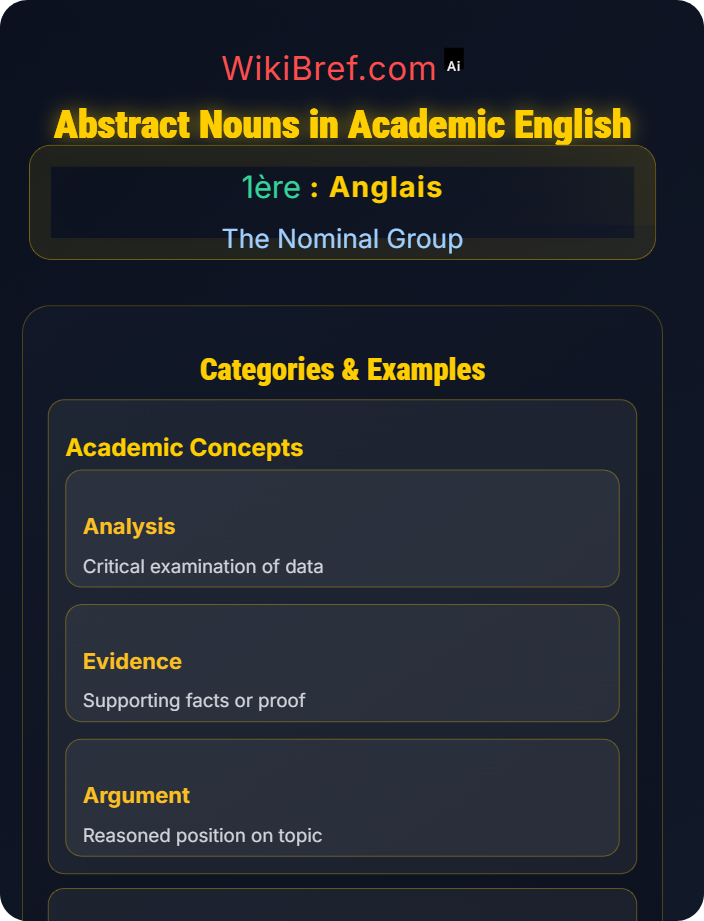
Academic Abstract Nouns: Nouns representing intangible concepts frequently used in scholarly writing.
Look for words that function as nouns in the sentence structure.
Ask whether the noun represents something you can physically experience.
Identify if it represents an emotion, quality, state, or idea.
Confirm the noun fits within academic discourse patterns.
Classify it as emotion, quality, state, concept, or process.
Academic texts contain abstract nouns like "analysis", "hypothesis", "justice", "freedom", "development". These represent intangible concepts essential for scholarly discussion.
• Tangibility Test: Abstract nouns represent intangible concepts
• Academic Relevance: Look for scholarly terminology
• Context Clues: Academic texts frequently use abstract nouns
Concrete to Abstract: Transforming specific, tangible expressions into intangible noun forms.
Determine the specific, tangible concept to be transformed.
Identify the abstract idea behind the concrete expression.
Use appropriate suffixes to create abstract noun forms.
Ensure the abstract noun fits academic writing standards.
Effective conversions include: "do research" → "research", "work hard" → "dedication", "think deeply" → "analysis". These create more formal academic expressions.
• Nominalisation: Transform verbs and adjectives to abstract nouns
• Academic Formality: Abstract nouns enhance scholarly tone
• Concept Preservation: Maintain original meaning in abstract form
Abstract vs Concrete: Differentiating between tangible and intangible noun types.
Ask if you can see, touch, hear, smell, or taste the noun.
Determine if it represents a physical object or an idea.
Does it point to something physical or conceptual?
Label as abstract if intangible, concrete if tangible.
Concrete nouns (tangible): book, table, dog. Abstract nouns (intangible): freedom, justice, love. The distinction depends on physical perceptibility.
• Tangibility Test: Can you physically interact with it?
• Conceptual Nature: Does it represent an idea or physical object?
• Sensory Experience: Abstract nouns lack sensory properties
Academic Benefits: The advantages of using abstract nouns in scholarly writing.
Examine how abstract nouns increase the formal tone of writing.
Consider how abstract nouns enable more specific expression.
Review how abstract nouns create connections between ideas.
Understand how abstract nouns handle complex ideas.
Combine all elements to explain overall benefit.
Abstract nouns enhance academic writing by providing formality, precision, cohesion, and the ability to discuss complex concepts. They allow for sophisticated expression of intangible ideas.
• Formality: Abstract nouns contribute to scholarly tone
• Precision: Enable nuanced expression of complex ideas
• Cohesion: Create connections between concepts across text
Academic Construction: Building sentences using abstract nouns in scholarly style.
Select intangible concepts relevant to academic discourse.
Construct sentences following academic writing conventions.
Incorporate abstract nouns smoothly into the sentence.
Ensure the sentence reflects scholarly writing standards.
Effective academic sentences use abstract nouns: "The analysis revealed significant developments in understanding." Here, abstract nouns like "analysis" and "developments" enhance scholarly expression.
• Relevance: Use abstract nouns appropriate to academic context
• Integration: Incorporate abstract nouns naturally in sentences
• Formality: Maintain scholarly tone throughout