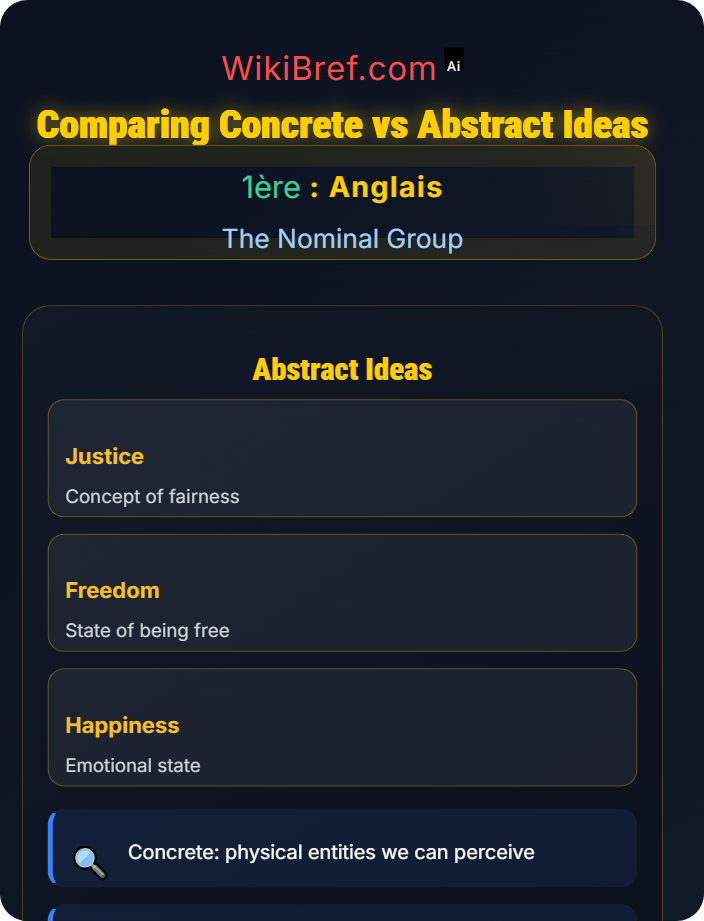
✅ Visible
✅ Measurable
✅ Physical objects
📦 Examples: table, dog, car
❌ Not visible
❌ Intangible
💭 Concepts only
🧠 Examples: love, freedom, justice
Concrete nouns: Words that represent things you can perceive with your five senses (touch, see, hear, smell, taste).
Abstract nouns: Words that represent ideas, feelings, qualities, or concepts that cannot be physically sensed.
For each word, ask: Can I touch/see/hear/smell/taste this?
• happiness: Cannot be touched/seen - Abstract (A)
• apple: Can be seen, touched, tasted - Concrete (C)
• courage: Cannot be touched/seen - Abstract (A)
• chair: Can be seen, touched - Concrete (C)
• beauty: Cannot be touched/seen directly - Abstract (A)
• mountain: Can be seen, climbed - Concrete (C)
happiness (A), apple (C), courage (A), chair (C), beauty (A), mountain (C)
Concrete: apple, chair, mountain / Abstract: happiness, courage, beauty
• SENSES Test: If perceivable by senses → concrete
• Intangible Rule: If represents concept/feeling → abstract
• Physical Existence: Concrete nouns have physical presence
Nominalization: The process of converting adjectives or verbs into abstract nouns.
"democratic" is an adjective describing a type of government system
• Adjective "democratic" → Abstract noun ending in "-cy"
• democratic → democracy
"democracy" represents the system/government type that is democratic
The democracy of democracy
• Adjective to Noun: democratic → democracy
• Common Endings: -tion, -ness, -ity, -ment, -cy
• Meaning Preservation: Noun retains core meaning of adjective
Verbal Nominalization: Converting action words into abstract nouns representing the action.
"decide" is a verb meaning to make a choice
• Verb "decide" → Abstract noun ending in "-ion"
• decide → decision
Example: "The decision was made after careful consideration."
Abstract noun: decision / Sentence: "The decision was made after careful consideration."
• Verb to Action Noun: decide → decision
• Common Pattern: -e verbs often become -ion
• Function: Converts action into concept
Abstract Noun Recognition: Finding intangible concepts within sentences.
"Her intelligence impressed everyone"
• "intelligence": Cannot be touched/seen - represents mental ability
• "everyone": Refers to people but is collective noun
"intelligence" is intangible, represents a quality/ability
The abstract noun is intelligence.
• Quality Words: intelligence represents a mental quality
• Intangibility: Cannot be physically sensed
• Conceptual Nature: Represents idea/ability
Complex Sentences: Using both tangible and intangible nouns in one sentence.
Include at least one concrete noun (tangible) and one abstract noun (intangible)
Concrete: book, table, cat / Abstract: knowledge, happiness, freedom
Example: "The book contains ancient wisdom about freedom."
• "book": concrete (can be touched)
• "wisdom": abstract (cannot be touched)
• "freedom": abstract (concept)
Example sentence: "The book contains ancient wisdom about freedom."
Concrete: book / Abstract: wisdom, freedom
• Balance: Include both concrete and abstract nouns
• Context: Make grammatical sense together
• Distinction: Clear difference between types
Nouns that refer to physical objects that can be perceived by the five senses. They have a tangible existence.
Nouns that represent ideas, qualities, emotions, or concepts that cannot be physically sensed. They exist only as concepts.
The process of converting verbs, adjectives, or phrases into nouns, often creating abstract nouns from other parts of speech.
• table, chair, book
• water, air, food
• house, tree, mountain
• phone, computer, pen
• freedom, justice, peace
• beauty, truth, honesty
• decision, movement, education
• happiness, fear, courage