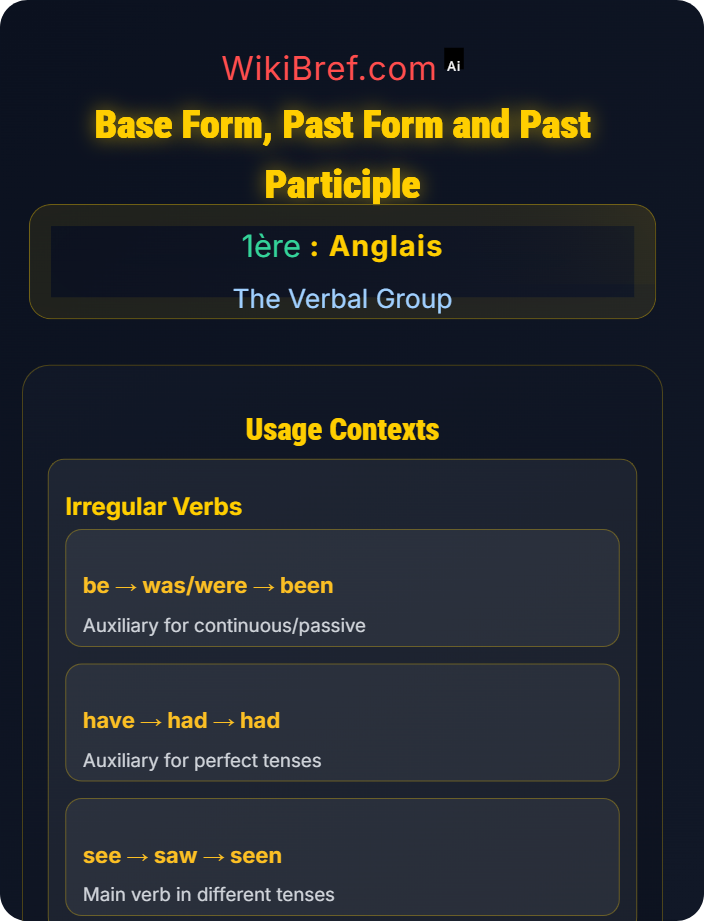
✅ Present tense
📝 eat, go, take
✅ Past tense
📝 ate, went, took
✅ Passive voice
📝 eaten, gone, taken
Past: walked
Participle: walked
Past: ate
Participle: eaten
Past: went
Participle: gone
Past: took
Participle: taken
Complete the sentences with the correct form of the verb in parentheses.
Context indicates simple past → use past form: "went"
Perfect tense with "have" → use past participle: "taken"
Present tense → use base form: "eat"
Simple past → use past form: "wrote"
Perfect tense with "have" → use past participle: "seen"
1. went, 2. taken, 3. eat, 4. wrote, 5. seen
• Simple Past: Use past form with time markers like "yesterday", "last night"
• Perfect Tenses: Use past participle with auxiliaries (have/has/had)
• Present Tense: Use base form for regular present actions
Identify the form of each underlined verb: Base, Past, or Past Participle.
After "to" → Base form
Simple past action → Past form
With auxiliary "have" → Past participle
• After "to" → Base form
• Time markers (yesterday, last week) → Past form
• With auxiliaries (have, has, had) → Past participle
Use context clues to determine which form is needed
• After "to": Base form (to + verb)
• Time Markers: Past form (yesterday, last week, ago)
• Auxiliaries: Past participle (have/has/had + verb)
Convert the following sentences from present to past and perfect tenses.
Past: "I ate breakfast" (use past form)
Perfect: "I have eaten breakfast" (use past participle)
Past: "She went to school"
Perfect: "She has gone to school"
Past: "They wrote stories"
Perfect: "They have written stories"
Present (base) → Past (past form) → Perfect (auxiliary + past participle)
• Simple Past: Replace base with past form
• Present Perfect: Use "have/has" + past participle
• Consistency: All three forms must match the verb type
Correct the mistakes in the following sentences.
Mistake: "went" is past form, not past participle
Correction: "I have gone to Paris"
Mistake: "wrote" is past form, not past participle
Correction: "She has written a letter"
Mistake: "goed" is incorrect past form
Correction: "Yesterday I went to the park"
Mistake: Subject-verb agreement error
Correction: "They have eaten dinner"
1. went → gone, 2. wrote → written, 3. goed → went, 4. has → have
• Confusing Forms: Past form vs past participle
• Regular Formation: Don't apply -ed rule to irregular verbs
• Auxiliary Agreement: Have/has with past participle
Choose the correct verb form for each context.
Present continuous → Use base form: "am doing"
Simple past → Use past form: "did"
Present perfect → Use past participle: "have done"
Past perfect → Use past participle: "had done"
1. am doing, 2. did, 3. have done, 4. had done
• Present Tense: Base form with subject
• Simple Past: Past form for completed actions
• Perfect Tenses: Auxiliary + past participle