✅ Be verbs
✅ Modal auxiliaries
❓ "Do you like coffee?"
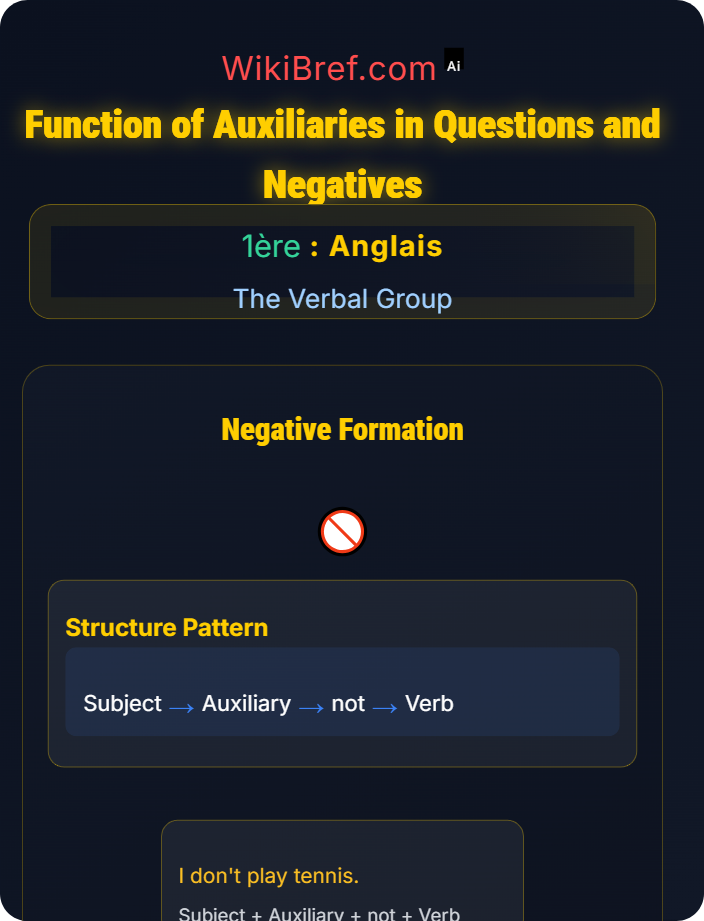
✅ Be not
✅ Modal not
❌ "I do not like coffee"
Does (he/she/it)
Did (all persons)
Is (he/she/it)
Are (you/they)
Has (he/she/it)
Had (all persons)
Will, Would
May, Might
Transform the statements into yes/no questions using appropriate auxiliaries.
Subject "she" (3rd person singular) + main verb "likes" → Use "does"
Move "does" before subject: "Does she like ice cream?"
Subject "they" (plural) + main verb "play" → Use "do"
Move "do" before subject: "Do they play football?"
"is" is a be verb → Move "is" before subject: "Is he happy?"
"can" is modal → Move "can" before subject: "Can I swim?"
1. Does she like ice cream? 2. Do they play football? 3. Is he happy? 4. Can I swim?
• Do Forms: Use "do" for I/you/we/they, "does" for he/she/it
• Be Verbs: Move be verbs directly (am/is/are)
• Modals: Move modals directly (can/will/may)
Create wh-questions using appropriate auxiliaries for the given answers.
Ask "Who plays tennis?" → "Who" is subject, so no auxiliary needed
Ask "Where does she live?" → Use "does" as "where" is object
Ask "How much does the book cost?" → Use "does" as "how much" is object
Ask "What is he?" → Use "is" directly
1. Who plays tennis? 2. Where does she live? 3. How much does the book cost? 4. What is he?
• Subject Questions: No auxiliary when question word is subject
• Object Questions: Use auxiliary when question word is object
• Be Verbs: Direct inversion for subject questions
Transform the statements into negatives using appropriate auxiliaries.
Subject "she" + main verb "likes" → Use "does" + "not"
Result: "She does not like music" or "She doesn't like music"
"are" is be verb → Add "not" after: "They are not students" or "They aren't students"
"can" is modal → Add "not" after: "I cannot drive" or "I can't drive"
"has" is have verb → Use "does not have": "He does not have a car"
1. She doesn't like music 2. They aren't students 3. I can't drive 4. He doesn't have a car
• Do Forms: Use "do not", "does not", "did not"
• Be Verbs: Add "not" after be verbs
• Modals: Add "not" after modal verbs
Correct the mistakes in the following questions and negatives.
Mistake: "do" for 3rd person singular
Correction: "Does she like apples?"
Mistake: "are" with 3rd person singular he
Correction: "Is he coming?"
Mistake: Double auxiliary "doesn't has"
Correction: "She doesn't have a car"
Mistake: Mix of "do" and "has"
Correction: "Have you seen him?"
Mistake: "don't" with 3rd person singular + double "s"
Correction: "He doesn't like coffee"
1. Does she like apples? 2. Is he coming? 3. She doesn't have a car? 4. Have you seen him? 5. He doesn't like coffee
• Subject-Auxiliary Agreement: Match person and number
• Double Auxiliaries: Don't combine auxiliaries
• Verb Forms: Keep main verb in base form after auxiliaries
Form questions and negatives for complex structures.
Question: "Has he been working since morning?" (auxiliary "has")
Negative: "He has not been working since morning" (add "not" after "has")
Question: "Will they have finished by then?" (auxiliary "will")
Negative: "They will not have finished by then" (add "not" after "will")
Question: "Can she have been studying?" (modal "can")
Negative: "She cannot have been studying" (add "not" after "can")
Question: "Should we be going now?" (modal "should")
Negative: "We should not be going now" (add "not" after "should")
In complex tenses, use the first auxiliary for questions/negatives
• First Auxiliary: Use the leftmost auxiliary for inversion
• Perfect Continuous: Has/have/had + been + -ing
• Future Perfect: Will + have + past participle