Anglais • 1ère

Agreement and Subject-Verb Concord
The Verbal Group - Main Verbs and Auxiliaries

Subject-Verb Agreement
⚖️ Subject-Verb Concord
Matching subjects with their verbs
Singular Subjects
✅ He/She/It + verb-s
✅ One/Each + verb-s
📝 He runs
She sings
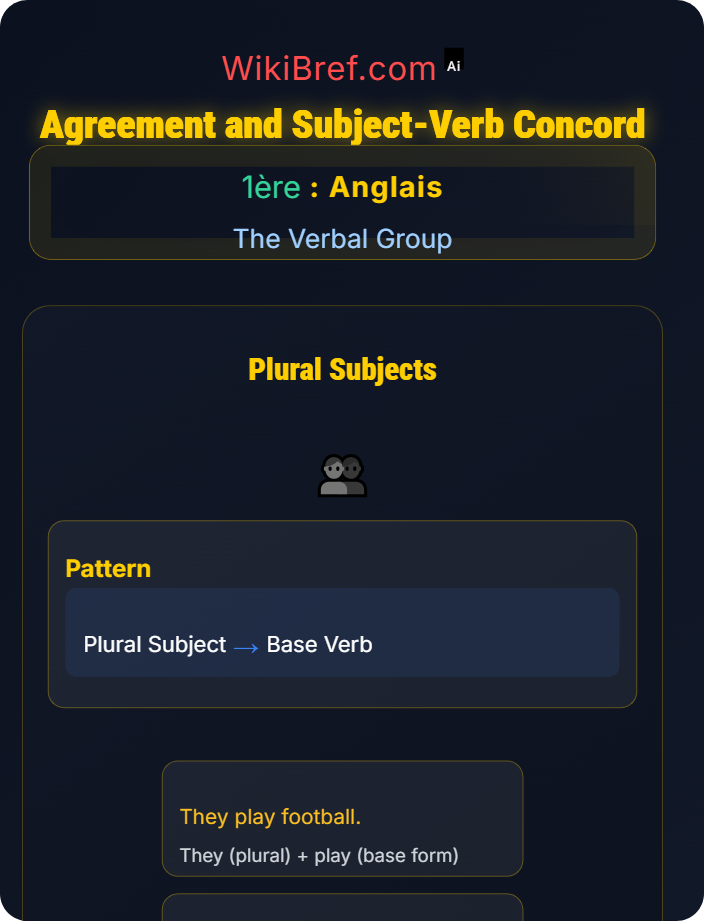
Plural Subjects
✅ I/You/We/They + verb
✅ Many/Several + verb
📝 They run
We sing
🎯
Definition: Subject-verb agreement means the verb must match the subject in number (singular/plural).
👤
Singular Subjects: He, She, It, One, Each, Everyone, Someone, Anyone require -s verbs.
👥
Plural Subjects: I, You, We, They, Many, Several, All require base form verbs.
🔄
Collective Nouns: Can be singular or plural depending on context (team, family, class).
💡
Tip: Find the subject before checking the verb form
🔍
Attention: Prepositional phrases don't affect subject-verb agreement
Rule: Always match singular with singular, plural with plural
📋
Method: Cross out prepositional phrases to find the real subject
SINGULAR
He/She/It runs
Each student tries
Everyone knows
PLURAL
I/You/We/They run
Many students try
All know
BE VERBS
I am
He/She is
We/They are
HAVE VERBS
I/You/We/They have
He/She has
They have
Agreement Exercises
1 Basic Agreement
Instructions :

Choose the correct verb form to complete each sentence.

Step 1: "The cat ___ (run/runs) quickly"

Subject: "cat" (singular) → Need singular verb: "runs"

Step 2: "The cats ___ (run/runs) quickly"

Subject: "cats" (plural) → Need plural verb: "run"

Step 3: "He ___ (like/likes) music"

Subject: "he" (singular) → Need singular verb: "likes"

Step 4: "They ___ (watch/watches) TV"

Subject: "they" (plural) → Need plural verb: "watch"

Step 5: "Everyone ___ (know/knows) the answer"

Subject: "everyone" (singular indefinite pronoun) → Need singular verb: "knows"

Answers :

1. runs, 2. run, 3. likes, 4. watch, 5. knows

Rules Applied :

Singular Subjects: Take -s verbs (he runs, she sings)

Plural Subjects: Take base form verbs (they run, we sing)

Indefinite Pronouns: Everyone, someone, anyone are singular

2 Complex Subjects
Instructions :

Identify the subject and choose the correct verb form.

Step 1: "The list of books ___ (is/are) on the table"

Subject: "list" (singular), ignore "of books" → "is"

Step 2: "A team of players ___ (was/were) ready"

Subject: "team" (singular collective noun) → "was"

Step 3: "The majority of students ___ (agree/agrees)"

Subject: "majority" (singular) → "agree" (but majority is singular, so "agrees")

Step 4: "Neither John nor Mary ___ (was/were) there"

Subject closest to verb: "Mary" (singular) → "was"

Step 5: "Each of the girls ___ (has/have) a book"

Subject: "each" (singular) → "has"

Answers :

1. is, 2. was, 3. agrees, 4. was, 5. has

Complex Rules :

Prepositional Phrases: Ignore phrases starting with "of", "with", "by"

Collective Nouns: Team, family, class can be singular or plural

Either/Neither: Use verb that agrees with closest subject

3 Be and Have Agreement
Instructions :

Complete with the correct form of "be" or "have".

Step 1: "I ___ (am/is/are) happy"

Subject: "I" → Use "am"

Step 2: "He ___ (am/is/are) tall"

Subject: "he" → Use "is"

Step 3: "They ___ (am/is/are) students"

Subject: "they" → Use "are"

Step 4: "She ___ (has/have) a car"

Subject: "she" → Use "has"

Step 5: "We ___ (has/have) books"

Subject: "we" → Use "have"

Answers :

1. am, 2. is, 3. are, 4. has, 5. have

Be/Have Rules :

Be Verb: I-am, he/she/it-is, we/you/they-are

Have Verb: I/you/we/they-have, he/she/it-has

Special Forms: "am", "is", "are" are unique to be verb

Advanced Exercises
4 Error Correction
Instructions :

Find and correct the subject-verb agreement errors.

Error: "The dogs bark loudly" → Correct

No error: plural subject "dogs" with plural verb "bark"

Error: "The dog bark loudly"

Error: singular subject "dog" needs singular verb

Correction: "The dog barks loudly"

Error: "He don't like pizza"

Error: singular subject "he" needs "doesn't"

Correction: "He doesn't like pizza"

Error: "Each of the students have a book"

Error: "each" is singular, needs singular verb

Correction: "Each of the students has a book"

Error: "The team were playing well"

Depends on context: "team" as unit (singular) vs members (plural)

Correction: Both can be correct depending on meaning

Corrections :

1. The dog barks, 2. He doesn't like, 3. Each...has, 4. Depends on context

Common Errors :

Prepositional Trap: Don't let "of" phrases confuse subject

Compound Subjects: "and" usually makes plural, "or/nor" depends on closest

Collective Nouns: Context determines singular/plural treatment

5 Compound Subjects
Instructions :

Determine verb agreement with compound subjects.

Step 1: "John and Mary ___ (is/are) here"

Compound subject with "and" → plural verb: "are"

Step 2: "Bread and butter ___ (is/are) served"

Idiomatic expression treated as singular → "is"

Step 3: "Either John or his friends ___ (was/were) late"

Closest subject "friends" is plural → "were"

Step 4: "Neither the teacher nor the students ___ (was/were) prepared"

Closest subject "students" is plural → "were"

Step 5: "The teacher or the students ___ (was/were) wrong"

Closest subject "students" is plural → "were"

Answers :

1. are, 2. is, 3. were, 4. were, 5. were

Compound Rules :

And: Usually makes compound subject plural

Or/Nor: Verb agrees with closest subject

Idiomatic Pairs: Some treated as singular (bread and butter)
Key Points Summary
🎯
Agreement Rule: Singular subjects take singular verbs, plural subjects take plural verbs
🔍
Prepositional Phrases: Ignore "of", "with", "by" phrases when finding subject
Indefinite Pronouns: Everyone, someone, nobody are singular
📋
Compound Subjects: "and" usually plural, "or/nor" follows closest subject
Singular
He/She runs
One student tries
Plural
They run
Many students try
Collective
Team (unit)
Team (members)
Agreement and subject-verb concord Main Verbs and Auxiliaries