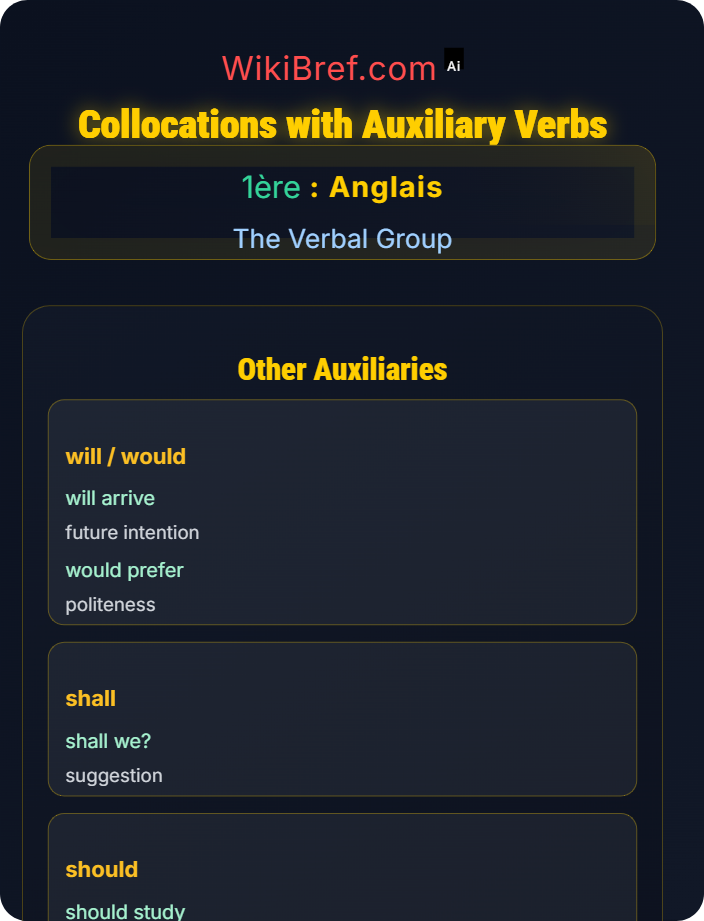
✅ could do
✅ be able to
📝 can speak French
✅ have to
✅ should do
📝 must study hard
could run
be able to
have to
should come
might rain
could occur
would prefer
want to
Complete the sentences with appropriate auxiliary verbs for expressing ability.
Expressing past ability → Use "could"
Complete: "When I was young, I could swim across the lake"
Expressing present ability → Use "can"
Complete: "She can speak three languages fluently"
Conditional ability → Use "would be able to"
Complete: "If I studied harder, I would be able to pass the exam"
Present inability → Use "can't"
Complete: "Unfortunately, I can't lift heavy boxes anymore"
Past inability → Use "couldn't"
Complete: "He couldn't drive when he was 16"
1. could, 2. can, 3. would be able to, 4. can't, 5. couldn't
• Can: Present ability
• Could: Past ability
• Be able to: Alternative for expressing ability
Match the auxiliary verbs with their typical obligation meanings.
Strong obligation/internal necessity → "internal requirement"
External obligation → "external requirement"
Advice/recommendation → "moral obligation"
Moral duty → "ethical recommendation"
Personal necessity → "personal requirement"
must: internal requirement, have to: external requirement, should: advice, ought to: moral duty, need to: personal necessity
• Must: Speaker's strong opinion
• Have to: External rule/law
• Should: Advice/recommendation
Complete the probability expressions with appropriate auxiliaries.
Low probability → Use "might"
Complete: "It might rain tomorrow"
Moderate probability → Use "may"
Complete: "She may be at home now"
Possible situation → Use "could"
Complete: "The train could be delayed"
Logical deduction → Use "must"
Complete: "He must have missed the bus"
Uncertain advice → Use "might"
Complete: "You might not want to go there"
1. might, 2. may, 3. could, 4. must, 5. might
• May/Might: Permission or possibility
• Could: Possible situation
• Must (deduction): Logical conclusion
Complete the conditional sentences with appropriate auxiliary verbs.
Second conditional → Use "would"
Complete: "If I had more time, I would travel more"
Conditional offer → Use "would"
Complete: "I would help you if you asked me"
Unreal condition → Use "would"
Complete: "If she were here, she would know what to do"
Polite request → Use "would"
Complete: "Would you mind closing the door?"
Complete: "I would prefer to stay home tonight"
1. would, 2. would, 3. would, 4. would, 5. would
• Would: Second conditional results
• Polite Requests: Would you mind...?
• Preferences: Would prefer/like
Complete the modal perfect constructions with appropriate auxiliaries.
Past regret → Use "should have"
Complete: "She should have studied harder"
Past possibility → Use "could have"
Complete: "You could have told me earlier"
Past logical deduction → Use "must have"
Complete: "He must have passed the exam"
Expected completion → Use "should have"
Complete: "They should have arrived by now"
Past obligation → Use "ought to have"
Complete: "We ought to have prepared better"
1. should, 2. could, 3. must, 4. should, 5. ought to
• Should have: Past regret or expectation
• Could have: Past possibility
• Must have: Past logical deduction