Permission: can go
Possibility: can happen
Polite request: could you?
Conditional: could if...
Possibility: may rain
Polite: may I?
Polite request: might I?
Past possibility
Choose the correct modal to express ability in different contexts.
Expressing past ability → Use "could"
Complete: "When I was young, I could run fast"
Expressing present ability → Use "can"
Complete: "She can speak three languages"
Conditional ability → Use "could"
Complete: "If I practiced more, I could learn guitar"
Present inability → Use "can't"
Complete: "Unfortunately, I can't lift heavy weights now"
Past ability → Use "could"
Complete: "He could drive when he was 18"
1. could, 2. can, 3. could, 4. can't, 5. could
• Can: Present ability
• Could: Past ability or conditional ability
• Can't/Couldn't: Inability
Complete the permission requests and grants with appropriate modals.
Polite permission request → Use "May"
Complete: "May I borrow your pen?"
Granting permission → Use "can"
Complete: "Yes, you can"
Denying permission → Use "can't"
Complete: "Students can't use their phones during exams"
Polite seating request → Use "May"
Complete: "May I sit here?"
Prohibition → Use "mustn't"
Complete: "You mustn't smoke in this area"
1. May, 2. can, 3. can't, 4. May, 5. mustn't
• May: Formal/polite permission request
• Can: Informal permission grant
• Can't/Mustn't: Prohibition
Complete the possibility statements with appropriate modals.
Uncertain future possibility → Use "might"
Complete: "It might rain tomorrow"
Present possibility → Use "may"
Complete: "She may be at home now"
Possible situation → Use "could"
Complete: "The train could be delayed"
Logical deduction → Use "must"
Complete: "He must have missed the bus"
Uncertain advice → Use "might"
Complete: "You might not want to go there"
1. might, 2. may, 3. could, 4. must, 5. might
• May/Might: Permission or possibility (might = less likely)
• Could: Possible situation
• Must (deduction): Logical conclusion
Complete the obligation and advice expressions with appropriate modals.
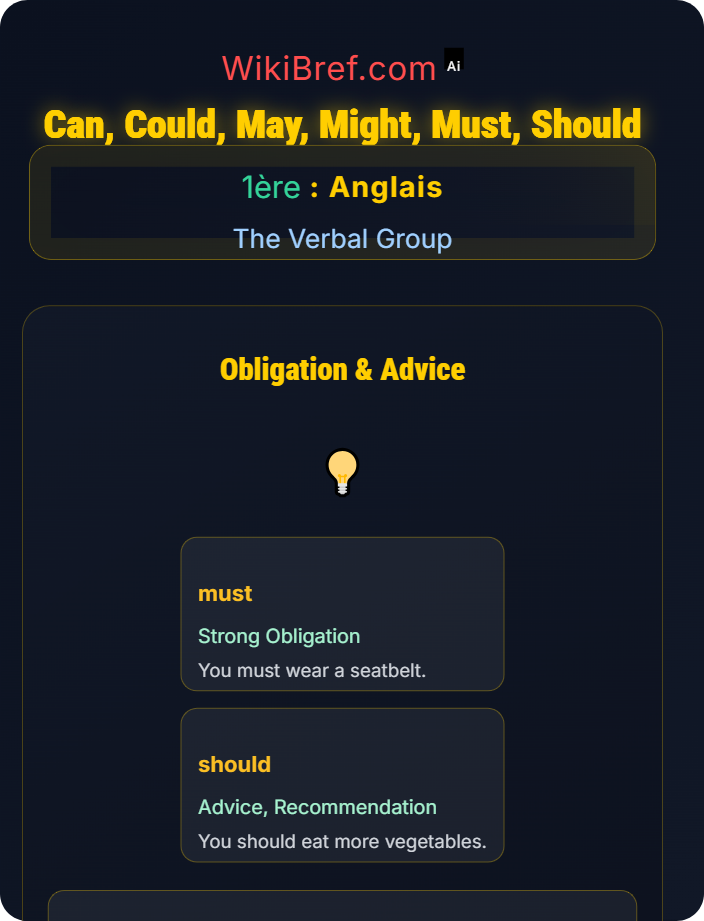
Strong obligation → Use "must"
Complete: "You must study hard for the exam"
External rule → Use "have to"
Complete: "Students have to wear uniforms"
Advice → Use "should"
Complete: "You should eat more vegetables"
Negative advice → Use "shouldn't"
Complete: "He shouldn't smoke so much"
Strong requirement → Use "must"
Complete: "We must arrive on time"
1. must, 2. have to, 3. should, 4. shouldn't, 5. must
• Must: Speaker's strong opinion
• Have to: External requirement
• Should: Advice/recommendation
Complete the modal perfect constructions for past situations.
Past regret → Use "should have"
Complete: "She should have studied harder"
Past possibility → Use "could have"
Complete: "You could have told me earlier"
Past logical deduction → Use "must have"
Complete: "He must have passed the exam"
Past expectation → Use "should have"
Complete: "They should have arrived by now"
Past obligation → Use "ought to have"
Complete: "We ought to have prepared better"
1. should, 2. could, 3. must, 4. should, 5. ought to
• Should have: Past regret or expected completion
• Could have: Past possibility
• Must have: Past logical deduction