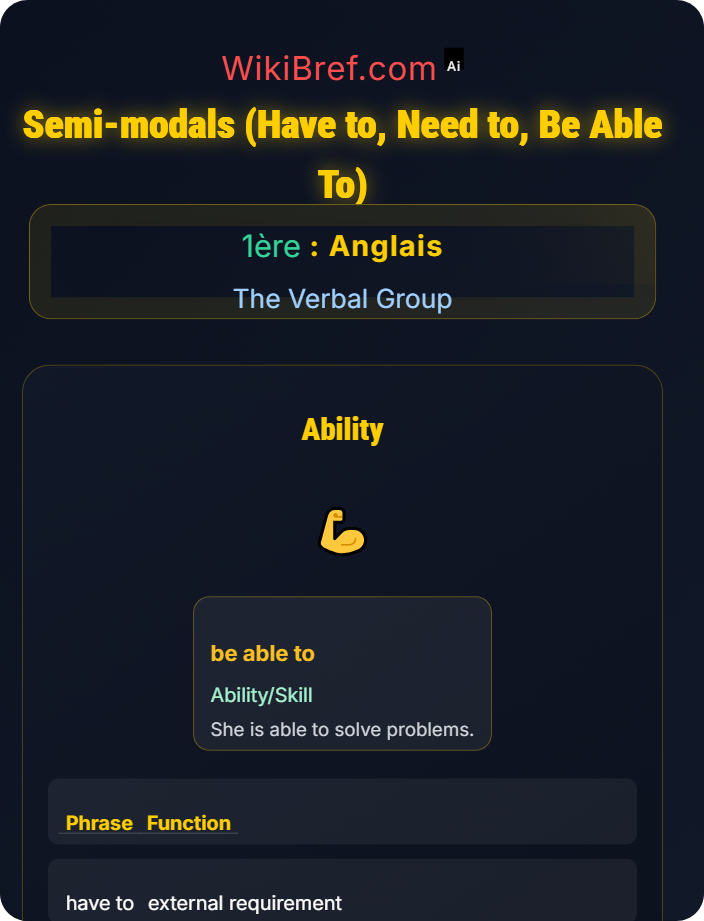
Past: had to
Future: will have to
Past: needed to
Future: will need to
Past: was/were able to
Future: will be able to
don't need to
am/is/are not able to
Complete the sentences with "have to" in the appropriate tense.
Present obligation → Use "have to"
Complete: "Students have to wear uniforms"
Past obligation → Use "had to"
Complete: "Yesterday, we had to finish the project"
Future obligation → Use "will have to"
Complete: "Tomorrow, I will have to attend the meeting"
Legal requirement → Use "have to"
Complete: "Drivers have to stop at red lights"
Past requirement → Use "had to"
Complete: "Last year, employees had to work overtime"
1. have to, 2. had to, 3. will have to, 4. have to, 5. had to
• Present: Subject + have to + base verb
• Past: Subject + had to + base verb
• Future: Subject + will have to + base verb
Complete the necessity expressions with "need to" in appropriate tenses.
Present necessity → Use "need to"
Complete: "You need to study harder"
Present necessity (3rd person) → Use "needs to"
Complete: "She needs to prepare for the exam"
Past necessity → Use "needed to"
Complete: "Yesterday, I needed to buy groceries"
Future necessity → Use "will need to"
Complete: "Tomorrow, we will need to submit the report"
Present necessity (3rd person) → Use "needs to"
Complete: "He needs to improve his grades"
1. need to, 2. needs to, 3. needed to, 4. will need to, 5. needs to
• Present: I/You/We/They + need to + base verb
• Present: He/She/It + needs to + base verb
• Past: Subject + needed to + base verb
Complete the ability expressions with "be able to" in appropriate forms.
Present ability → Use "am able to"
Complete: "I am able to speak two languages"
Present ability (3rd person) → Use "is able to"
Complete: "She is able to swim across the pool"
Past success → Use "were able to"
Complete: "Yesterday, we were able to solve the problem"
Future ability → Use "will be able to"
Complete: "Tomorrow, they will be able to finish the work"
Past inability → Use "was not able to"
Complete: "He was not able to participate due to illness"
1. am able to, 2. is able to, 3. were able to, 4. will be able to, 5. was not able to
• Present: am/is/are + able to + base verb
• Past: was/were + able to + base verb
• Future: will be + able to + base verb
Compare semi-modals with true modals and choose the appropriate form.
External obligation (company policy) → Use "has to"
Complete: "He has to work late tonight"
Speaker's strong opinion → Use "must"
Complete: "She must finish the project"
Specific past ability → Use "was able to"
Complete: "I was able to swim well when I was young"
Prohibition → Use "mustn't"
Complete: "You mustn't smoke here"
Necessity vs advice → Use "need to"
Complete: "They need to improve their performance"
1. has to, 2. must, 3. was able to, 4. mustn't, 5. need to
• Have to: External obligation, Must: Internal obligation
• Be able to: All tenses available, Can: Limited tenses
• Need to: Necessity, Should: Advice
Complete the modal perfect constructions with semi-modals.
Past regret → Use "should have"
Complete: "She should have studied harder"
Past possibility → Use "could have"
Complete: "You could have told me earlier"
Past logical deduction → Use "must have"
Complete: "He must have passed the exam"
Past obligation → Use "ought to have"
Complete: "They ought to have prepared better"
Past success → Use "were able to"
Complete: "We were able to finish on time"
1. should, 2. could, 3. must, 4. ought to, 5. were able to
• Should have: Past regret or expectation
• Could have: Past possibility
• Must have: Past logical deduction