✅ should (probable)
✅ might (possible)
📝 must be right
✅ would (politer)
✅ might (most polite)
📝 could you help?
should: 80% sure
may: 50% sure
might: 30% sure
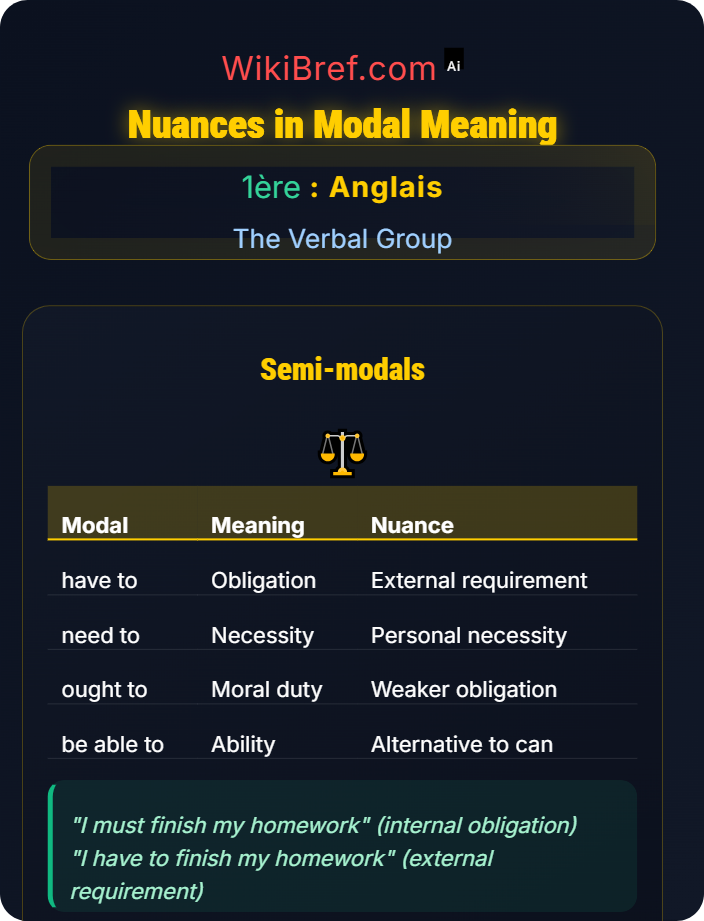
have to: external
should: advice
need to: necessity
could: past/conditional
be able to: all tenses
could: polite
would: more polite
might: most polite
Choose the modal that best expresses the degree of certainty.
Probable but not certain → Use "should"
Complete: "He should be at home now"
Very confident deduction → Use "must"
Complete: "She must have passed the exam"
Uncertain possibility → Use "might"
Complete: "It might rain tomorrow"
Expected but not confirmed → Use "should"
Complete: "They should be arriving soon"
Possible explanation → Use "might"
Complete: "He might have forgotten the appointment"
1. should, 2. must, 3. might, 4. should, 5. might
• Must: Very certain (logical conclusion)
• Should: Probable (based on expectation)
• May/Might: Possible (uncertain)
Arrange the modals in order of politeness for requests.
Least polite → Direct request
More polite → Conditional form
Even more polite → Willingness request
Most polite → Very tentative
Can < Could < Would < Might (least to most polite)
Can → Could → Would → Might (increasing politeness)
• Can: Direct, informal
• Could: Polite, conditional
• Would: More polite, willingness
Choose the appropriate modal to express different types of obligation.
Speaker's strong opinion → Use "must"
Complete: "You must study hard"
External rule → Use "have to"
Complete: "Students have to wear uniforms"
Advice → Use "should"
Complete: "You should eat more vegetables"
Personal necessity → Use "need to"
Complete: "We need to finish this project"
Company policy → Use "have to"
Complete: "Employees have to arrive on time"
1. must, 2. have to, 3. should, 4. need to, 5. have to
• Must: Speaker's strong opinion
• Have to: External requirement
• Should: Advice/recommendation
Select the modal that fits best in each contextual situation.
Medical imperative → Use "must"
Complete: "You must quit smoking"
Recommendation → Use "should"
Complete: "You should try this restaurant"
Formal permission → Use "May"
Complete: "May I borrow your pen?"
Uncertain prediction → Use "might"
Complete: "It might rain later"
House rule → Use "have to"
Complete: "You have to be home by 9 PM"
1. must, 2. should, 3. May, 4. might, 5. have to
• Relationship: Formal/informal affects modal choice
• Authority: Professional advice vs personal opinion
• Certainty: Facts vs possibilities
Identify the subtle differences between similar modal expressions.
"Must" = speaker's opinion, "have to" = external obligation
"May" = formal permission, "Can" = informal ability/request
"Could" = general ability, "was able to" = specific achievement
"Might" = less likely than "May"
"Ought to" = slightly stronger moral obligation than "should"
1. Internal vs external obligation, 2. Formal vs informal, 3. General vs specific ability, 4. Probability levels, 5. Strength of advice
• Source: Internal opinion vs external requirement
• Formality: Formal vs informal contexts
• Specificity: General vs specific situations