✅ may/might
✅ must/have to
✅ should
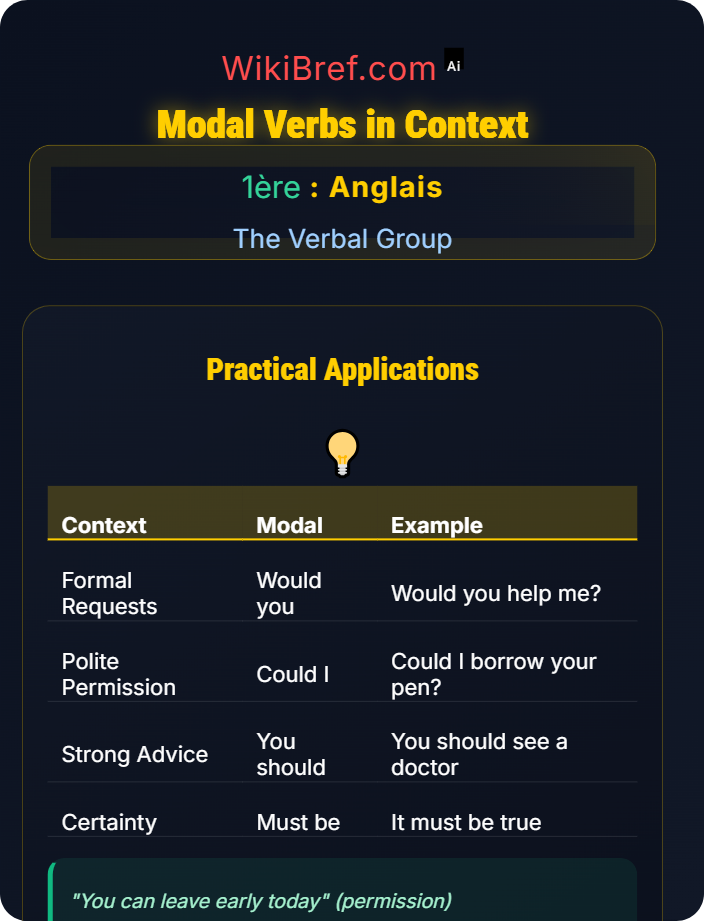
📝 formal requests
Modal Verbs in Context
📚 Modal Verbs in Context
Real-life situations and appropriate modals
FORMAL SITUATIONS
INFORMAL SITUATIONS
✅ can/could
✅ will/would
✅ need to
📝 casual requests
✅ will/would
✅ need to
📝 casual requests
Definition: Context determines which modal verb is most appropriate for the situation.
Formal Context: May, might, must are preferred in professional settings.
Informal Context: Can, could, will are common in everyday conversation.
Relationship Context: Modals vary based on who is speaking to whom.
Tip: Consider the relationship between speakers when choosing modals
Attention: Formal contexts require more polite modals
Rule: Authority figures often use "must", subordinates use "should"
Method: Practice with role-play scenarios to understand context
PROFESSIONAL
May I? (formal)
You must...
You should...
You must...
You should...
SOCIAL
Could you? (polite)
Can I? (casual)
Would you? (friendly)
Can I? (casual)
Would you? (friendly)
ACADEMIC
Students must...
You should read...
You need to submit...
You should read...
You need to submit...
FAMILY
You have to...
You need to...
You should...
You need to...
You should...
Professional Context
1 Workplace Situations
Instructions :
Choose the appropriate modal for professional workplace contexts.
Step 1: Employee to boss: "___ I leave early today?"
Formal request to superior → Use "May"
Complete: "May I leave early today?"
Step 2: Boss to employee: "You ___ finish this by 5 PM"
Professional requirement → Use "must"
Complete: "You must finish this by 5 PM"
Step 3: Colleague to colleague: "___ you help me with this?"
Polite request between equals → Use "Could"
Complete: "Could you help me with this?"
Step 4: Manager to staff: "All employees ___ attend the meeting"
Company policy → Use "have to"
Complete: "All employees have to attend the meeting"
Step 5: HR to employee: "You ___ submit your timesheet"
Administrative requirement → Use "need to"
Complete: "You need to submit your timesheet"
Answers :
1. May, 2. must, 3. Could, 4. have to, 5. need to
Professional Rules :
• Superior to subordinate: Use "must" for authority
• Subordinate to superior: Use "May" for formal requests
• Equals: Use "Could" for polite collaboration
2 Academic Context
Instructions :
Complete the academic requirements with appropriate modals.
Step 1: Professor to student: "You ___ submit your thesis by deadline"
Academic requirement → Use "must"
Complete: "You must submit your thesis by deadline"
Step 2: Student to professor: "___ I borrow your book?"
Formal request → Use "May"
Complete: "May I borrow your book?"
Step 3: Syllabus: "Students ___ attend at least 80% of classes"
Institutional rule → Use "have to"
Complete: "Students have to attend at least 80% of classes"
Step 4: Professor: "You ___ consider all perspectives"
Academic advice → Use "should"
Complete: "You should consider all perspectives"
Step 5: Research: "You ___ follow ethical guidelines"
Professional standard → Use "need to"
Complete: "You need to follow ethical guidelines"
Answers :
1. must, 2. May, 3. have to, 4. should, 5. need to
Academic Rules :
• Requirements: Use "must" for mandatory elements
• Requests: Use "May" for formal academic interactions
• Guidelines: Use "should" for recommendations
3 Customer Service
Instructions :
Choose modals appropriate for customer service interactions.
Step 1: Customer to staff: "___ you help me find this item?"
Polite request → Use "Could"
Complete: "Could you help me find this item?"
Step 2: Staff to customer: "You ___ present ID for returns"
Store policy → Use "have to"
Complete: "You have to present ID for returns"
Step 3: Customer: "___ I exchange this for a different size?"
Formal inquiry → Use "May"
Complete: "May I exchange this for a different size?"
Step 4: Staff: "You ___ bring the receipt"
Necessary condition → Use "need to"
Complete: "You need to bring the receipt"
Step 5: Manager: "Staff ___ be polite to all customers"
Service standard → Use "must"
Complete: "Staff must be polite to all customers"
Answers :
1. Could, 2. have to, 3. May, 4. need to, 5. must
Customer Service Rules :
• Customer requests: Use "Could" or "May" for politeness
• Policies: Use "have to" for store requirements
• Standards: Use "must" for mandatory behavior
Social Context Exercises
4 Family and Friends
Instructions :
Complete family and friendship scenarios with appropriate modals.
Step 1: Parent to child: "You ___ be home by 9 PM"
Family rule → Use "have to"
Complete: "You have to be home by 9 PM"
Step 2: Child to parent: "___ I go to the party?"
Request for permission → Use "Can" (informal) or "May" (formal)
Complete: "Can I go to the party?"
Step 3: Friend to friend: "___ you lend me some money?"
Casual request → Use "Can" or "Could"
Complete: "Could you lend me some money?"
Step 4: Parent: "You ___ do your homework first"
Requirement → Use "need to"
Complete: "You need to do your homework first"
Step 5: Friend: "You ___ try this new restaurant"
Recommendation → Use "should"
Complete: "You should try this new restaurant"
Answers :
1. have to, 2. Can, 3. Could, 4. need to, 5. should
Social Rules :
• Family rules: Use "have to" for household requirements
• Friend requests: Use "Could" for polite informal requests
• Recommendations: Use "should" for friendly advice
5 Multiple Context Scenarios
Instructions :
Identify the most appropriate modal based on changing contexts.
Step 1: Same request in different contexts:
• Formal: "May I use your phone?"
• Casual: "Can I use your phone?"
• Polite: "Could I use your phone?"
Step 2: Same obligation in different contexts:
• Authority: "You must submit the report"
• Policy: "You have to submit the report"
• Recommendation: "You should submit the report"
Step 3: Same advice in different contexts:
• Professional: "You need to review this carefully"
• Personal: "You should consider this option"
• Urgent: "You must consider this option"
Step 4: Context determines formality:
Relationship, setting, and purpose influence modal choice
Step 5: Adaptation strategy:
Consider formality level, relationship, and importance when choosing modals
Context Strategy :
Formality + Relationship + Purpose = Appropriate Modal Choice
Context Rules :
• Formality: Higher formality → More polite modals
• Relationship: Authority → "must", Equals → "should/could"
• Urgency: High importance → "must", Suggestions → "should"
Key Points Summary
Context Determines Choice: Situation, relationship, and formality level affect modal selection
Professional vs Casual: Formal: May/Must, Casual: Can/Could
Relationship Matters: Superior → "must", Equal → "should", Inferior → "may"
Importance Level: Mandatory → "must/have to", Suggested → "should"
Formal
May, Must
Professional settings
Casual
Can, Could
Everyday conversation
Advice
Should, Need to
Recommendations