Anglais • 1ère

Forms and Functions of Infinitives
The Verbal Group - Infinitives and Gerunds

Infinitive Forms and Functions
📝 Forms and Functions of Infinitives
To-infinitive and Bare infinitive
TO-INFINITIVE
✅ to + base verb
✅ to study
✅ to go
📝 "I want to go"
BARE INFINITIVE
✅ base verb only
✅ study
✅ go
📝 "Let me go"
🎯
Definition: Infinitives are verb forms that function as nouns, adjectives, or adverbs.
📚
To-infinitive: "to + base verb" (to study, to work, to play).
🔄
Bare infinitive: Base form without "to" (after modals, after certain verbs).
💡
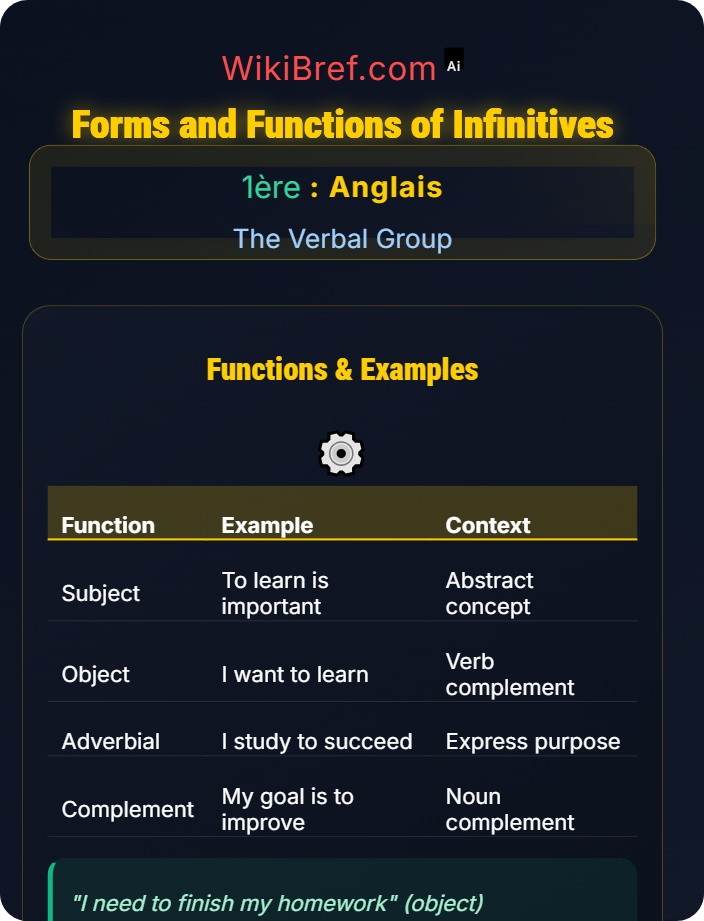
Functions: Subject, object, complement, adverbial modifier.
💡
Tip: "To" is part of the infinitive, not a preposition
🔍
Attention: Modal verbs are followed by bare infinitive
Rule: After "let/make/have" use bare infinitive
📋
Method: Practice with function identification in sentences
TO-INFINITIVE
want to
need to
hope to
decide to
BARE INFINITIVE
can go
will go
let go
make go
FUNCTIONS
Subject
Object
Complement
Adverbial
EXAMPLES
To learn is fun
Want to study
Ready to start
Too tired to continue
To-Infinitive Exercises
1 To-Infinitive Functions
Instructions :

Identify the function of the to-infinitive in each sentence.

Step 1: "To learn English is important"

To-infinitive as subject: "To learn English"

Step 2: "I want to study abroad"

To-infinitive as object of verb: "to study abroad"

Step 3: "My goal is to succeed"

To-infinitive as subject complement: "to succeed"

Step 4: "She came to help"

To-infinitive as adverbial (purpose): "to help"

Step 5: "This book is easy to read"

To-infinitive as adjectival complement: "to read"

Functions :

1. Subject, 2. Object, 3. Complement, 4. Adverbial (purpose), 5. Adjectival

Function Rules :

Subject: At beginning of sentence

Object: After verbs like want, hope, decide

Adverbial: Shows purpose, reason, result

2 Common Verbs with To-Infinitive
Instructions :

Complete the sentences with appropriate to-infinitive constructions.

Step 1: "I want ___ (to go) to the cinema"

Want is followed by to-infinitive → "to go"

Step 2: "She hopes ___ (to pass) the exam"

Hope is followed by to-infinitive → "to pass"

Step 3: "We decided ___ (to visit) Paris"

Decide is followed by to-infinitive → "to visit"

Step 4: "He needs ___ (to study) harder"

Need is followed by to-infinitive → "to study"

Step 5: "They plan ___ (to travel) next summer"

Plan is followed by to-infinitive → "to travel"

Completed Sentences :

1. to go, 2. to pass, 3. to visit, 4. to study, 5. to travel

Verb Patterns :

Want/Hope/Decide: + to-infinitive

Need/Plan/Expect: + to-infinitive

Learn/Aim/Refuse: + to-infinitive

3 Adverbial Functions of To-Infinitive
Instructions :

Identify the purpose/reason expressed by the to-infinitive.

Step 1: "He saved money to buy a car"

Expresses purpose: "in order to buy a car"

Step 2: "She woke up early to catch the train"

Expresses purpose: "in order to catch the train"

Step 3: "The weather is too cold to swim"

Expresses result: "so cold that swimming is impossible"

Step 4: "He ran fast enough to win"

Expresses result: "fast enough that he could win"

Step 5: "She is ready to start"

Expresses readiness/condition: "prepared to start"

Functions :

1. Purpose, 2. Purpose, 3. Result, 4. Result, 5. Condition

Adverbial Rules :

Purpose: "in order to", "so as to"

Result: "too...to", "enough...to"

Condition: "ready to", "likely to"

Bare Infinitive Exercises
4 Modal Verbs with Bare Infinitive
Instructions :

Complete sentences with bare infinitive after modal verbs.

Step 1: "You ___ (can/help) me with this"

Modal "can" + bare infinitive → "can help"

Step 2: "She ___ (must/finish) her homework"

Modal "must" + bare infinitive → "must finish"

Step 3: "They ___ (will/come) tomorrow"

Modal "will" + bare infinitive → "will come"

Step 4: "He ___ (should/study) harder"

Modal "should" + bare infinitive → "should study"

Step 5: "We ___ (can/visit) the museum"

Modal "can" + bare infinitive → "can visit"

Completed Sentences :

1. can help, 2. must finish, 3. will come, 4. should study, 5. can visit

Modal Rules :

All modals: Can, could, may, might, must, should, will, would

Pattern: Modal + bare infinitive (no "to")

Exception: Ought to (includes "to")

5 Causative Verbs with Bare Infinitive
Instructions :

Complete sentences with bare infinitive after causative verbs.

Step 1: "I made him ___ (clean) his room"

Causative "make" + bare infinitive → "clean"

Step 2: "She let me ___ (use) her car"

Causative "let" + bare infinitive → "use"

Step 3: "The teacher had students ___ (read) the book"

Causative "have" + bare infinitive → "read"

Step 4: "I heard her ___ (sing) in the shower"

Sensory verb "hear" + bare infinitive → "sing"

Step 5: "We saw them ___ (leave) early"

Sensory verb "see" + bare infinitive → "leave"

Completed Sentences :

1. clean, 2. use, 3. read, 4. sing, 5. leave

Causative Rules :

Causative verbs: Make, let, have

Sensory verbs: See, hear, feel, watch

Pattern: Verb + object + bare infinitive
Key Points Summary
🎯
To-Infinitive: "to + base verb" - used after many verbs, as subject, for purpose
🔍
Bare Infinitive: Base verb without "to" - after modals, causative verbs
Functions: Subject, object, complement, adverbial (purpose, reason, result)
📋
Memory Tip: Modals never take "to" before the infinitive
To-Infinitive
to + verb
want to, need to
Bare Infinitive
verb only
can go, make do
Functions
Subject/Object
Complement/Adverbial
Forms and functions of infinitives Infinitives and Gerunds