Définitions et Concepts Clés
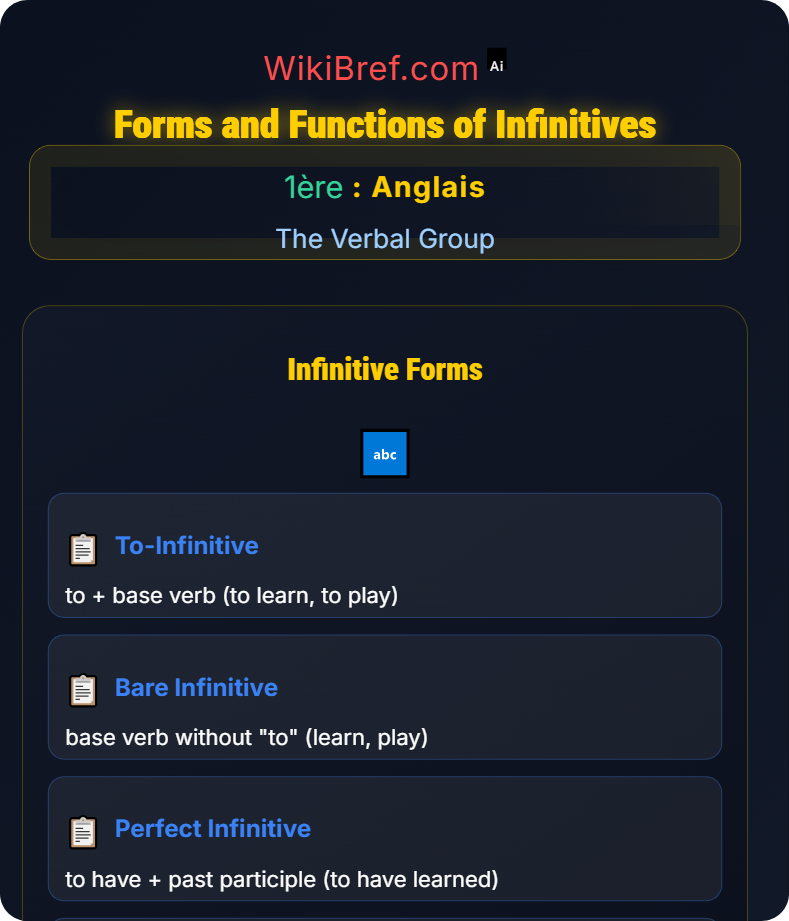
To + Base Verb OR Bare Infinitive
Structure de base des infinitifs
Définition :
Un infinitif est la forme de base d'un verbe, souvent précédée de "to". Il fonctionne comme un nom, un adjectif ou un adverbe dans une phrase, exprimant une action ou un état sans indiquer qui effectue l'action.
Formule générale :
Infinitif simple : to + verbe à la base
Infinitif composé : to have + participe passé
Infinitif progressif : to be + participe présent
Infinitif composé : to have + participe passé
Infinitif progressif : to be + participe présent
Types d'infinitifs
To-infinitive (with "to")
Bare infinitive (without "to")
Perfect infinitive (to have + past participle)
Continuous infinitive (to be + -ing)
Formes des infinitifs
Simple
to work, to eat
Perfect
to have worked, to have eaten
Continuous
to be working, to be eating
Perfect Continuous
to have been working
Exemples détaillés
Simple Infinitive :
I want to learn English.
She needs to study harder.
She needs to study harder.
Perfect Infinitive :
I seem to have forgotten my keys.
He appears to have finished his work.
He appears to have finished his work.
Continuous Infinitive :
She seems to be reading a book.
They appear to be discussing the project.
They appear to be discussing the project.
Fonctions des infinitifs
Sujet
To learn is important
Objet
I want to succeed
Complément
My goal is to improve
Adjectif
This is a good place to rest
Adverbe
She came to help
Attribut
The best way to learn is practice
Conseils & Astuces
Mémorisez les verbes qui exigent l'infinitif avec "to"
Apprenez les verbes qui prennent l'infinitif nu
Pratiquez les structures après adjectifs
L'infinitif peut remplacer un nom entier
Attention à la négation: not to + verb
Erreurs Fréquentes
Erreur 1 :
Confondre "want to do" avec "want doing" (incorrect)
Erreur 2 :
Omettre "to" après les verbes exigeant l'infinitif
Erreur 3 :
Utiliser la forme -ing au lieu de l'infinitif après certains verbes