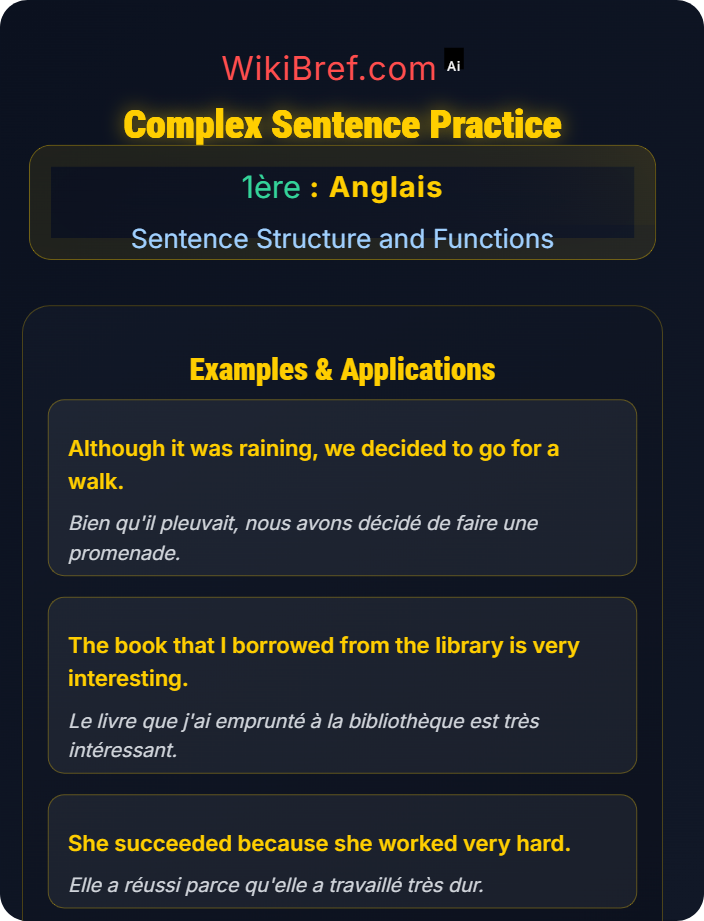
Relative clause : Proposition subordonnée qui modifie un nom ou un pronom.
- Identifier l'élément commun entre les deux phrases
- Déterminer le mot-relatif approprié (who, which, that)
- Remplacer l'élément répété par le mot-relatif
- Combiner les phrases en une seule
Phrase 1: "The book is interesting"
Phrase 2: "I bought it yesterday"
Elément commun: "the book"/"it"
"Book" est un objet, donc utiliser "which" ou "that"
"Which" est plus formel, "that" est plus courant
"The book" (sujet de la première phrase)
"I bought it" → "I bought which/that"
"The book which I bought yesterday is interesting"
Ou: "The book that I bought yesterday is interesting"
Proposition principale: "The book is interesting"
Proposition subordonnée: "which I bought yesterday"
The book which I bought yesterday is interesting
Ou: The book that I bought yesterday is interesting
Cette structure combine deux idées en une phrase complexe.
• Who : Pour les personnes
• Which : Pour les objets (formel)
• That : Pour personnes et objets (courant)
• Restrictive : Pas de virgule avant "that" ou "which" dans les clauses restrictives
Adverbial clause : Proposition subordonnée qui modifie le verbe principal.
"Because it was raining, we stayed home"
Proposition subordonnée: "Because it was raining"
Proposition principale: "we stayed home"
"We stayed home" est la proposition principale
Doit rester au début de la nouvelle phrase
Après la proposition principale
Utiliser une virgule pour séparer
"We stayed home because it was raining"
Le sens reste le même, mais la structure change
La proposition subordonnée suit la principale
Pas besoin de virgule avant "because" dans ce cas
We stayed home because it was raining
Cette structure maintient le même sens logique mais change l'ordre des propositions.
• Position : Adverbial clauses can come before or after main clause
• Comma : When clause comes first, use comma; when last, usually no comma
• Meaning : Cause/effect relationship maintained regardless of position
• Flexibility : Complex sentences allow different arrangements for emphasis
Relative pronouns : Mots qui introduisent des propositions relatives.
"The woman which lives next door is a doctor"
"Which" est incorrect car il désigne une personne
"Woman" est une personne
Utiliser "who" pour les personnes
"The woman who lives next door is a doctor"
"Who" remplace "which" dans ce contexte
Proposition principale: "The woman is a doctor"
Proposition subordonnée: "who lives next door"
"The woman that lives next door is a doctor" (moins formel)
"The woman, who lives next door, is a doctor" (non restrictive)
The woman who lives next door is a doctor
Utilisez "who" pour les personnes, "which" pour les objets.
• Who : For people (subject/object)
• Which : For things (subject/object)
• That : For people/things (restrictive clauses)
• Whose : For possession (people/things)
Noun clause : Proposition subordonnée qui fonctionne comme nom.
"I don't know why she left so early"
Phrase complexe avec proposition principale et subordonnée
"I don't know" est la proposition principale
A un sujet (I) et un verbe (don't know)
"why she left so early" est la proposition subordonnée
Commence avec "why" et fonctionne comme objet de "know"
"Why she left so early" est une noun clause
Fonctionne comme objet direct de "know"
Proposition principale: "I don't know" (sujet + verbe)
Proposition subordonnée: "why she left so early" (conjonction + sujet + verbe)
La clause subordonnée est: "why she left so early"
C'est une noun clause qui fonctionne comme objet de la proposition principale.
• Noun clauses : Start with question words (what, why, how, whether, etc.)
• Function : Act as subject, object, or complement
• Word order : Statement order (not question order) within clause
• Examples : What he said, Why she left, How it works
Noun clause : Proposition subordonnée qui remplace un nom.
"He knows the answer"
Phrase simple avec sujet (he), verbe (knows), objet (the answer)
Remplacer "the answer" par une proposition subordonnée
Utiliser une question indirecte
"What the question is" ou "How to solve it"
Ce sont des propositions nominales
"He knows what the question is"
Ou: "He knows how to solve it"
Proposition principale: "He knows" (sujet + verbe)
Proposition subordonnée: "what the question is" (fonctionne comme objet)
He knows what the question is
Ou: He knows how to solve it
Ces phrases contiennent des propositions nominales qui remplacent l'objet original.
• Formation : Question word + statement (not question) order
• Function : Replace nouns as subjects, objects, or complements
• Common words : What, how, whether, if, when, where, why
• Order : Statement order inside clause (no inversion)
- Relative : Modifie un nom (adjective function)
- Adverbial : Modifie un verbe (adverb function)
- Noun : Fonctionne comme nom (subject/object/complement)
• Restrictive : Essentiel à l'identification du nom
• Non-restrictive : Informations supplémentaires (virgules obligatoires)
• That : Only for restrictive clauses
• Which : Both restrictive and non-restrictive (with commas for non-restrictive)
- Wrong: "The woman which..." → Right: "The woman who..."
- Wrong: "The car, that is red..." → Right: "The car that is red..."
- Wrong: "He knows what does he want" → Right: "He knows what he wants"
- Utiliser "who" pour les personnes, "which" pour les objets
- Virgules avec les clauses non restrictives seulement
- Ordre des mots dans les propositions nominales est celui des énoncés
- "That" ne s'utilise pas avec des virgules