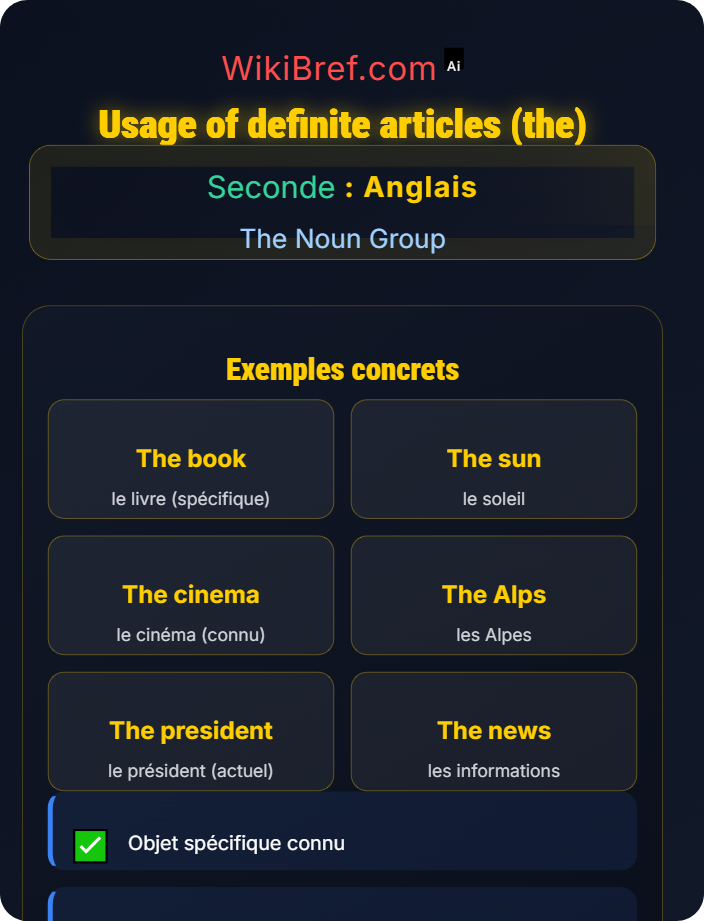
The definite article: Used when both speaker and listener know exactly which noun is being referred to.
- Identify if the noun is specific or general
- Determine if it has been previously mentioned
- Check if it's unique in context
- Apply the rule accordingly
"Book" and "table" are both specific items in the context. Both are known to speaker and listener.
Since both items are specific and known, we use "the" for both: "The book on the table..."
Both the book and table are particular items, not just any book or table.
"The book on the table" clearly refers to specific items known in the context.
The correct sentence is: "The book on the table is mine."
• Specific reference: Both book and table are specific items known to both parties
• Contextual definiteness: Items are identifiable in the immediate context
• Prepositional phrase: "on the table" requires "the" because the table is specific
Country names: Generally do not take "the" unless they are plural or contain words like "States", "Kingdom", or "Republic".
"France" is a singular country name without plural or special descriptors.
Most singular country names do not require "the" (France, Germany, Spain, etc.).
Exceptions include: The United States, The United Kingdom, The Netherlands, The Philippines.
France does not fit any exception categories requiring "the".
The correct sentence is: "I visited France last summer."
• Country rule: Singular country names generally don't use "the"
• Exception pattern: Only use "the" with plural names or those containing "States", "Kingdom", etc.
• Examples: Use "the" with: USA, UK, Netherlands, Philippines
Mountain ranges: Plural geographical features that require "the" because they refer to specific collections of mountains.
"Alps" is a mountain range, which is a plural geographical feature.
Mountain ranges, rivers, oceans, and plural geographical features typically require "the".
Similar patterns: The Himalayas, The Rockies, The Amazon, The Pacific Ocean.
The Alps refers to a specific, well-known mountain range.
The correct sentence is: "The Alps are beautiful mountains."
• Geographical rule: Mountain ranges require "the"
• Plural features: Rivers, oceans, and mountain ranges use "the"
• Examples: The Nile, The Sahara, The Andes
Superlatives: Adjectives expressing the highest degree of comparison always require "the" because they specify a unique entity.
"Tallest" is a superlative form indicating the highest degree of tallness.
All superlatives require "the" because they refer to a unique entity (the tallest person).
"Class" is a specific classroom known in the context, so it requires "the".
Superlative + specific class = both require "the".
The correct sentence is: "She is the tallest girl in the class."
• Superlative rule: All superlatives require "the"
• Examples: The fastest, the most beautiful, the strongest
• Uniqueness: Superlatives identify one specific entity
Famous ships: Well-known vessels that require "the" because they refer to specific, unique entities.
"Titanic" refers to a specific, famous ship with historical significance.
There is only one famous Titanic, making it a unique, specific entity.
Other famous ships: The Titanic, The Mayflower, The Santa Maria.
Everyone knows which specific ship is being referenced.
The correct sentence is: "The Titanic sank in 1912."
• Unique entity rule: Famous ships require "the"
• Historical significance: Well-known vessels are specific references
• Examples: The Queen Mary, The Beagle, The Endeavour
Time expressions: Certain time periods like "morning", "afternoon", "evening" take "the" when referring to them generally.
"Morning" is a time period being discussed in general terms.
When speaking about time periods in general, use "the": the morning, the afternoon, the evening.
Without "the": "Morning is the best time" sounds incomplete or awkward.
Compare: "The morning is good" vs "Morning is good" - the first is grammatically correct.
The correct sentence is: "The morning is the best time to study."
• Time rule: Morning, afternoon, evening require "the" when used generally
• Examples: The morning, the afternoon, the evening, the night
• Exception: Not used with "at night", "in the morning", etc.
General vs specific: Distinguish between general statements (no article) and specific references (use "the").
"I love dogs" expresses a general statement about dogs in general - no "the" needed.
"dog in my yard" refers to a specific dog that is known to both speaker and listener.
General statements: "I love dogs". Specific reference: "the dog in my yard".
The sentence contrasts general preference with a specific relationship.
The correct sentence is: "I love dogs, but the dog in my yard is special."
• General rule: Plural countable nouns in general statements don't need "the"
• Specific rule: Nouns with specific identifiers require "the"
• Example: I like cats vs The cat sleeping there
Compound country names: Countries with plural elements like "States", "Kingdom", or "Republic" require "the".
"United States" contains "States" which makes it a plural compound name.
Countries with "States", "Kingdom", "Republic", or plural elements require "the".
Similar cases: The United Kingdom, The United Arab Emirates, The Philippines.
Even though it's a country name, the plural element triggers the use of "the".
The correct sentence is: "The United States is a large country."
• Compound rule: Countries with plural elements require "the"
• Examples: The United States, The United Kingdom, The Netherlands
• Pattern: Any country name with "States", "Kingdom", "Republic"
Institution vs location: Universities often take "the" while city names generally don't, except for specific cases.
When used in the general sense "at university" (meaning "at college"), no article is needed.
London is a singular city name, which generally doesn't take "the".
If specifying a particular university: "at the University of London".
Common phrases: "go to university", "at school", "in hospital" (British English).
The correct sentence is: "He is studying at university in London."
• General institution: At university/school/hospital (no article)
• Specific institution: At the University of London
• City names: Generally no "the" (except The Hague, The Bronx)
Relative clauses: When a noun is specified by a relative clause, it becomes specific and requires "the".
"we watched yesterday" specifies which movie is being discussed.
When a noun is identified by a relative clause, it becomes specific and needs "the".
Without the clause: "Movies are interesting" (general, no article).
Both speaker and listener know exactly which movie is being referenced.
The correct sentence is: "The movie we watched yesterday was excellent."
• Relative clause rule: Nouns specified by relative clauses are definite
• Examples: The book I read, The woman who called, The car that broke down
• Logic: Specification creates definiteness