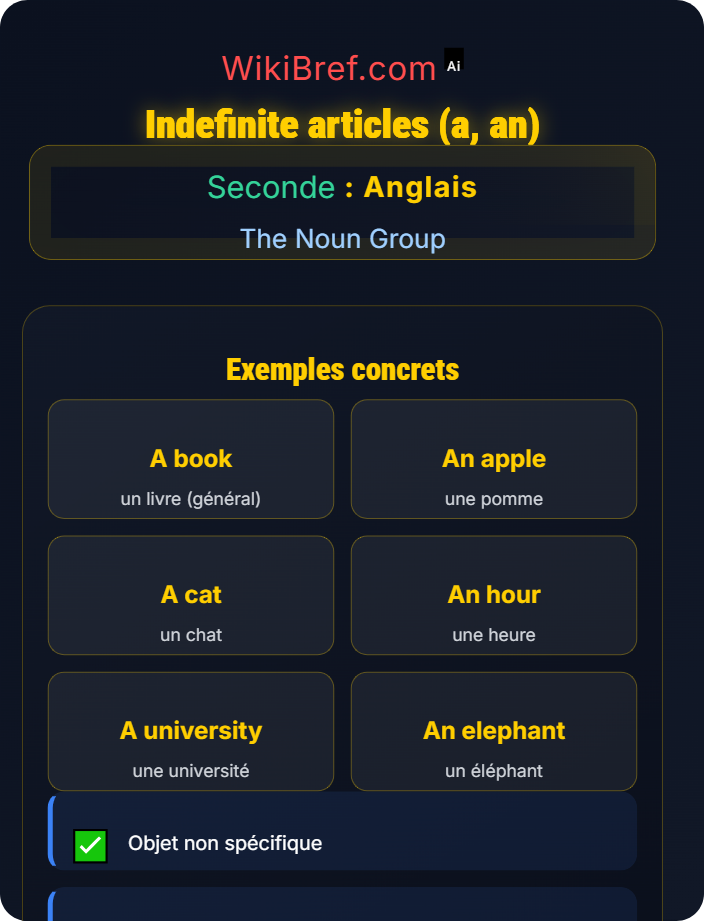
Indefinite articles: Used for non-specific, singular countable nouns when mentioning them for the first time.
- Identify the first sound of the following word
- Determine if it's a vowel or consonant sound
- Choose "a" for consonant sounds or "an" for vowel sounds
- Verify the noun is singular and countable
The word after the blank is "eagle", which starts with the letter "e".
"Eagle" begins with the /iː/ sound (long "e"), which is a vowel sound.
Use "an" before vowel sounds, so "an eagle" is correct.
"Eagle" is a singular, countable noun, making it eligible for an indefinite article.
The correct sentence is: "I saw an eagle flying overhead."
• Sound rule: Use "an" before vowel sounds (/iː/ in "eagle")
• Countability: "Eagle" is a singular countable noun
• Non-specificity: Refers to any eagle, not a specific one
Color adjectives: The choice of "a" or "an" depends on the sound of the color word, not the following noun.
The word after the blank is "orange", which starts with the letter "o".
"Orange" begins with the /ɒrɪndʒ/ sound (short "o"), which is a vowel sound.
Use "an" before vowel sounds, so "an orange" is correct.
Adjective + noun: "an orange jacket" follows proper article-adjective-noun order.
The correct sentence is: "She is wearing an orange jacket."
• Sound rule: Use "an" before vowel sounds (/ɒrɪndʒ/ in "orange")
• Adjective position: Article precedes adjective in the noun phrase
• Color words: Follow the same rules as other adjectives
Silent letters: Some words begin with silent letters, so focus on the actual pronunciation rather than spelling.
The word after the blank is "hour", which starts with the letter "h".
"Hour" begins with the /aʊər/ sound (starting with "ow"), which is a vowel sound. The "h" is silent.
Use "an" before vowel sounds, so "an hour" is correct despite starting with "h".
This is a common example of silent letters affecting article choice.
The correct sentence is: "It takes an hour to reach the airport."
• Sound over spelling: Focus on pronunciation, not initial letter
• Silent "h": Words like "hour", "honest", "honor" start with vowel sounds
• Common exceptions: Remember silent "h" words for article selection
Y as vowel sound: Some words beginning with "u" have a consonant-like "y" sound (/juː/) that requires "a".
The word after the blank is "university", which starts with the letter "u".
"University" begins with the /juː/ sound (like "you"), which is a consonant sound.
Use "a" before consonant sounds, so "a university" is correct.
Other "u" words: "university", "uniform", "unit" all use "a" due to the /juː/ sound.
The correct sentence is: "He studies at a university in London."
• Y-sound rule: Words with /juː/ sound use "a" (not "an")
• Examples: A university, a uniform, a unit, a European
• Sound focus: The actual pronunciation determines the article
First mention: Use "a/an" when introducing something for the first time in conversation or text.
The word after the blank is "email", which starts with the letter "e".
"Email" begins with the /iː/ sound (long "e"), which is a vowel sound.
Use "an" before vowel sounds, so "an email" is correct.
The speaker is requesting any email (not a specific one), making "an" appropriate.
The correct sentence is: "Please send me an email with the details."
• Sound rule: Use "an" before vowel sounds (/iː/ in "email")
• Non-specificity: "An email" means any email, not a specific one
• Request context: First mention of an unspecified email
Consonant sounds: Use "a" before words that begin with consonant sounds, regardless of their spelling.
The word after the blank is "spoon", which starts with the letter "s".
"Spoon" begins with the /sp/ sound, which starts with a consonant sound.
Use "a" before consonant sounds, so "a spoon" is correct.
"Spoon" is a singular, countable noun suitable for an indefinite article.
The correct sentence is: "Pass me a spoon from the drawer."
• Consonant rule: Use "a" before consonant sounds
• Sound focus: The initial consonant sound determines the article
• Countability: "Spoon" is a singular countable noun
Abbreviations and acronyms: Choose "a" or "an" based on how the abbreviation is pronounced.
The word after the blank is "euro", which starts with the letter "e".
"Euro" begins with the /ˈjʊərəʊ/ sound (starting with "yoo"), which is a consonant sound.
Use "a" before consonant sounds, so "a euro" is correct.
Compare with "a European" where both have the /j/ sound at the beginning.
The correct sentence is: "This costs a euro fifty."
• Y-sound rule: Words starting with /j/ sound use "a" (not "an")
• Examples: A euro, a European, a union, a useful tool
• Pronunciation focus: Always consider how the word is spoken
Silent "h" words: Words beginning with silent "h" have vowel sounds and require "an".
The word after the blank is "honest", which starts with the letter "h".
"Honest" begins with the /ɒnɪst/ sound (starting with "on"), where the "h" is silent.
Use "an" before vowel sounds, so "an honest" is correct despite the initial "h".
Other silent "h" words: "an honor", "an hour", "an heir", "an honest" all use "an".
The correct sentence is: "An honest person would never lie."
• Silent "h" rule: Words with silent "h" use "an" (not "a")
• Examples: An honest, an honor, an hour, an heir, an herb
• Sound over spelling: Focus on pronunciation, not initial letter
Professions: Career aspirations use the same article rules based on the sound of the profession.
The word after the blank is "astronaut", which starts with the letter "a".
"Astronaut" begins with the /æstrənɔːt/ sound (starting with "as"), which is a vowel sound.
Use "an" before vowel sounds, so "an astronaut" is correct.
"Astronaut" is a singular, countable profession noun.
The correct sentence is: "My sister wants to become an astronaut."
• Sound rule: Use "an" before vowel sounds (/æ/ in "astronaut")
• Profession context: Career goals follow standard article rules
• Countability: Professions are treated as singular countable nouns
Descriptive phrases: Articles are determined by the first sound after the article, even when adjectives precede the noun.
The first word after the blank is "expensive", which starts with the letter "e".
"Expensive" begins with the /ɪkspensɪv/ sound (starting with "eks"), which is a vowel sound.
Use "an" before vowel sounds, so "an expensive" is correct.
The article is determined by the first word after it, regardless of adjectives in between.
The correct sentence is: "They bought an expensive robot for the kitchen."
• First sound rule: Article determined by the first sound after the article
• Adjective phrases: Don't affect the article choice
• Structure: "An" + adjective + noun when adjective starts with vowel sound