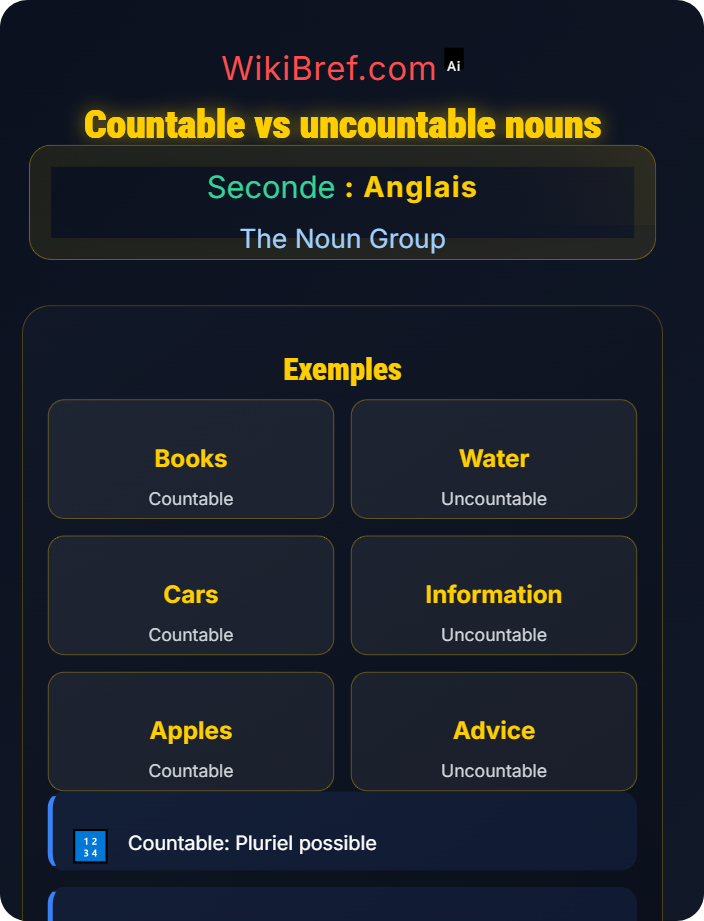
Uncountable nouns: Nouns that cannot be counted individually and do not have plural forms.
- Try to count the noun (one information, two informations)
- Check if it has a plural form
- Determine if it can be divided into separate units
- Consider its nature (abstract, liquid, material, etc.)
Try: "one information", "two informations", "three informations" - this sounds incorrect.
"Information" does not have a standard plural form. We say "pieces of information" when needing to quantify.
"Information" is an abstract concept that cannot be physically separated into individual units.
Correct: "I need information" (not "I need an information").
"Information" is an uncountable noun. It cannot be counted individually and does not have a plural form.
• Abstract rule: Abstract nouns like "information" are typically uncountable
• No plural: Does not form regular plurals
• Quantifiers: Use "much information", "little information", "some information"
Liquid nouns: Substances in liquid form that are typically uncountable when referring to the substance itself.
Try: "one wine", "two wines" - in general context this sounds incorrect.
As a substance: uncountable ("I drank wine"). As different types: countable ("I tried three wines").
When referring to the liquid substance itself, it's uncountable.
Correct: "I enjoy wine" (substance), "I ordered three wines" (types).
"Wine" is primarily uncountable when referring to the substance, but can be countable when referring to different types.
• Liquid rule: Liquids are typically uncountable when referring to the substance
• Context dependency: Same noun can be both depending on usage
• Examples: Water, milk, wine, coffee (substances) vs. types of wine
Countable nouns: Nouns that can be counted individually and have both singular and plural forms.
We can count people: "one person", "two people", "three people", etc.
"People" is already the plural of "person", showing it's countable.
People are distinct individuals who can be counted separately.
Correct: "There are many people here", "I saw three people", "One person entered".
"People" is a countable noun. It refers to individual humans that can be counted.
• Individual units: People are separate, countable entities
• Plural form: "People" is the plural of "person"
• Quantifiers: Use "many people", "few people", "several people"
Abstract uncountable nouns: Intangible concepts that cannot be divided into separate units.
Try: "one advice", "two advices" - this sounds incorrect and is grammatically wrong.
"Advice" does not have a standard plural form. We say "pieces of advice" when needing to quantify.
"Advice" is an abstract concept representing guidance or recommendations.
Correct: "I gave him advice", "She offered good advice", "I need some advice".
"Advice" is an uncountable noun. It represents an abstract concept that cannot be counted individually.
• Abstract rule: Abstract concepts like "advice" are typically uncountable
• No plural: Does not form regular plurals
• Quantifiers: Use "much advice", "good advice", "some advice"
Collective uncountable nouns: Terms that represent a collection of items considered as a whole.
Try: "one furniture", "two furnitures" - this is grammatically incorrect.
"Furniture" does not have a plural form. Individual pieces are "furniture pieces" or "items of furniture".
"Furniture" represents a collective term for various items (tables, chairs, etc.) viewed as a category.
Correct: "The furniture is nice", "I bought furniture", "much furniture".
"Furniture" is an uncountable noun. It represents a collective category of items.
• Collective rule: Collective terms like "furniture" are uncountable
• Category representation: Represents a group of items as a whole
• Quantifiers: Use "much furniture", "little furniture", "some furniture"
Abstract uncountable nouns: Concepts that represent continuous quantities without discrete units.
Generally: "one time", "two times" - sounds odd when referring to the concept of time.
"Time" can be both! As a concept: uncountable ("much time"). As instances: countable ("three times").
When referring to the abstract concept of time, it's uncountable.
Correct: "I need time" (concept), "I've been there three times" (instances).
"Time" is primarily uncountable when referring to the abstract concept, but countable when referring to instances or occurrences.
• Concept vs instance: Abstract concept is uncountable, specific instances are countable
• Context dependency: Meaning changes usage
• Examples: "Much time" vs "Three times" vs "A time in history"
Material/abstract uncountable nouns: Substances or concepts that represent continuous quantities.
Try: "one money", "two moneys" - this is grammatically incorrect.
"Money" does not have a plural form. Individual units are "coins" or "bills".
"Money" represents a collective concept of currency, not individual physical units.
Correct: "I have money", "much money", "some money", "a lot of money".
"Money" is an uncountable noun. It represents the concept of currency as a whole.
• Substance rule: Represents a collective concept
• No plural: Does not form regular plurals
• Quantifiers: Use "much money", "little money", "some money"
Physical countable nouns: Tangible objects that can be counted individually and have plural forms.
We can count sandwiches: "one sandwich", "two sandwiches", "three sandwiches".
"Sandwich" has a regular plural form: "sandwiches".
Sandwiches are distinct, physical objects that can be separated and counted.
Correct: "I ate a sandwich", "I made sandwiches", "There are many sandwiches".
"Sandwich" is a countable noun. It refers to individual food items that can be counted.
• Physical objects: Tangible items that can be counted
• Regular plural: Forms "sandwiches" in plural
• Quantifiers: Use "a sandwich", "many sandwiches", "few sandwiches"
Food substance uncountable nouns: Food items considered as substances rather than individual units.
Try: "one bread", "two breads" - this is grammatically incorrect.
"Bread" does not have a regular plural form. Individual units are "loaves of bread".
"Bread" represents the food substance itself, not individual loaves.
Correct: "I bought bread", "much bread", "a loaf of bread", "some bread".
"Bread" is an uncountable noun when referring to the food substance.
• Food substance rule: Many foods are uncountable as substances
• Portioning: Use "a loaf of bread", "slices of bread"
• Quantifiers: Use "much bread", "some bread", "a little bread"
Collective uncountable nouns: Terms representing groups of items considered as a whole.
Try: "one clothing", "two clothings" - this is grammatically incorrect.
"Clothing" does not have a plural form. Individual items are "clothes" or "garments".
"Clothing" represents the collective concept of garments worn by people.
Correct: "I need clothing", "much clothing", "some clothing", "a piece of clothing".
"Clothing" is an uncountable noun representing the collective concept of garments.
• Collective rule: Represents a category of items as a whole
• No plural: Does not form regular plurals
• Quantifiers: Use "much clothing", "little clothing", "some clothing"