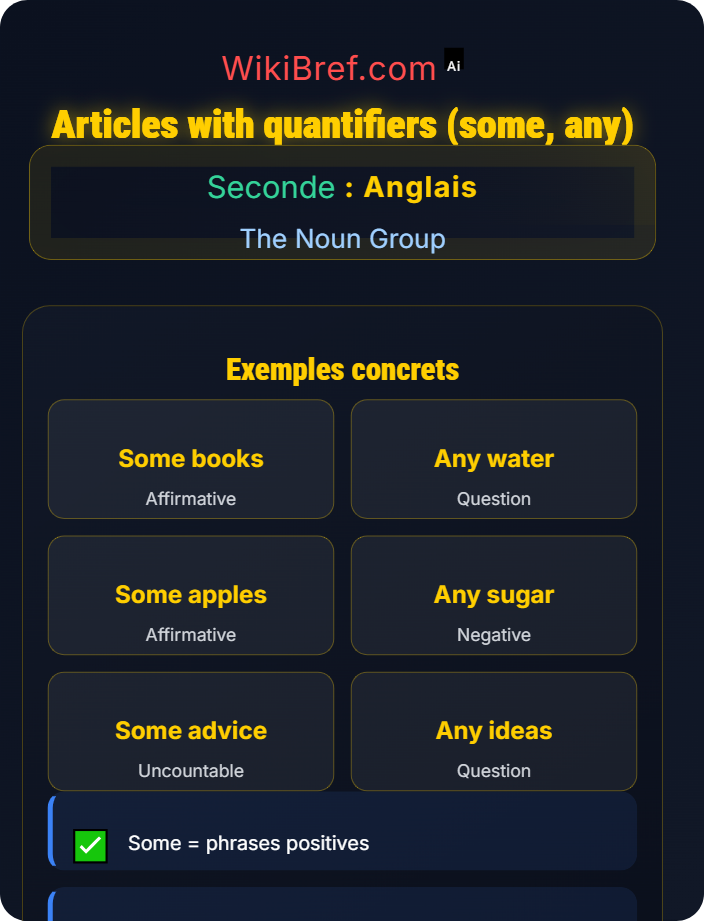
Positive sentences: Use "some" in positive declarative sentences to express an indefinite quantity.
- Identify the sentence type (positive, negative, question)
- Determine if it's a statement, offer, or request
- Select the appropriate quantifier based on context
- Verify the noun type (countable or uncountable)
The sentence "I bought apples" is a positive declarative statement.
For positive sentences, use "some" to indicate an indefinite quantity.
"Apples" is a countable noun, so "some" is appropriate.
The speaker bought an unspecified number of apples.
The correct sentence is: "I bought some apples at the market."
• Positive sentence rule: Use "some" in positive declarative sentences
• Countable noun: "Apples" can take "some" for indefinite quantity
• Indefinite quantity: Speaker doesn't specify how many apples
Negative sentences: Use "any" in negative sentences to indicate absence or lack of quantity.
The sentence contains "doesn't", making it a negative sentence.
For negative sentences, use "any" to indicate absence or zero quantity.
"Friends" is a countable noun, so "any" is appropriate.
The sentence indicates she has zero friends in the city.
The correct sentence is: "She doesn't have any friends in this city."
• Negative sentence rule: Use "any" in negative sentences
• Countable noun: "Friends" can take "any" in negative context
• Absence indicator: "Any" emphasizes the lack of friends
Questions: Use "any" in questions to inquire about the presence or existence of something.
The sentence begins with "Do you", making it a yes/no question.
For questions, use "any" to ask about the existence of something.
"Money" is an uncountable noun, so "any" is appropriate.
The question asks whether the person possesses any amount of money.
The correct sentence is: "Do you have any money for the ticket?"
• Question rule: Use "any" in questions asking about existence
• Uncountable noun: "Money" takes "any" in questions
• Existence inquiry: Asking whether money exists, not how much
Offers and requests: Use "some" in offers and polite requests, even in question form.
Though this is a question, "Would you like" is an offer/request structure.
Offers and requests use "some" even in question form to make them more inviting.
"Coffee" is an uncountable noun, so "some" is appropriate.
This is a polite offer of coffee, suggesting the speaker has some available.
The correct sentence is: "Would you like some coffee?"
• Offer rule: Use "some" in offers and polite requests
• Special case: "Would you like" + "some" for politeness
• Uncountable noun: "Coffee" takes "some" in offers
Positive sentences: Use "some" in positive statements to indicate an indefinite number or amount.
The sentence "There are problems" is a positive declarative statement.
For positive sentences, use "some" to indicate an indefinite quantity.
"Problems" is a countable noun, so "some" is appropriate.
The speaker acknowledges there are problems but doesn't specify how many.
The correct sentence is: "There are some problems with this plan."
• Positive sentence rule: Use "some" in positive declarative sentences
• Countable noun: "Problems" can take "some" for indefinite quantity
• Neutral tone: Indicates problems exist without specifying severity
Negative sentences: Use "any" in negative sentences to emphasize absence or non-existence.
The sentence contains "didn't", making it a negative sentence.
For negative sentences, use "any" to indicate absence or zero quantity.
"Students" is a countable noun, so "any" is appropriate.
The sentence indicates zero students were seen in the classroom.
The correct sentence is: "I didn't see any students in the classroom."
• Negative sentence rule: Use "any" in negative sentences
• Countable noun: "Students" can take "any" in negative context
• Absence emphasis: "Any" reinforces the complete absence
Requests: Use "some" in polite requests to suggest availability or willingness.
Though this is a question, "Can you" + verb is a request structure.
Polite requests often use "some" to make the request more specific and polite.
"Music" is an uncountable noun, so "some" is appropriate.
This is a polite request for music to be played, suggesting the speaker expects some to be available.
The correct sentence is: "Can you play some music for me?"
• Request rule: Use "some" in polite requests
• Uncountable noun: "Music" takes "some" in requests
• Politeness: "Some" makes the request more specific and less demanding
Positive sentences: Use "some" in positive statements to indicate an indefinite number or amount.
The sentence "There are restaurants" is a positive declarative statement.
For positive sentences, use "some" to indicate an indefinite quantity.
"Restaurants" is a countable noun, so "some" is appropriate.
The speaker indicates there are good restaurants but doesn't specify how many.
The correct sentence is: "There are some good restaurants nearby."
• Positive sentence rule: Use "some" in positive declarative sentences
• Countable noun: "Restaurants" can take "some" for indefinite quantity
• Neutral tone: Indicates restaurants exist without specifying exact number
Questions: Use "any" in questions to inquire about the presence or occurrence of something.
The sentence begins with "Has", making it a present perfect question.
For questions, use "any" (in this case "anyone") to ask about the occurrence of something.
"Anyone" is the pronoun form of "any" for people.
The question asks whether someone called during the speaker's absence.
The correct sentence is: "Has anyone called while I was away?"
• Question rule: Use "any" in questions asking about occurrence
• Pronoun form: "Anyone" is the interrogative pronoun form of "any"
• Present perfect: Questions about past actions use "anyone"
Positive sentences: Use "some" in statements expressing need or desire for an indefinite amount.
The sentence "I need sugar" is a positive declarative statement expressing need.
For positive sentences expressing need, use "some" to indicate an indefinite amount.
"Sugar" is an uncountable noun, so "some" is appropriate.
The speaker indicates they need an unspecified amount of sugar.
The correct sentence is: "I need some sugar for my tea."
• Positive sentence rule: Use "some" in positive declarative sentences
• Uncountable noun: "Sugar" takes "some" for indefinite quantity
• Need expression: Indicates requirement without specifying amount