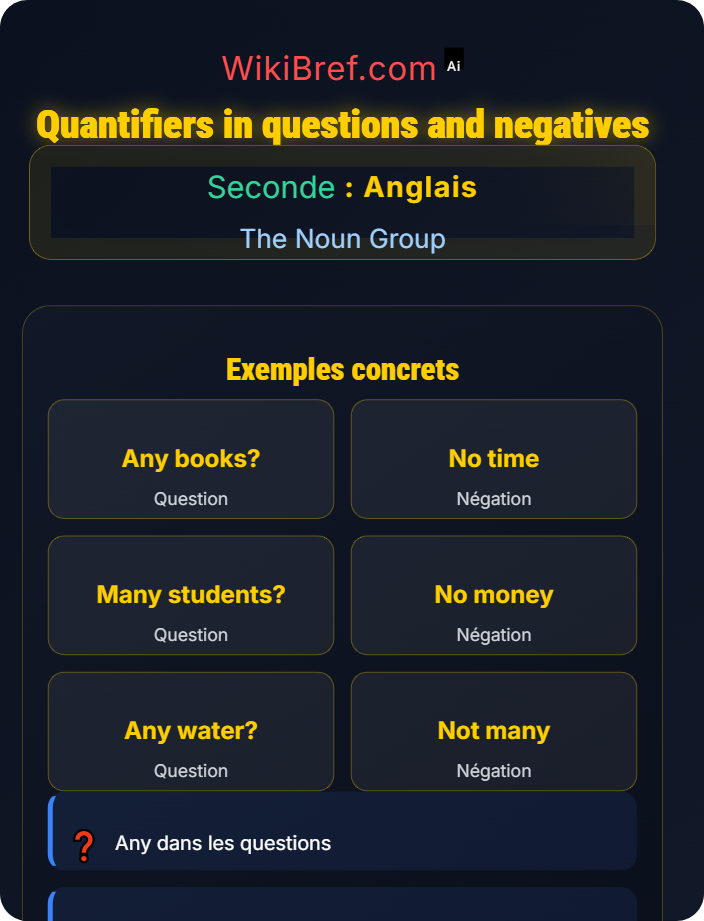
Questions with quantifiers: Use "any" in most yes/no questions asking about existence or presence.
- Identify the sentence type (question, negative, positive)
- Determine if the noun is countable or uncountable
- Select the appropriate quantifier based on sentence type
- Apply the specific rule for the context
The sentence "Do you have friends?" is a yes/no question.
"Friends" is a countable noun (can be counted: one friend, two friends).
For yes/no questions, use "any" regardless of noun type.
The question asks whether the person has friends present.
The correct sentence is: "Do you have any friends here?"
• Question rule: Use "any" in yes/no questions about existence
• Countable noun: "Friends" is countable but still uses "any" in questions
• Location context: "Here" indicates location of the friends
Negatives with quantifiers: Use "any" in negative sentences to indicate absence or zero quantity.
The sentence contains "don't", making it a negative statement.
"Money" is an uncountable noun (cannot be counted individually).
For negative sentences, use "any" regardless of noun type.
The sentence indicates zero money is available for lunch.
The correct sentence is: "I don't have any money for lunch."
• Negative rule: Use "any" in negative sentences
• Uncountable noun: "Money" is uncountable but uses "any" in negatives
• Specific context: "For lunch" indicates purpose of the money
Countable quantity questions: Use "how many" with countable nouns to ask about specific numbers.
The sentence begins with "How", making it a quantity question.
"People" is a countable noun (can be counted: one person, two people).
For quantity questions with countable nouns, use "how many".
The question asks for the specific number of people attending.
The correct sentence is: "How many people are coming?"
• Countable rule: Use "how many" with countable nouns
• Quantity question: "How many" asks for specific numbers
• People as countable: "People" is always countable
Yes/no questions with uncountable nouns: Use "any" in yes/no questions about uncountable nouns.
The sentence "Is there wine?" is a yes/no question.
"Wine" is an uncountable noun (cannot be counted individually).
For yes/no questions about existence, use "any" regardless of noun type.
The question asks whether any wine remains.
The correct sentence is: "Is there any wine left?"
• Question rule: Use "any" in yes/no questions about existence
• Uncountable noun: "Wine" is uncountable
• Remaining context: "Left" indicates what remains
Negatives with uncountable nouns: Use "any" in negative sentences regardless of noun type.
The sentence contains "haven't", making it a negative statement.
"Cash" is an uncountable noun (cannot be counted individually).
For negative sentences, use "any" regardless of noun type.
The sentence indicates zero cash is currently available.
The correct sentence is: "I haven't got any cash on me."
• Negative rule: Use "any" in negative sentences
• Uncountable noun: "Cash" is uncountable
• Location context: "On me" indicates personal possession
Uncountable quantity questions: Use "how much" with uncountable nouns to ask about specific amounts.
The sentence begins with "How", making it a quantity question.
"Time" is an uncountable noun (cannot be counted individually).
For quantity questions with uncountable nouns, use "how much".
The question asks for the specific amount of time available.
The correct sentence is: "How much time do we have?"
• Uncountable rule: Use "how much" with uncountable nouns
• Quantity question: "How much" asks for specific amounts
• Time as uncountable: "Time" is always uncountable
Negatives with countable nouns: Use "any" in negative sentences with countable nouns.
The sentence contains "aren't", making it a negative statement.
"Cars" is a countable noun (can be counted: one car, two cars).
For negative sentences, use "any" regardless of noun type.
The sentence indicates zero cars are present in the parking lot.
The correct sentence is: "There aren't any cars in the parking lot."
• Negative rule: Use "any" in negative sentences
• Countable noun: "Cars" is countable but uses "any" in negatives
• Location context: "Parking lot" indicates specific location
Yes/no questions about partial quantity: Use "any" in yes/no questions asking about partial possession.
The sentence "Have you read books?" is a yes/no question about partial reading.
"Books" is a countable noun (can be counted: one book, two books).
For yes/no questions about partial possession, use "any".
The question asks whether any of the books have been read.
The correct sentence is: "Have you read any of these books?"
• Partial quantity: "Any" in questions about partial possession
• Of construction: "Any of" is used for selections from groups
• These books: Indicates specific books previously mentioned
Negatives with countable nouns: Use "any" in negative sentences with countable nouns.
The sentence contains "didn't", making it a negative statement.
"Apples" is a countable noun (can be counted: one apple, two apples).
For negative sentences, use "any" regardless of noun type.
The sentence indicates zero apples were eaten during the day.
The correct sentence is: "I didn't eat any apples today."
• Negative rule: Use "any" in negative sentences
• Countable noun: "Apples" is countable but uses "any" in negatives
• Time context: "Today" indicates specific timeframe
Uncountable quantity questions: Use "how much" with uncountable nouns to ask about specific amounts.
The sentence begins with "How", making it a quantity question.
"Water" is an uncountable noun (cannot be counted individually).
For quantity questions with uncountable nouns, use "how much".
The question asks for the specific amount of water needed.
The correct sentence is: "How much water do we need?"
• Uncountable rule: Use "how much" with uncountable nouns
• Quantity question: "How much" asks for specific amounts
• Water as uncountable: "Water" is always uncountable