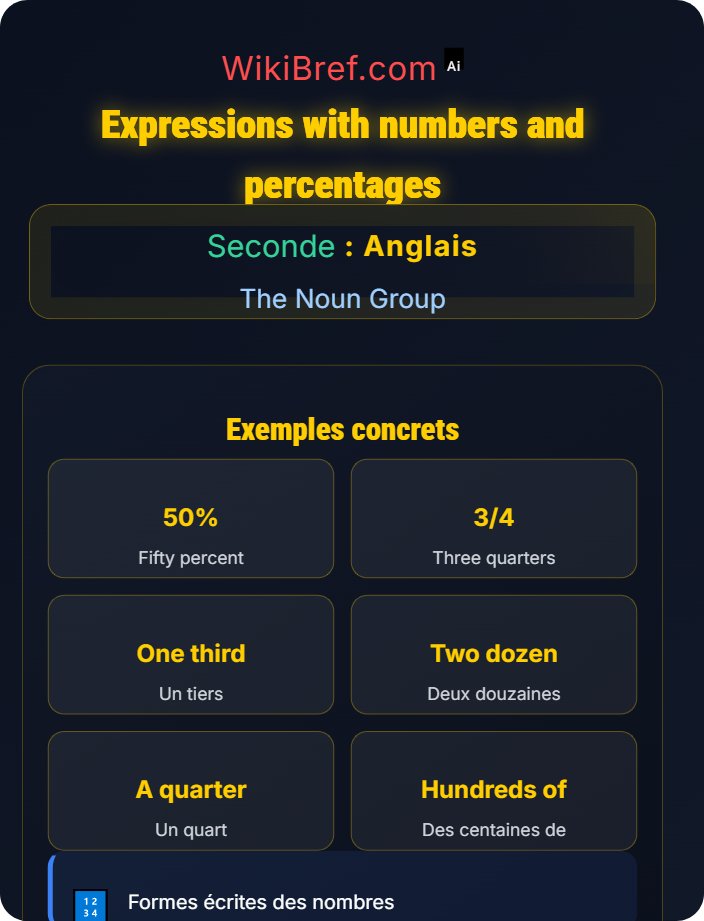
Number expressions: Use numerals or written numbers directly with countable nouns without articles.
- Identify if the context requires a specific number or percentage
- Determine if the noun is countable or uncountable
- Select the appropriate numerical expression format
- Ensure proper agreement between number and noun
"Students" is a countable noun that can take numerical expressions.
The context suggests a specific number of students passed.
For countable nouns, use numbers directly: "twenty-five students".
The sentence now specifies exactly how many students passed.
The correct sentence is: "Twenty-five students passed the exam."
• Countable noun rule: Use numbers directly with countable nouns
• No article needed: Numbers don't require articles when modifying nouns
• Hyphenation: Compound numbers from twenty-one to ninety-nine use hyphens
Fractional expressions: Use fractions to express parts of a whole, followed by "of" and the noun.
The sentence requires a fractional expression with "of" construction.
Common fractions for expressing proportions: half, quarter, third, etc.
For proportional expressions, use fractions: "three-quarters of".
The sentence now indicates what proportion of the population voted.
The correct sentence is: "Three-quarters of the population voted."
• Fractional rule: Use fractions followed by "of" for proportional expressions
• Hyphenation: Fractions are hyphenated: three-quarters, one-third
• Of construction: Always use "of" after fractions
Percentage expressions: Use numbers followed by "percent" to express parts per hundred.
The sentence specifically mentions "percent", requiring a numerical percentage.
Survey results often show percentages like 75% for high agreement.
For percentage expressions, use number + "percent": "seventy-five percent".
The sentence now specifies the exact percentage of agreement found in the survey.
The correct sentence is: "The survey showed seventy-five percent agreement."
• Percent rule: Always use "percent" after numbers for percentage expressions
• No "of": "Percent" doesn't require "of" when directly modifying nouns
• Spelling: "Percent" is one word
Number expressions: Use numerals or written numbers directly with countable nouns.
"Books" is a countable noun that can take numerical expressions.
The context suggests a specific number of books read.
For countable nouns, use numbers directly: "twelve books".
The sentence now specifies exactly how many books were read.
The correct sentence is: "She has read twelve books this year."
• Countable noun rule: Use numbers directly with countable nouns
• No article needed: Numbers don't require articles when modifying nouns
• Time context: "This year" indicates a specific timeframe for the action
Percentage expressions: Use percentages with "of" construction to express parts of a group.
The sentence requires a percentage followed by "of" and the noun group.
Survey results often show percentages like 60% for moderate agreement.
For group percentages, use number + "percent of": "sixty percent of".
The sentence now indicates what percentage of respondents agreed.
The correct sentence is: "Sixty percent of the respondents agreed."
• Percent with "of": Use "percent of" when referring to parts of a group
• Group context: "Respondents" indicates a specific group being measured
• Spelling: "Percent" is one word
Large number expressions: Use numbers with magnitude words (million, billion) for large quantities.
The sentence involves a company investment, which is typically expressed in millions.
Corporate investments often involve round numbers like five million.
For large amounts, use number + magnitude word: "five million dollars".
The sentence now specifies the exact amount of the investment.
The correct sentence is: "The company invested five million dollars."
• Magnitude rule: Use number + magnitude words for large quantities
• No hyphens: Don't hyphenate numbers with magnitude words
• Capitalization: Don't capitalize magnitude words unless at sentence start
Time expressions: Use numbers directly with time units without articles.
"Hours" is a unit of time that can take numerical expressions.
Work completion might involve a significant amount like eighty hours.
For time units, use numbers directly: "eighty hours".
The sentence now specifies the amount of work completed in hours.
The correct sentence is: "Eighty hours of work completed."
• Time unit rule: Use numbers directly with time units
• No article needed: Numbers don't require articles with time units
• Plural form: Use plural for numbers greater than one
Fractional expressions: Use fractions to express parts of a whole, followed by "of" and the noun.
The sentence requires a fractional expression with "of" construction.
Common fractions for expressing proportions: half, third, quarter, etc.
For proportional expressions, use fractions: "one-third of".
The sentence now indicates what proportion of tasks remain unfinished.
The correct sentence is: "One-third of the tasks remain unfinished."
• Fractional rule: Use fractions followed by "of" for proportional expressions
• Hyphenation: Fractions are hyphenated: one-third, two-thirds
• Of construction: Always use "of" after fractions
Number expressions: Use numerals or written numbers directly with countable nouns.
"Items" is a countable noun that can take numerical expressions.
Sales often involve hundreds of items sold.
For large numbers, use "number + hundred/thousand": "three hundred".
The sentence now specifies exactly how many items were sold.
The correct sentence is: "They sold three hundred items during the sale."
• Large number rule: Use number + hundred/thousand for large quantities
• No hyphens: Don't hyphenate numbers with magnitude words
• Plural form: Use plural for numbers greater than one
Global percentage expressions: Use percentages with "of" construction for worldwide statistics.
The sentence discusses world population, requiring a significant proportion.
Urbanization statistics often show more than half live in cities.
For global proportions, use expressions like "more than half of".
The sentence now indicates the global urbanization statistic.
The correct sentence is: "More than half of the world's population lives in cities."
• Global statistics: Use "more than half" for significant worldwide proportions
• Of construction: Always use "of" after fractions when modifying groups
• Comparison: "More than" adds precision to fractional expressions