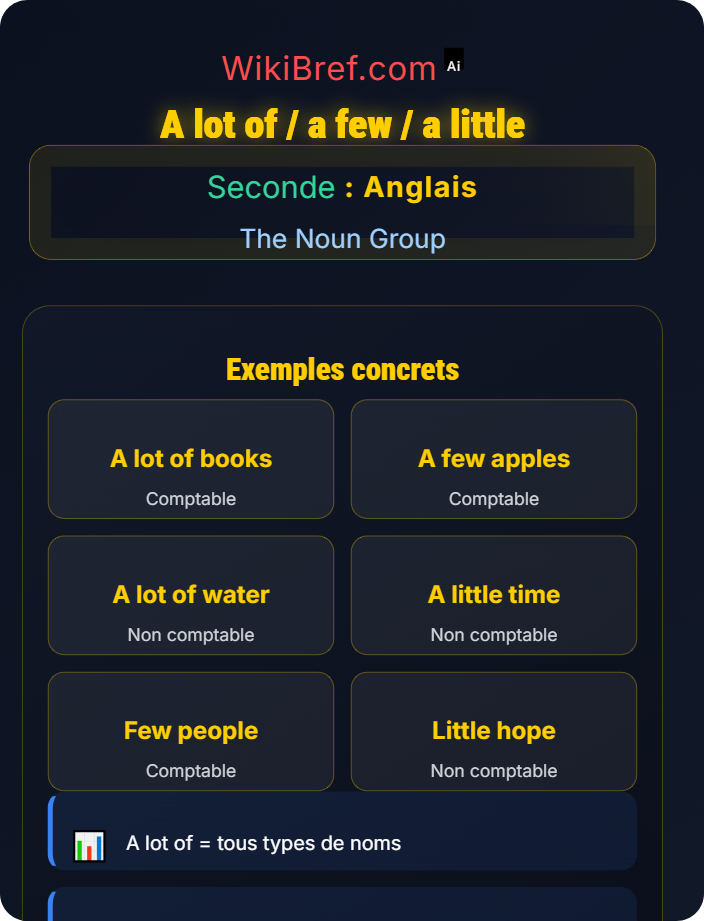
Countable nouns: Use "a lot of" with countable nouns to express a large quantity.
- Identify the noun type (countable or uncountable)
- Determine the intended meaning (large, small, or specific quantity)
- Select the appropriate quantifier based on both criteria
- Verify the meaning fits the context
"Books" is a countable noun (can be counted: one book, two books, etc.).
The sentence suggests a large quantity of books in the library.
For countable nouns expressing a large quantity, use "a lot of".
The sentence now indicates she has many books in her library.
The correct sentence is: "She has a lot of books in her library."
• Countable noun rule: Use "a lot of" with countable nouns for large quantities
• Large quantity: "A lot of" indicates a significant number
• Library context: Libraries typically contain many books
Uncountable nouns: Use "a lot of" with uncountable nouns to express a large quantity.
"Wine" is an uncountable noun (cannot be counted individually).
The sentence suggests a large quantity of wine remains in the bottle.
For uncountable nouns expressing a large quantity, use "a lot of".
The sentence indicates there is plenty of wine remaining.
The correct sentence is: "There is a lot of wine left in the bottle."
• Uncountable noun rule: Use "a lot of" with uncountable nouns for large quantities
• Large quantity: "A lot of" indicates a significant amount
• Liquid context: Wine as liquid is uncountable
Small but sufficient quantity: Use "a few" with countable nouns to express a small but adequate number.
"Friends" is a countable noun (can be counted: one friend, two friends, etc.).
The sentence suggests a small number of trustworthy friends, but enough for the purpose.
For countable nouns expressing a small but adequate number, use "a few".
The sentence indicates he has some trusted friends, though not many.
The correct sentence is: "He has a few close friends he can trust."
• Countable noun rule: Use "a few" with countable nouns for small quantities
• Positive connotation: "A few" suggests adequacy despite small number
• Trust context: Quality matters more than quantity for trusted friends
Small but sufficient quantity: Use "a little" with uncountable nouns to express a small but adequate amount.
"Time" is an uncountable noun (cannot be counted individually).
The sentence suggests a small amount of time, but enough to do something.
For uncountable nouns expressing a small but adequate amount, use "a little".
The sentence indicates there is some time available, though limited.
The correct sentence is: "I have a little time before my next appointment."
• Uncountable noun rule: Use "a little" with uncountable nouns for small amounts
• Positive connotation: "A little" suggests adequacy despite small amount
• Time context: "Time" is always uncountable
Countable nouns: Use "a lot of" with countable nouns to express a large quantity.
"Cars" is a countable noun (can be counted: one car, two cars, etc.).
The sentence suggests a large number of cars are in the parking lot.
For countable nouns expressing a large quantity, use "a lot of".
The sentence indicates there are many cars in the parking lot.
The correct sentence is: "There are a lot of cars in the parking lot."
• Countable noun rule: Use "a lot of" with countable nouns for large quantities
• Large quantity: "A lot of" indicates a significant number
• Location context: Parking lots typically accommodate multiple cars
Uncountable nouns: Use "a lot of" with uncountable nouns to express a large quantity.
"Rain" is an uncountable noun (cannot be counted individually).
The sentence suggests a large amount of rain fell this month.
For uncountable nouns expressing a large quantity, use "a lot of".
The sentence indicates there was heavy rainfall this month.
The correct sentence is: "We received a lot of rain this month."
• Uncountable noun rule: Use "a lot of" with uncountable nouns for large quantities
• Large quantity: "A lot of" indicates a significant amount
• Weather context: Rain is always uncountable
Small but sufficient quantity: Use "a few" with countable nouns to express a small but adequate number.
"Students" is a countable noun (can be counted: one student, two students, etc.).
The exam is described as "difficult," suggesting few students would pass.
For countable nouns expressing a small number in challenging circumstances, use "a few".
The sentence indicates some students passed, though not many due to the difficulty.
The correct sentence is: "A few students passed the difficult exam."
• Countable noun rule: Use "a few" with countable nouns for small numbers
• Challenging context: "Difficult exam" suggests low pass rate
• Positive connotation: "A few" suggests success despite challenges
Small but sufficient quantity: Use "a little" with uncountable nouns to express a small but adequate amount.
"Money" is an uncountable noun (cannot be counted individually).
The sentence suggests a small amount of money available for spending.
For uncountable nouns expressing a small but available amount, use "a little".
The sentence indicates there is some money to spend, though not much.
The correct sentence is: "I have a little money to spend this week."
• Uncountable noun rule: Use "a little" with uncountable nouns for small amounts
• Positive connotation: "A little" suggests availability despite small amount
• Financial context: "Money" is always uncountable
Countable nouns: Use "a few" with countable nouns to express a small but adequate number.
"Apples" is a countable noun (can be counted: one apple, two apples, etc.).
The sentence suggests a small number of apples, perhaps just enough for immediate use.
For countable nouns expressing a small but adequate number, use "a few".
The sentence indicates she bought some apples, though not many.
The correct sentence is: "She bought a few apples at the market."
• Countable noun rule: Use "a few" with countable nouns for small quantities
• Shopping context: "A few" suggests a modest purchase
• Positive connotation: "A few" suggests adequacy despite small number
Small but sufficient quantity: Use "a little" with uncountable nouns to express a small but adequate amount.
"Coffee" is an uncountable noun (cannot be counted individually).
The sentence suggests a small amount of coffee remains, but enough for one more cup.
For uncountable nouns expressing a small but available amount, use "a little".
The sentence indicates there is some coffee remaining, though not much.
The correct sentence is: "There is a little coffee left in the pot."
• Uncountable noun rule: Use "a little" with uncountable nouns for small amounts
• Positive connotation: "A little" suggests availability despite small amount
• Liquid context: Coffee as liquid is uncountable