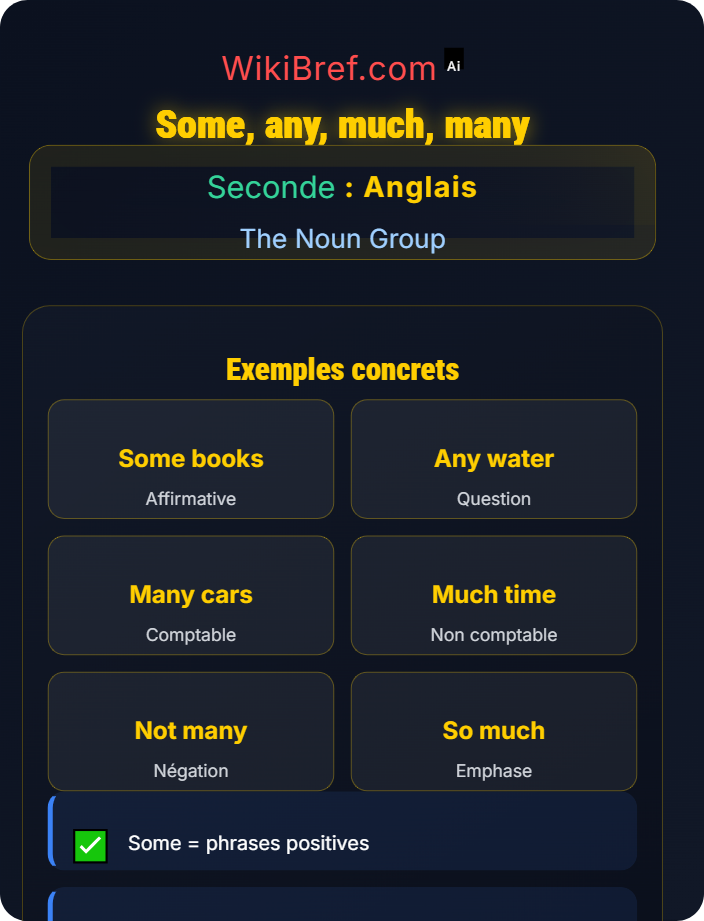
Positive sentences: Use "some" in positive declarative sentences to express an indefinite quantity.
- Identify the sentence type (positive, negative, question)
- Determine if the noun is countable or uncountable
- Select the appropriate quantifier based on both criteria
- Verify the meaning fits the context
The sentence "I bought apples" is a positive declarative statement.
"Apples" is a countable noun.
For positive sentences with countable nouns, use "some" to indicate an indefinite quantity.
The speaker bought an unspecified number of apples.
The correct sentence is: "I bought some apples at the market."
• Positive sentence rule: Use "some" in positive declarative sentences
• Countable noun: "Apples" can take "some" for indefinite quantity
• Indefinite quantity: Speaker doesn't specify how many apples
Negative sentences: Use "any" in negative sentences to indicate absence or lack of quantity.
The sentence contains "doesn't", making it a negative sentence.
"Friends" is a countable noun.
For negative sentences, use "any" to indicate absence or zero quantity.
The sentence indicates she has zero friends in the city.
The correct sentence is: "She doesn't have any friends in this city."
• Negative sentence rule: Use "any" in negative sentences
• Countable noun: "Friends" can take "any" in negative context
• Absence indicator: "Any" emphasizes the lack of friends
Questions: Use "any" in questions to inquire about the presence or existence of something.
The sentence begins with "Do you", making it a yes/no question.
"Money" is an uncountable noun.
For questions, use "any" to ask about the existence of something.
The question asks whether the person possesses any amount of money.
The correct sentence is: "Do you have any money for the ticket?"
• Question rule: Use "any" in questions asking about existence
• Uncountable noun: "Money" takes "any" in questions
• Existence inquiry: Asking whether money exists, not how much
Countable nouns: Use "many" with countable nouns to ask about quantity.
The sentence begins with "How", making it a question about quantity.
"People" is a countable noun.
For questions about quantity with countable nouns, use "how many".
The question asks about the number of people who attended.
The correct sentence is: "How many people attended the meeting?"
• Countable noun rule: Use "many" with countable nouns
• Quantity question: "How many" asks about numbers of countable items
• People as countable: "People" is always countable
Uncountable nouns: Use "much" with uncountable nouns in negative sentences.
The sentence contains "don't", making it a negative sentence.
"Time" is an uncountable noun.
For negative sentences with uncountable nouns, use "much" to indicate lack of quantity.
The speaker indicates they have little time available.
The correct sentence is: "I don't have much time today."
• Uncountable noun rule: Use "much" with uncountable nouns
• Negative context: "Much" in negatives indicates small quantity
• Time as uncountable: "Time" is always uncountable
Uncountable nouns: Use "much" with uncountable nouns to ask about quantity.
The sentence begins with "How", making it a question about quantity.
"Money" is an uncountable noun.
For questions about quantity with uncountable nouns, use "how much".
The question asks about the amount of money spent.
The correct sentence is: "How much money did you spend?"
• Uncountable noun rule: Use "much" with uncountable nouns
• Quantity question: "How much" asks about amounts of uncountable items
• Money as uncountable: "Money" is always uncountable
Negative sentences with countable nouns: Use "many" with countable nouns in negative sentences.
The sentence contains "aren't", making it a negative sentence.
"Cars" is a countable noun.
For negative sentences with countable nouns, use "many" to indicate small quantity.
The sentence indicates there are few cars in the parking lot.
The correct sentence is: "There aren't many cars in the parking lot."
• Countable noun rule: Use "many" with countable nouns
• Negative context: "Many" in negatives indicates small quantity
• Existence negation: "Aren't many" means few exist
Questions with uncountable nouns: Use "any" in questions about uncountable nouns.
The sentence begins with "Is there", making it a yes/no question.
"Wine" is an uncountable noun.
For questions about uncountable nouns, use "any" to ask about existence.
The question asks whether any wine remains.
The correct sentence is: "Is there any wine left?"
• Question rule: Use "any" in questions asking about existence
• Uncountable noun: "Wine" takes "any" in questions
• Existence inquiry: Asking whether wine exists, not how much
Positive sentences with countable nouns: Use "many" with countable nouns in positive sentences to indicate a large number.
The sentence is a positive declarative statement.
"Students" is a countable noun.
For positive sentences with countable nouns indicating a large number, use "many".
The sentence indicates a significant number of students passed.
The correct sentence is: "Many students passed the exam."
• Countable noun rule: Use "many" with countable nouns
• Large quantity: "Many" indicates a significant number
• Positive context: "Many" in positives indicates substantial quantity
Negative sentences with uncountable nouns: Use "much" with uncountable nouns in negative sentences.
The sentence contains "don't", making it a negative sentence.
"Water" is an uncountable noun.
For negative sentences with uncountable nouns, use "much" to indicate small quantity needed.
The sentence indicates only a small amount of water is needed.
The correct sentence is: "We don't need much water for the plants."
• Uncountable noun rule: Use "much" with uncountable nouns
• Negative context: "Much" in negatives indicates small quantity
• Water as uncountable: "Water" is always uncountable