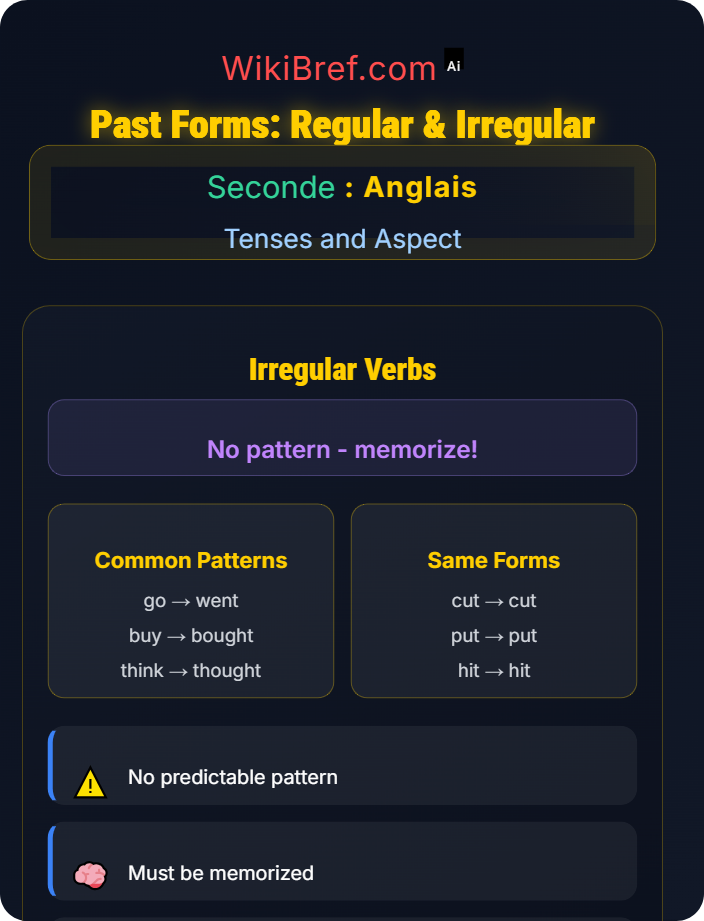
Irregular: go → went
Regular Verb : Verbe régulier qui suit la règle standard.
"walk" est un verbe régulier
Verbe régulier = V + -ed
walk + -ed = walked
"walked" se prononce /wɔːkt/ (son -t)
"Yesterday I walked to school."
walk → walked
• Regular Verb Rule : V + -ed
• Sound of -ed : Final consonant determines pronunciation
• Walk : Ends in -k consonant → -ed pronounced /t/
Irregular Verb : Verbe irrégulier qui change complètement sa forme.
"go" est un verbe irrégulier très courant
"go" → "went" (forme irrégulière)
Infinitive → Past → Past Participle
go → went → gone
"Yesterday I went to the cinema."
"go" est un des verbes irréguliers les plus fréquents
go → went
• Irregular Verb : No pattern, must memorize
• Go Pattern : go → went → gone
• Usage : Movement verbs often irregular
Regular Verb with Doubling : Verbe régulier avec doublement de la consonne finale.
"stop" = voyelle + consonne finale
Quand voyelle courte + consonne → doubler la consonne avant -ed
stop → stopped
"stopped" se prononce /stɒpt/ (son -t)
"He stopped the car at the red light."
stop → stopped
• Double Consonant Rule : Vowel + consonant → double consonant
• Pattern : stop → stopped
• Sound : -ed pronounced /t/ after voiceless consonants
Irregular Verb : Verbe irrégulier avec changement de voyelle.
"see" est un verbe irrégulier de perception
"see" change la voyelle e → a
Infinitive: see → Past: saw → Past Participle: seen
"I saw a movie yesterday."
"saw" se prononce /sɔː/ (voyelle longue)
see → saw
• Irregular Pattern : see → saw → seen
• Vowel Change : e → a
• Perception Verbs : Often irregular (see, hear, feel)
Regular Verb : Verbe régulier qui suit la règle standard.
"play" est un verbe régulier
Verbe régulier = V + -ed
play + -ed = played
"played" se prononce /pleɪd/ (son -d)
"They played football yesterday."
play → played
• Regular Verb Rule : V + -ed
• Sound of -ed : After vowel/d voiced consonant → /d/ sound
• Play : Ends in voiced consonant /j/ → -ed pronounced /d/
Irregular Verb : Verbe irrégulier avec changement de voyelle.
"take" est un verbe irrégulier très courant
"take" change la voyelle a → o
Infinitive: take → Past: took → Past Participle: taken
"She took the bus to school."
"took" se prononce /tʊk/ (voyelle courte)
take → took
• Irregular Pattern : take → took → taken
• Vowel Change : a → oo
• Common Verb : One of most frequent irregular verbs
Regular Verb with Doubling : Verbe régulier avec doublement de la consonne finale.
"plan" = voyelle + consonne finale
Quand voyelle courte + consonne → doubler la consonne avant -ed
plan → planned
"planned" se prononce /plænd/ (son -d)
"We planned our trip last week."
plan → planned
• Double Consonant Rule : Vowel + consonant → double consonant
• Pattern : plan → planned
• Sound : -ed pronounced /d/ after voiced consonants
Irregular Verb : Verbe irrégulier qui change complètement sa forme.
"buy" est un verbe irrégulier de transaction
"buy" change complètement sa forme
Infinitive: buy → Past: bought → Past Participle: bought
"I bought a new book yesterday."
"bought" se prononce /bɔːt/ (voyelle longue)
buy → bought
• Irregular Pattern : buy → bought → bought
• Complete Change : No predictable pattern
• Transaction Verbs : Often irregular (buy, sell, pay)
Regular Verb : Verbe régulier qui suit la règle standard.
"visit" est un verbe régulier
Verbe régulier = V + -ed
visit + -ed = visited
"visited" se prononce /ˈvɪzɪtɪd/ (son -id)
"I visited my grandparents last weekend."
visit → visited
• Regular Verb Rule : V + -ed
• Sound of -ed : After -t or -d → /id/ sound
• Visit : Ends in -t consonant → -ed pronounced /ɪd/
Irregular Verb : Verbe irrégulier avec changement de voyelle.
"drive" est un verbe irrégulier de mouvement
"drive" change la voyelle i → o
Infinitive: drive → Past: drove → Past Participle: driven
"He drove to work this morning."
"drove" se prononce /drəʊv/ (voyelle longue)
drive → drove
• Irregular Pattern : drive → drove → driven
• Vowel Change : i → o
• Movement Verbs : Often irregular (drive, ride, write)